|
Colin Paton
5/10/1945 - 6/2/2021
Colin was Calum's, Jamie's and Pippa's grandfather.
|
|
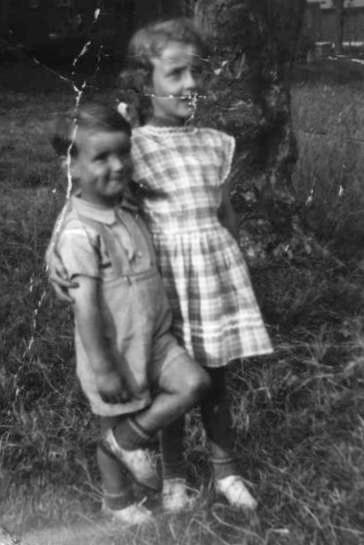
| Colin and his sister Sheila in Belfast, approx 1950 |
Colin was born during the reign of the British queen
Elizabeth II (Elizabeth I of Scotland) at 42 Whitewell Crescent, Greencastle, Belfast, just after the war ended. The informant
to the Belfast registrar was Evelyn Morris, a neighbour from Whitewell Crescent, who was present at
the birth.
At around the age of 5, Colin's
mother and father separated, with his mother leaving the house at Whitewell Crescent. After a short time, his father
swapped the house he was living in at Whitewell Crescent with that of a Mrs Lorrimer, their housekeeper, who lived just off
the Sandy Row, and with whom he had developed a relationship. At one point Colin remembers his dad having a full blown row
with Mrs Lorrimer, and that he and his sister Sheila ran to fetch a policeman to stop the row. Shortly after,
their mother returned and took Sheila away with her back to Scotland, where she had a job at the Gleneagles Hotel in
Auchterarder, whilst Colin, Robert and Charlie remained with their father in Belfast. Colin
remembers that his mother came in to say good night, told him that his mummy would always love him, and then never saw her
or his sister again for another two years.
A couple of years later, his mum returned with Sheila
to Northern Ireland, and picked up her three sons from her husband Charlie. She then moved with all of her children to Carrickfergus,
nine miles from Belfast on the northern shore of Belfast Lough, where she initially took up residence in a cottage called
The Drift, in the town's suburb of Eden, a place of which Colin has many fond memories.
Whilst living in Eden, Colin remembers often
trawling the beach to look for driftwood for the fire with his brothers, Robert and Charlie (better known as "Chuck"),
and sister Sheila. The four of them would also go looking for chicken eggs laid by wandering wild chickens in a
nearby field, which they would take back to the house and fry up for a sandwich. He also remembers that as a child,
one of his favourite books was "Mr. Punch in Scotland" and remembers that one of his mother's books was "The
Story of John G. Paton", a missionary in Africa. Whilst living in Eden, Colin, like his siblings, all attended
Eden Primary School.
A short while later, the family moved to
2 Robinson's Row in Joymount, about a mile away from Eden, and about 15 metres from the beach, the new Marine Highway route
not having yet been constructed on the recalimed land that now marks this area of the town. Colin remembers going swimming
in the beach, which was literally just outside his front door (see photo). Whilst in Joymount, Colin attended Carrickfergus
Technical College (now the town's main library), and then as a teenager, he worked in Dobbins' Inn Hotel,
peeling potatoes for the restaurant with his sister Sheila.
As a child Colin also remembers being a member of a Boys Brigade company in Glengormley, though
cannot recall why he should be there, despite thinking that he actually lived there for a brief period. His BB tenure was
not long however. That particular honour belonged to his membership of the Air Training Corps in Carrickfergus, in which he
learned the basics of flight and all things aeroplane. On one occasion, he remembers going up with an instructor and being
allowed to fly over his house. He further recalls training requiring him to shoot a gun, as well as many camps etc.
Later in his teens, Colin worked as
a waiter somewhere in Whitehead, about six miles from Carrick. On the day after he finished school, he jumped onto a ferry
and crossed over to England to stay with his brother Charlie, where he found a job in London working as a waiter. On
one occasion in the English capital he got into trouble after asking Cliff Richards for an autograph,
who was not impressed and who duly complained to the manager!
|
|
| Joymount - the chimney right of the tree on the left of frame is Colin's house at Robinson's Row |
In 1962, aged about sixteen and a half, Colin joined the Merchant Navy (service
number R779485). He signed up in Belfast, the whole point being to see whether he might be interested in a longer term
career in the Royal Navy at some stage in the future, like his brother Robert. He was sent to either Sheerness or Sharpness
in England to do his basic training, and soon after signed up to a ship called the Cameo, owned by a
Glaswegian firm called Robertson's or Robinson's. Although he had intended to join as a deckhand, when he arrived
the captain told him all he was interested in was a galley boy, and having worked in a hotel before, Colin agreed to take
on that role, at a rate of £8 a week. On board the Cameo he sailed to Norway and Casablanca, before his final trip, to
Hamburg. Soon after his rate increased to £24 a week, when he took over the role of another galley staff member who was a
rank above him.
Intending to leave the boat soon after for the Christmas holiday, Colin gave
money to one of his colleagues to buy him a bottle of whisky for his mother as a present (she liked a hot toddy once
in a while, but he was under age), but the colleague returned with a bottle of gin instead. Knowing she would never drink
that, and unable to swap it for the desired whisky, he took it to his cabin and drank it en route to Germany. When he woke
up, he discovered that the door to his cabin was locked, and after banging on it for a while, a deckhand let him out, after
which he made his way to the galley. The senior galley steward told him the captain wanted to see him straight away, and so
he made his way to see him. Upon meeting the captain, Colin was asked if he knew where the boat was going. Confused, he replied
that they were en route to Hamburg. The captain corrected him - they had been to Germany, and were heading home!
It turned out that the gin had not gone down well with him. Having finished the bottle, at Hamburg he had been absolutely
paralytic, and had started throwing eggs at German workers shouting "My dad beat your dad in the war"! When the eggs
ran out, he had then started throwing kitchen utensils at them, after which he was locked into his cabin until he had sobered
up!
Reaching Derry shortly after, he signed off the boat and made his way back home to his mother's
house in Carrickfergus. On December 25th 1962, he then had a knock at the door in Robinson's Row. It was the dole officer,
demanding that Colin, who was claiming unemployment benefit, should come out to put salt on the roads. Upon refusing
to do so, the officer stopped his dole allowance. Soon after, Colin signed up to another ship, the MV Cardiff Brook,
and was soon on his way to Poland on another job.
Having spent over six months in the Merchant Navy, and having picked up some
basic seamanship qualifications, on March 5th 1963, Colin decided to take his naval career further by volunteering
to join the Royal Navy. He tried to sign up but was initially refused, as he had 'knock knees'! An officer he knew took
him straight up tro Belfast and told the recruiting naval officer that if there was a problem with knock knees, Colin
could wear bell bottoms! Needless to say, he was duly enlisted.
From March 5th to July 19th, Colin did his basic seamanship training at HMS
Raleigh in Devonport, and was then transferred to the maritime warfare school of HMS Dryad in Hampshire,
where he received further basic instruction.
On September 25th 1963, Colin joined his first ship, HMS Bulwark,
as an ordinary seaman, and having just passed his first examination in radar plotting, his chosen field of interest. Ironically,
on the very day he joined, his eldest brother Robert was due to disembark from the vessel, and both met up briefly on shore. Colin
was to spend the next two years on board the Bulwark, receiving a promotion as an acting able seaman on June 5th 1964,
and then formally becoming an able seaman on August 5th, just three months later, having passed another radar plotting examination.
|
|
| The Crew of HMS Bulwark - AB Colin Paton is circled on the right (CLICK ON IMAGE TO ENLARGE) |
Aboard the Bulwark, Colin saw service in the Borneo crisis in April 1964,
and spent several months in the Far East on active service, for which he eventually received a general service medal
on June 4th 1966. Whilst in the Far East, other places he visited apart from Borneo included Aden, Singapore (with many
memories of Raffles hotel!) and the Phillippines.
|
|
| Medal for RN service in the Far East |
In March 1965, HMS Bulwark took part in a joint Royal Naval exercise
with the Royal Australian Naval Service, which was called FOTEX 65. Three other ships also participated
in the military exercise, being HMAS Melbourne, HMS Victorious and HMS Eagle. And on June 18th 1966, the vessel carried out a sea trial with the "Kestrel", which
was to be the forerunner of the Sea Harrier (Colin's brother Robert has a starter cartridge from these trials as a souvenir).
When Colin eventually left the Bulwark in October 1965, his time on board
had not impressed one of the ship's officers - Lieutenant Commander A. Whitaker noted he was "a below average RP, untidy
and erratic"!!! Fortunately another officer had a better a valuation of him - he had "the making of a good seaman".
But in 1965, Colin began training for the real passion of his naval career, the submarine
service. Between October 18th 1965 and August 21st 1966 he remained shore based at HMS Dolphin, where he
did his basic submariners training.
Between August 22nd 1966 and September 22nd 1969, Colin did his first tour
at sea on board a nuclear submarine, the Churchill class HMS Warspite. During this period, Warspite
was based at three separate naval bases - HMS Dolphin, until March 24th 1967; Maidstone until October 8th 1967; and HMS
Neptune, until September 22nd 1969.
|
|
| Colin, and his mother at the Warspite service, April 4th 1967 - the medal is for service in Borneo |
Just after her launch, Warspite was docked at base with a reception being held
to celebrate the achievement of her entering the service. As a part of this, Colin's mother was on board as a guest, along
with many other relatives of the crew, and the wife of Prime Minister Harold Wilson, the Royal Navy's 's guest of honour for
the occasion. Harold Wilson was leader of the British Labour Party.
At one point during the reception in the submarine's Ward Room (Naval jargon for
the officer's mess), Colin took his mother over to introduce her to the Prime Minister's wife. The conversation went as follows:
"Mum, I'd like you to meet Mrs Wilson".
With an interested attitude, Jean duly replied "And which Mrs Wilson is this son?".
"This is the Prime Minister's wife, Mum".
"Oh, that Mrs Wilson", she replied haughtily, and
immediately turned round and walked away, refusing to speak with her - not a Labour supporter then!
In October 1968, Colin was involved in a major Cold War incident in the Barents
Sea, the cover story of which, less than truthful, appeared in the London Times as the following front page feature:
Saturday October 19th 1968:
ICE DAMAGES NUCLEAR SUBMARINE
By a Staff Reporter
Ice on the sea has damaged the 3,500-ton Warspite, one of the Navy's five nuclear-powered submarines.
There was no risk of radio-active leakage, the department said. Warspite, which was delivered to the Navy last
year, returned to Faslane, on the Clyde, for repairs.
The Warspite, on exercise in the North Atlantic, cleared the obstruction with slight damage to her conning tower
and other parts of the superstructure.
The Guardian newspaper also picked up on the story on October 23rd 1968
(p.20):
Damage to Nuclear Submarine
With her conning tower and superstructure damaged, the nuclear submarine
Warspite was last night making her way to Barrow for repairs.
The submarine, launched in barrow three years ago, hit an underwater ice
projection in the North Atlantic 10 days ago.
Word of Colin's involvement in the accident soon made its way back to Carrickfergus,
and appeared on the front page of the Carrickfergus Advertiser:
Thursday October 31 1968:
CARRICK SEAMAN ON ICE-CRASH
SUBMARINE
Carrick seaman A.B.Colin Paton, 2 Robinson's Row, was on board the 20,000,000 nuclear submarine Warspite
when it was in collison while cruising under the ice in the North Atlantic just over a week ago.
Like the other 99
crew members he was unhurt. Some of the crew had slight bruising but no one was seriosuly injured, a Ministry of Defence spokesman
said in London.
A.B.Paton, son of Mrs J.Paton is 23, and followed in his brother's footsteps into the Navy. Mr Robert
Paton is just out of the Fleet Air Arm after 12 years service. The 3500 ton Warspite's superstructure smashed against the
ice during under ice training but was able to return to the Clyde for repairs under its own steam although escorted by the
frigate Duncan.
The Warspite was launched three years ago and named by Mrs Mary Wilson, wife of the British Prime
Minister.
For the word 'ice', try re-reading the above with the words 'Russian Echo 2
submarine'! They were actually shadowing the Russian vessel, and after several days were detected. A collision ensued, and
after a tense few hours trying to avoid the Russian fleet, Warspite barely made it back to the international harbour of Lerwick
in the Shetland Islands, under the escort of an American fighter plane. Warspite suffered serious damage to her central fin,
which the Russian submarine had basically ploughed through the centre of.
In order to deny the Russians a chance to see the damage caused to Warspite's
central fin, a Royal Naval repair team was sent out by helicopter to join the submarine at Lerwick, and overnight it hastily
constructed a wooden scaffold over the damaged central fin, over which a large black tarpaulin was then secured, making it
seem to any passing Russian spotter plane that no damage had actually been caused to one of the few nuclear submarines Britain
possessed at that time. The Warspite then made its way back to Faslane on the Clyde, and after some further repair work was
taken to Barrow-on-Furness. Evidently at Barrow-on-Furness, the repair team at the naval dry dock did not have much belief
in the cover story - when Colin told one of the engineers that the submarine had collided with an iceberg, the engineer looked
him straight in the eye and replied that it was amazing how much gray paint had come off the lump of ice...!!!
|
|
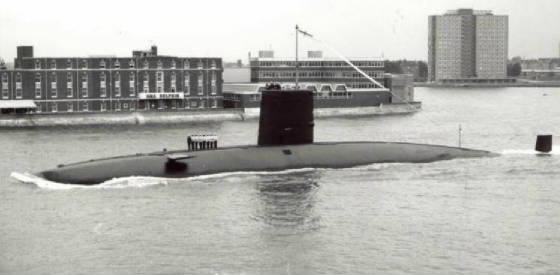
| HMS Warpsite leaving HMS Dolphin RN submarine base in Portsmouth, June 1971 |
On August
30th 1969, Colin married Charlotte Harper Graham, in Joymount Presbyterian Church in Carrickfergus. The engagement had only been a few days, and Charlotte, or "Cherie"
as she was better known, had had to obtain special permission from her mother to marry, as she was under 21 years old, and
as documented in a license from the Presbyterian Church issued to Colin the day before the wedding in Belfast. The witnesses
to the wedding were Cherie's aunt and uncle, Margaret and Tommy Smyth, with the only
other family member in attendance at the ceremony being Colin's mum Jean.
For their honeymoon, the couple spent two days in Bangor, County Down. When the honeymoon finished, Colin had
to return to his navy digs in Barrow on Furness for a few weeks, and Cherie left Ireland to join him. Shortly after, she
became pregnant with the couple's first child, and towards the end of her pregnancy, Cherie returned briefly to
Carrickfergus to be looked after by her family.
On September 23rd 1969, Colin was transferred
to HMS Churchill, a Resolution Class submarine. Whilst on board, he passed his proficiency examination
for Leading Seaman, on July 3rd. During this time, he and Cherie were living in Barrow on Furness, in naval digs.
(Unknown to Colin, his first cousin Sheena
Paton in fact lived on the exact same housing estate as himself whilst he was there, although at that stage he did
not even know of her existence, never mind the fact that she was there.)
Whilst on board the Churchill, Colin was drawn as a charicature by a shipmate
called Harry McGroarty, as part of a drawing entitled "The Joys of Being a Submariner", which was later published in the Churchill's
own magazine Thumper.
Colin
became a father for the first time with the birth of Christopher Mark Paton. Chris was due two
weeks earlier, and Colin, now based in at HMS Neptune Helensburgh was due to go to sea. As Churchill
was minutes away from departing Faslane, he was still on the phone trying to find out if Chris had been born yet. He was virtually
dragged onto the sub at the last minute, still with no news! When news was finally transmitted to the Churchill that Colin's
wife had finally given birth on the 6th, his mate, having received the transmission, refused to tell Colin what sex his child
was, or what size etc. Colin was forced to leave his station and chase him from one end of the submarine to the other, until
he finally cornered his mate and got the news!
|
|
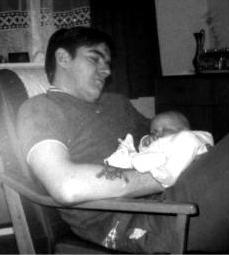
| Colin recovering after having his son Chris christened aboard HMS Churchill - 24/1/1971 |
Twenty days after his father was awarded a general
service clasp, Chris (later to become Calum's father) was baptised on the Churchill, now back at dock at Faslane.
He was the first ever child to be baptised aboard the newly commissioned submarine. In the best naval tradition, Chris was
baptised in the ship's bell, with the Royal Naval chaplain performing the ceremony being the Reverend John Vass.
In
1971, on May 18th, Colin was temporarily upgraded to Acting Leading Seaman until June 9th, when he was temporarily downgraded
again to AB, and transferred to base at HMS Dolphin. Six days later, he regained his acting LS designation, and four
days after that, on July 19th passed his Radar Plotting 2 examination. He then became a father again, with the birth of his
second son, Colin.
Between April 4th 1972 and January 30th 1974, Colin became an instructor in
the Royal Navy's SCTT facility at Faslane (Submarine Command Team Trainer), basically teaching tactics to
emerging submarine crews, and was officially promoted to Leading Seaman on May 18th 1972. He soon started taking his
exams for the rank of Petty Officer, passing the proficiency test for it on
November 10th 1972.
At some stage in 1972, Colin was filmed on board a submarine
as part of a documentary entitled "Four Men Went to Sea", which was narrated by Jonny Morris, and recalls
an amusing incident concerning the director of the film. The director wanted the captain to ask Colin for a chart or some
other such document. On the first take, the captain called over: "Paton, get me the chart". The director called "Cut",
and asked the captain if he would mind doing it one more time, but this time, could he ask "Colin, could you pass me that
chart over please?" instead of the more abrupt command he had just given. The captain looked with confusion at the director,
who then shouted "Action" one more time. The captain cleared his throat, then called over: "Paton, get me that
bloody chart"!
On another occasion, Colin
was on shore leave on the Rock of Gibraltar, staying at a hotel there. He got himself ready to go on a fishing trip,
and carrying the relevant gear, made his way to the hotel lift. He got in and pressed the button for the ground floor.
A couple of levels down, the doors opened and Colin found himself facing three American sailors who were about to get in to
the lift as well. Colin looked at them, gave them a big smile, and fully laden with his rod and tackle, calmly asked if any
of them had seen the hotel swimming pool?! The three Americans sailors looked at each other and decided to wait for the next
lift!
Colin soon became a father again, this time to the first of his
two daughters, Dawn.
|
|
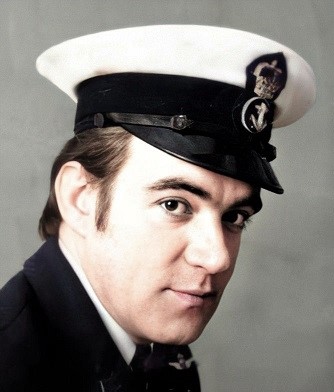
| Petty Officer Colin Paton, 1975 |
Colin remained shore based until 1976. Between January 31st and March 7th 1974,
he did a course at HMS Royal Arthur, after which he returned to Faslane in Scotland for a week, before moving to the submarine
training school at HMS Dolphin at Gosport, near Portsmouth, where he stayed for three months. On July 29th
1974, he was again transferred, to HMS Defiance in Devonport, where on September 23rd he was promoted
to Acting Petty Officer. At this point, his wife, Cherie, and his three children moved to Plymouth, where they initially
took up residency in naval digs at Leefield Drive, before moving to 53 Wycliffe Road in the Laira Green district of the
city, in early 1975, which was to be Colin's first owned house. Not long after moving in, his mother, Jean, arrived from Northern
Ireland to stay with the family for a few weeks, and was there when Colin's son Chris first went to school
in September that year.
On September 18th 1975, Colin attended the presentation at Martini Terrace in London
of the new Sea Lion trophy to the Royal Naval Submarine Service by Kelvin Hughes, the marine division of Smiths Industries
Limited. The pamphlet inviting Colin to the ceremony describes the trophy's aims:
The Sealion Trophy
The Sealion Trophy is being presented to the Royal Navy
Submarine Service by Kelvin Hughes, the marine division of Smiths Industries Limited. It will be officially recognised by
the Navy, and will be used as an award for top performance in modern torpedo marksmanship.
Such marksmanship is today increasingly judged by highly
technical computer style analysis, and the Navy see an important need for a trophy to act as an incentive to maintain the
high level of perfection required in modern torpedo operations. The trophy will be presented annually to the submarine assessed
as having achieved the highest overall proficiency in its torpedo firings during the preceding year.
Members of the winning attack team will also receive
a tie embroidered with the trophy motif as personal mementoes, and a commemorative bulkhead plaque will be retained
by the submarine. The designs of the trophy and these associated awards were specially commissioned by Kelvin Hughes from
the artist and sculptor, Mr. Jim Corless.
In his own unique style, at the presentation, Colin decided to stake his claim
to the trophy. After a few drinks, he walked up to the stage, bold as brass, and introduced himself to the admiral in charge
of the presentation of the trophy: "Good morning sir, I'm Petty Officer Colin Paton, second submarine squadron, second
to none, and I'll be picking up that trophy next year!". His mates apparently just held their heads in their hands...!
On November 24th 1975, Colin was officially promoted to Petty Officer. With the gauntlet laid down to prove his team's efficiency in torpedo attacks, Colin helped the team
of the conventional submarine, HMS Narwhal, under the command of Captain Dai Evans, to go for the Sealion Trophy. There were
three competing attack groups, the 1st Submarine Squadron (Portsmouth), the Second Submarine Squadron (Plymouth), and the
3rd and 10th Submarine Squadron (Faslane). HMS Narhwhal came tops, winning the trophy. His performance clearly delighted
a Captain RG Heaslip, who sent Colin and nine other submariners (Lt. Com. T. Le Marchand, Lt. Com. C. May, Lt. Perowne, Lt.
Crothers, FCPO Catherall, CPO Reeves, L/Sea Beresford, PO Tedder and PO Sullivan) the following memo, on January 16th
1976:
SEA LION TROPHY
|
|
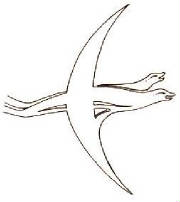
| Design of the Sealion Trophy |
1. As you know, NARWHAL is the first winner
of the new Sea Lion Trophy for torpedo firing proficiency. I am very pleased at this, not only for NARWHAL, but because it
helps to show that the Second Squadron is second to none.
2. I appreciate that the winning of the Sea Lion Trophy
is in fact a Squadron effort, and that it could not be done at all without all the effort at planning, sea-riding, arranging
suppluing and loading weapons, and analysing attacks.
3. Well done everybody,. The next task is to keep the
Sea Lion Trophy in the Squadron in 1976.
16 January 1976
R. G. HEASLIP, Captain, Second Submarine Squadron
Also at Defiance, Colin was to win the Herbert Lott Award, again for his work in
torpedo effiency. The award took the form of a silver tankard, with his name inscribed upon it.
On January 29th 1976, Colin again went to sea, this time aboard Britain's
first built nuclear submarine, HMS Valiant, which was the first in the class of submarine that Warspite eventually
followed.
Colin's son Chris remembers his father coming back from sea at one point
with a huge beard, which was soon removed by sharp words from his mother! He also returned at one point with two toy
trucks for both Chris and Colin, who remember him giving the toys to them in the back garden of the house, and being
told they had been brought back from Hong Kong. Whether this was true or not, is not known - they may have been "made in Hong
Kong"!
In the run up to the Queen's Silver Jubilee celebrations on
June 7th 1977, the sovereign made a trip to Plymouth, and Colin took his children to see her as she drove over the bridge
crossing the River Plym. When Chris asked why she never waved to him from her car, and why she looked so glum, he replied
that she must have been tired! (As far as Chris was to be concerned, she'd had her one chance, and she blew it!).
On May 16th 1977, Colin was
transferred to HMS Neptune in Helensburgh, Scotland, where amongst his many duties, he had to take charge of three
Green Goddess fire engines in Helensburgh when the UK Fire
Service went on strike. During the strike, one of his calls was out to the local Commodore Hotel, which burned down. Colin's
job was not in fact to put out the fire, but to save people who may have been trapped inside. He recalls not being too dismayed
to see the hotel burn however, it having a reputation at Faslane base of being extrremely unfriendly to submariners.
|
|
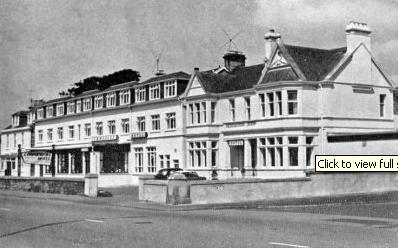
| The Commodore Hotel prior to its destruction in 1977 |
Colin's main reason for returning to Helensburgh
was to take up submarine tactical training again at SCTT, but this time he wanted to do so on the notoriously difficult
Perishers course. The Perishers course is designed to teach naval lieutenant commanders the skill of commanding a submarine
for themselves. For those who pass, a job ensues as captain or first lieutenant of a submarine; for those who fail, a long
career in submarines usually comes to an end with a transfer to a shore job or ship command.
|
|
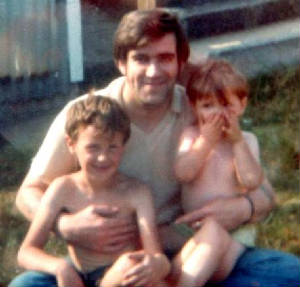
| Colin with sons Colin and Robert - Laira Green, Plymouth, summer 1977 |
When Colin made his intention known that he wanted
to do the Perishers training, an officer told him that he was not up to it. A furious Colin challenged him
to a contest to prove his worth against the officer. There were two attack trainers at SCTT at that time, and Colin suggested
that he could get the results of an attack sorted faster than the officer, and more importantly, would do so with 100% accuracy.
The officer agreed to the test, and Colin won the challenge! He was immediately given the task of running the attack trainer
for the Perishers course.
A Royal Naval memo from the time gives a summary
of his performance:
RESTRICTED
SUBMARINE TEMPORARY MEMORANDA
8 December 1977
40/77 (cont'd)
PATON PO (R) STAFF OF CAPTAIN (SM) SECOND SUBMARINE
SQUADRON
PATON served on the Staff for eighteen months. Throughout
this period he maintained a high standard as an Instructor in the Attack Teacher and as a Staff Sea-Rider. His most important
contribution, however, was in Torpedo Analysis where he demonstrated an extensive knowledge of this subject and consistent
enthusiasm, working long hours to ensure that analysis results were published to the submarine promptly. His high standards
and personal drive encouraged the Squadron to produce good records, and helped to generate interest in Torpedo Firings.
However, with Colin being based in Scotland, and
his family in England, strains began to emerge in his relationship with his wife Cherie. Things became
worse when on February 2nd 1978, his mother died at her home in Carrickfergus.
On July 27th 1978, Colin finally left the Royal Navy, after 15 years of service,
and returned to Plymouth. Not long after, the strain between Colin and Cherie had become too much, and the couple separated,
with Cherie taking the two youngest children with her back to Carrickfergus in Ireland, and Colin remaining in Plymouth with
the two eldest. In summer 1979, Colin himself moved back to Carrickfergus.
Back in Carrick, and now on civvy street,
Colin worked for a while at Kilroot Power Station, where he was also a shop steward. Shortly after this, he joined the
local Carrickfergus branch of the single parents charity, Gingerbread, which he was to chair for most of the Eighties. Spending
most of his time in voluntary work, he spent a long period in unemployment. He helped to create the Rathcoole Self Help
Group in 1983, and became a member of the national co-ordinating group for Gingerbread in Northern Ireland, working as its
treasurer. In the late Eighties, Colin joined the Forum for Community
Work Education, and himself sat some GCE exams through the Open University.
In the mid 1980s, Colin had a relationship with Paula.
In June 2005, the following poem was discovered by Colin's son when visiting him in Crete, written by Paula, which totally
describes life in the Paton household at that time:
The Head of the House
The head of the house, or so we are
told
Is 'Big Colin' Paton, so brave and so bold.
He's tall and dark, and not bad looking,
And tries his best at cleaning and cooking.
He’s mostly quiet, pleasant and
is usually good fun.
But when it comes to giving orders,
he knows how that’s done.
It’s time for the tea, the chips
must be cut,
So it’s “go
tell Christopher to get off his butt,
XXX dry the dishes, do it right, don’t
go wrong,
And you set the table, Colin, and don’t
be too long.”
Now everything’s ready, it’s
nearly time to eat,
So this is where Paula gets on her feet.
His intrusions begin with – ‘Aren’t
you going to heat that fat?’
And the infamous one – ‘Why
not put some tomatoes in that?’
However when all’s said and done,
At the dinner table it can be a lot
of fun.
But everyone in this house certainly
knows,
Its ‘stretch or starve’
as the saying goes,
Drinking coffee to Colin is a full time
job
He drinks a dozen in a day – the
big fat slob.
When it comes to making them, he gives
that a miss,
And usually that’s left to poor
aul’ Chris.
The back hall’s a mess, of that
there’s no doubt,
But he’ll get Colin to do that
before he goes out.
But I must admit, he’ll light
the fire at a cinch,
But somehow manages it without moving
an inch.
It’s “someone empty those
ashes or heads will roll,
And when you’re out there bring
in a shovel of coal”.
Now we’re nice and warm, there’s
plenty of heat,
But then it’s “What are
you doing there, get out of my seat”.
When you want to make a phone call,
it’s down on your knees,
And for 20p he might see to lending
you the keys.
Our friends and our relatives must think
we’re insane,
For we have all learnt to talk at the
speed of a train.
It’s “pay 60p, or get off
the phone”, he’ll interrupt,
Talk on much longer and you’ll
surely be bankrupt.
After all’s said and done, he’s
really not bad,
The kids could not get much better –
he’s a rather caring dad.
But as he gets older and weaker he really
should recall,
That Christopher and Colin are growing
quite tall.
After all I’ve said, it can really
go to pot,
Because deep down really, we love him
a lot.
With Paula, Colin had his fifth child, Bronagh.
In 1995, Colin decided
to leave Ireland and to return to England to look for work. He joined Great Western Rail as a train guard. On October 5th
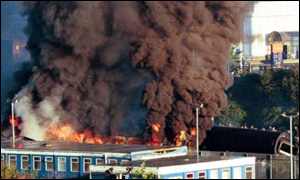
1999, Colin was working as the senior guard on board the First Great Western train that was involved in the Ladbroke Grove
disaster in London. Through his actions he helped to prevent another train crashing into the accident site moments after,
and also helped many on board to get off the train safely. The following article from the Belfast Telegraph on
February 5th 2000, a few months after the accident, recalls what happened:
Ulsterman was 'unsung hero'
in rail crash horror
Conductor relives disaster of Paddington
By Smyth Harper
A CARRICKFERGUS man who was an unsung hero
of last year's Paddington rail disaster spoke today about his struggle to rebuild his life after the accident which killed
31 people. Colin Paton was senior conductor on board the Great Western train which ploughed into another train on October
5, 1999, after the second train passed through a warning sign. Mr Paton said: "My life has stopped for the past four
months. I will never forget what happened that day."
Mr Paton was seriously injured in the accident but
that did not stop him rushing to the aid of passengers on the train as well as ensuring that the electric was cut off from
overhead power lines and radioing ahead to stop a high speed train that was only four minutes away. Without his quick action
it is likely that more people would have died.
He added: "I remember being flung forward and hitting
my head but I thought nothing of it and the adrenaline kicked in. I knew that the train behind was only minutes away and there
was a lot to do. There was smoke and flames everywhere and passengers were screaming and yelling for help. The emergency services
arrived very quickly and I helped out for about an hour and a half."
Despite his lifesaving work, Mr Paton has not received
any thanks or commendation from the rail company he worked for. Mr Paton sustained injuries when he bashed his head and is
receiving treatment because he suffers from headaches. He is receiving counselling twice a week to help deal with the horrors
he witnessed on that fateful day. Mr Paton has been unable to return to work and said that when he feels well enough he wants
to campaign for rail safety so that something as terrible as Paddington will never happen again.
He said: "I want to get involved with the Safety
in Trains Action Group (STAG) which is pressuring the government and rail companies to make train travel more safe."
The rail disaster was not the first time that
Mr Paton was involved in a transport accident. After joining the navy, he was on board a submarine when it hit an iceberg.
Following the accident, he left the navy and returned to his native Carrickfergus where he was involved in a number of groups
including Gingerbread, a support group for single parents.
And on Wednesday, 31st May, 2000, the following
apperaed in the Carrickfergus Advertiser and East Antrim Gazette, following the events of the subsequent Cullen Inquiry (page
2):
Carrick Man Praised for Role in Paddington Train Crash
Aftermath
Former Carrickfergus man Colin Paton, who survived the
Ladbroke Grove rail crash which claimed 31 lives last year, has given evidence to the enquiry being conducted into the disaster
by Lord Cullen, at Central Hall, Westminster.
Mr. Paton, who is a regular visitor to the area from
his new home in Bristol, was praised for his actions in the aftermath of the tragedy. He also made numerous suggestions to
the enquiry concerning rail safty measures.
There were around 600 people in the two trains which
crashed near Paddington Station last October.
Questioned by Mr. Robert Owen, QC, counsel
to the enquiry, Mr. Paton testified that is a senior conductor employed by First Great Western. On the day of the crash he
had booked for duty just after 4 o' clock that morning at Bristol Temple Meads.
The train then went to Cheltenham. It was then to become
the 6.03 from Cheltenham to London Paddington, stopping at Gloucester, Stonehouse, Stroud, Kemble, Swindon, Didcot and finally
at Reading, where there was a change of driver.
The crash happened as the train neared Paddington, said
Mr. Paton, who recounted his experience:
"I was flung quite violently forward. I have never,
ever in my life met force like it. You know, I was just heaved forward and back. By the end of that time I got - we had no
warning it was going to happen, we did not see anything, just suddenly there was a massive collision and I was heaved forward.
"Afterwards, thrown backwards, I was able to get my
hands down on to my desk to try and control them, but the first one we had no warning about it, I was just heaved."
Mr. Owen: Were you injured in that initial impact?
Mr. Paton - I was not aware of it at the time, but subsequently
I have had - well, continuously I have had headaches since the accident, a permanent headache in the last eight months.
Asked to tell the enquiry what he witnessed,
Mr. Paton replied:
"Towards the front there was a large
fireball. The diesel had black sort of smoke coming from it. I am familiar with diesel fires. And I also noticed all the overhead
power cables were hanging down.
He continued:
"I opened the sliding door between my van and coach
A and looked up at it, and it was pretty chaotic".
Mr. Paton added:
"There were people upside-down, people cut, bleeding,
and there was a lot of - my immediate reaction was there was a lot of people that had been damaged but nothing serious. That
was my immediate reaction.
"There was no danger in that coach, that was my immediate
-- so I wasn't concerned at that coach. I was conscious of the fact that there was something happening but towards the front
of the train.
"As soon as I had seen what was happening in coach A,
I went straight onto the PA system, asked for medical staff, fire-fighters, service personnel and train staff to report to
me at the rear of the train".
Mr. Paton said passengers in coach A were trying to
get out through his door and he warned them that there was an electric cable hazard.
Having calmed the passengers, the local man managed
to get out to inspect damage and to try to contact the driver.
"My immediate intention was to get to the driver. Control
had told me to get in touch with the driver and I wanted to get in touch with the driver, but it was impossible".
He testified:
"There was some 50 or 60 people on lineside, who already
got out off the train. I was telling them to kepp back until they got protection and got the power shut off. When I got to
the gantry the middle coach of Thames train was leaning against the gantry at an angle and people started dragging me in towards
it, saying, "THere's people in there. You've got to get them out."
He said he crawled through between the two trains.
"There were two windows on the Thams train... There
were passengers in the train and they were shouting and screaming. There was smoke in the train; there was fire around the
train".
Mr. Paton went on: "There was a young lad who I had
met on previous occasions, a guy called Lee Tyack... He had two gallon gas/water and I got that off him, and I just sprayed
the window with it. But it was a waste of time. It was not a fierce fire, if I could add that. There was not any danger, to
me, there.
"And I then started swinging the fire extinguisher to
try and break the window at the bottom corner. I just kept bouncing off."
He added: "People were saying, "Up there, up there."
There was just bodies, people everywhere, you know?"
Mr. Paton said:
"I was still looking for my driver. Coach F was on its
side. There were still people inside it. I got in there, walked along the seats, and there was some lady I recall looking
for a shoe or something, some man looking for a briefcase. I helped them out and then when I came out of there I looked to
my right and that is when I saw coach H wich at that time was on its side.
"THere was flames coming out of every single window,
flame coming out both ends and there was a gentleman, and elderly gentleman I think he was, who said, 'There could be people
in there,. You've got to get them out'.
"I just remember saying to him, 'Be realistic,
sir. There's nothing left in there'. It was just on fire from end to end...
"I saw coach G further ahead and I expected to find
the engine in front of that because I thought that was coach H. So I went up there and there was no sign of an engine; I could
not find the engine. I think it is at that time I got across to the signalpost telephone and phoned the signalman".
He said he received confirmation that the power was
off.
Mr. Paton learned that there were two bodies to the
rear of the engine and reported to a manager, who had arrived at the scene, that he belived the driver to be among the dead.
Eventually, he said, he went to University College Hospital.
Mr. Paton made observations to the enquiry about safety
aspects, including a recommendation that there should be conductors on all trains and the conductor should be in charge of
safety in all circumstances.
He also made a point about 'freshness of staff', indicating
that staff could be rostered for ten and a half hours or 12 hours at weekends if there is line work to be done.
"Twelve hours in a shift, with perhaps very busy trains,
you are in no fit state to even consider taking charge of an accident".
Mr. Paton also made recommendations concerning availability
of rescue tools, hammers for windows and quick release windows.
He continued:
"There used to be two drivers until privitisation on
trains over 110 miles an hour, and I feel that had we had two drivers in this particular accident, it would not have done
any good from the Great Western point of view, but previous to the accident two drivers might have avoided that accident.
I think it is maybe wrong to be cutting costs that way.
Mr. Kenneth Hamer QC, counsel for the passengers, the
injured passengers and breaved, cross-examined Mr Paton, beginning:
"May I first of all
say that you acted on that day plainly in the heat of the moment and did everything you could in the interests of protecting
the train and in the interests of passengers".
|
|
| Colin with his eldest grandson Calum in Crete, 2003 |
A couple of weeks after he underwent a major spinal operation to repair
a crushed disc, and a heart operation to repair damage to a hitherto unknown heart attack suffered in the previous few
years, Colin celebrated his 60th birthday in Gouves, Crete, with family and freinds. As a part of the celebrations, Paula
composed yet another poem in honour of the occasion, which she read out to the assembled crowd:
COLIN - 60
This is not This is Your Life - Michael Aspel I am not
But I will attempt to amuse you with some of your lot.
It's all a bit jumbled, a bit like your life,
Changes and dramas with you have been rife
This day 60 years ago, in 1945,
A baby boy came into the world kicking and alive.
Your parents named you Colin, ahh, a wee bonny lad,
You grew up, grew tall, with looks that weren't bad.
You worked as a submariner travelling all over,
Had a girl in every port from Bangkok to Dover.
When you left, you settled back in Carrick, your home town,
Got divorced and joined Gingerbread, to some, raising a frown.
But now you live abroad which you'd always longed for
After rearing your children a few more jobs and off you tore
With wife number two you settled here abroad
A new part of life, you lucky big sod.
All these years you've stood over 6 foot tall,
A bit weghty now, built like a wall.
Still looking good, though going grey up top,
But an honour goes along with that - doesn't it Grand-Pop?!
So here we are all gathered in Crete,
To celebrate your birthday, that is no mean feat.
It's your sixtieth and we've come from afar and near
To celebrate with you and maybe shed a tear.
There's son number one Chris and your daughter-in-law Claire
And your two wee grandsons, an adorable pair,
Son number three Robert is here as well
All come to party with you, to eat, drink and yell.
There's some friends here as well
With some personal stories to tell.
And me of course - not sure what I am
I just turned up to make the place look glam!
And now today you're sixty years old,
When they made you they broke the mould.
You're loving and caring and really quite kind
But no-one would say you are big headed, mind!
Recently you had such a dreadful scare,
Carrying a heavy weight you felt your back tear.
Off to the hospital, practically on your knees
Saying just fix me up - let me walk again please.
An operation later and your back's been mended,
The doctors and nurses are to be commended.
Just like Humpty Dumpty and the soldier men,
They put you back together again.
So now you're celebrating in more ways than one, we can tell
As you've now turned 60 and feeling quite well.
Your family, neighbours and freinds are all glad to be here,
And hope we can do it all again on your 65th year.
In 2018 Colin moved to Scotland, initially residening in the
Ayrshire town of Largs (home to his son Chris and two grandsons), and then to accommodation in nearby Kilwinning. He eventually
passed away at Crosshouse Hospital, near Kilmarnock, on 6 FEB 2021.
* I had a very up and down relationship with my
father throughout his life, but I will always be grateful to him for raising me in Carrickfergus, and for giving me the
same enjoyment of storytelling that he so obviously loved. Dad was a smart man, a funny man, politically astute, had
no time for the themmuns and ussuns debates back home in Northern Ireland, and to his dying days was a Royal Naval man
above all.
RIP Dad - you were an incredible man in so
many ways, and you are sorely missed. Chris, Claire, Calum and Jamie xxx

Christopher Paton
19XX -
Chris is Calum's and Jamie's dad, and creator
of this family history project.
First things first! On a technical
level, I have had both my Y-DNA and mitochondrial DNA tested. The results for my Y-DNA profile can be viewed at Paton Part 1, and is the same Y-chromosome signature for all of the male Patons on this site. With regard to mitochondrial DNA,
my profile, which matches that of my mother, her mother, etc etc, was matched against the Cambridge Reference
Sequence by the Sorenson Molecular Genealogy Foundation, and the following mutations were noted:
HVR1: 16519C HVR2: 263G HVR3: 315.1C
Our maternal haplogroup is H,
which is the most common mitochiondrial DNA haplogroup found in Western Europe. The boffins in white coats will tell you that
anyone with the H haplogroup will have had a common ancestor called Helena. If anybody has the same mtDNA
mutations as myself, it will be extremely likely that we share a maternal ancestors somewhere in the last 500 years. So there!
Anyway!
I was born during the
reign of the British queen Elizabeth II (Elizabeth I of Scotland) in Larne, County Antrim, Northern Ireland in 19XX,
weighing in at six pounds and three onces, and within a week of my birth had moved to Scotland with my mother, where my
father worked in the Royal Navy.
|
|
| First day at school - Chris in the garden with grandmother Jean Paton (nee Currie) |
I was baptised on board the Valiant class submarine,
HMS Churchill, the first child to be given the honour. Under naval tradition, I was apparently entitled
to the ship's bell upon its eventual decommission, but it somehow seems to have found its way to a theatre in Churchill's
old parliamentary constituency!
At the age of four, our family moved to Plymouth
in England, as the result of another change of posting for my father. Whilst here, I attended Laira Green Primary School
for four years. I vividly remember my two grandmothers coming to stay at our home on separate visits, as well
as my aunt Nicole (aka "Coco") and cousin Cheryl, who stayed on with
our family for a year, and ended up attending the same school as me.
I soon moved back to Carrickfergus in Ireland with my
father and brother Colin as a result of our parent's separation. My sister Dawn and wee brother Robert had already returned
to Ireland separately with my mum.
In Carrick, I attended the Model Primary
School, and then Carrickfergus Grammar School, and was also an enthusiastic member of the the 3rd Carrickfergus Company of
the Boys Brigade, with whom I went to annual camps in Switzerland, France and London in the Eighties.
|
|
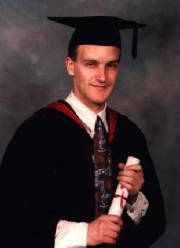
| Chris second university graduation, from UWE, Bristol, 1994 |
After gaining ten O-levels and two A-levels, I went to the University
of Ulster in Belfast for two years to study graphic design at HND level, and then moved to Bristol, England, in September
1991, to do a media degree at the University of the West of England, which I completed in 1994.
After my
degree, I joined BBC Television in January 1995, where I worked on a variety of series for BBC1 and BBC2 such as "999",
"War Walks" and "Driving School", taking me on filming trips to Brittany, Ireland, as well as the length and breadth
of England!
In November 1995, I met and started going out with mad Kilkenny woman Claire
Giles at a local ASDA store we were both working at in Bedminster, Bristol, after I had temporarily fallen out of
contract at the BBC.
A month later, I returned from work to my home
on Coldharbour Road, Bristol, to find paramedics pulling the body of my good friend and flatmate Richard Pennington
from our bath. About a month before, Richard had been in a minor road accident on the swing bridge over the Avon in Bristol
city centre, when a bus had shunted into his car from behind at a red light. Since the accident he had been complaining of
a pain in his leg, which after a couple of weeks had mysteriously moved to his other leg. It later transpired that
he had had a blood clot moving around his body, and whilst in the bath he had suffered a pulmonary embelism, and drowned where
he lay. The result of this shock was that I moved out and briefly stayed in a flat in Southville for six months,
after which both Claire and I moved into a flat together in the Totterdown area of the city.
|
|
| War Walks:Boyne crew - Mark Fielder, me, Vicky Carter, Roger Mills, Jeremy Humphreys &Richard Holmes |
In September 1997, both Claire and I moved to Scotland, a much nicer place
(!), and set up home in a flat in Dorset Street, Anderston, before moving to Errol Gardens in the Gorbals, where we remained
for the next five years. I initially took up work in the BBC's Gaelic Department, working on the "Eorpa" series, before taking
up work at Scottish Television Enterprises for three years, working on a variety of programmes for ITV and Channel Four. Whilst
at STE, I worked on a variety of programmes, including a series that saw me in the United States for nearly four months,
where I worked in over thirty of the different States and Canada. In 1999, I had a breakthrough with a programme idea
commissioned for Channel Four's Secret History series, an expose on the class divide that hampered the efforts of the pilots
that fought during the Battle of Britain.
Claire and I married in Piltown Church of Assumption, in Claire's home town of Piltown, in Kilkenny,
Republic of Ireland, with the best man being Claire's brother Shane, and the bridesmaid her sister, Majella. After Paddy sent
us off with a rousing rendition of Two Carrick Smashers, we spent our honeymoon in Galway and the Aran island of Inis Mor.
Having had a few years of relative peace and quiet, we were soon joined by our first son, Calum,
who was born in Glasgow Maternity Hospital at Rottenrow, which has since been pulled down - he obviously made an impact! Just
prior to Calum's birth, I again returned to BBC Scotland, to work in the Specialist Factual Department, working on a
series of documentaries that took me to Switzerland, Italy, Arizona, the length and breadth of Britain and in the tranplant
unit of the Royal Infirmary of Edinburgh.
The birth of Calum soon prompted me to start looking into the history of my family, leading to the
creation of this website, as well as a second website on the history of a civilian WW1 German POW camp at Ruhleben, near Berlin,
where my great uncle John Paton was interned in 1916. (This can be viewed at th following link: The Ruhleben Story).
Having moved to Largs in North Ayrshire, we were soon joined by our second son, Jamie,
who was born at Ayrshire Central Hospital, in Irvine.
After five years at BBC Scotland, I finally left the company in February
2006, disillusioned with how its ever increasing bureaucracy was impacting on programme makers during production, at
how the corporation continues to dumb down with its television output in respect to its audience (compare BBC1's 9 o'clock
news to BBC Radio 4's Today programme!) and its deteriorating ambition with regard to new ideas, preferring instead to
take its lead from its commercial rivals and in particular, its superiors in London rather than its local base. In addition,
I was also desperate to try new things away from television production.
I have subsequently pursued my interests in genealogy by obtaining a Postgraduate
Diploma in Genealogical Studies at the University of Strathclyde, and from 2012-13 I worked as a tutor for the university
on the postgrad certificate. In addition I run a Scottish based family history research service entitled Scotland's Greatest Story, write for many varied publications both within the world of genealogy and beyond, have had eleven books published and I
regularly lecture in Scotland, England and around the world on all matters genealogical.
It's a living...!
|
|
| Our wedding day in Piltown, Kilkenny, June 24th 2000 |
|