|
Unknown Graham
b: 17?? d: bef 1827
Very little is as yet known about the father of Thomas Graham
(below). From Brian Graham, who passed away in August 2007, we initially learned that the Graham family originated near
the plantation village of Caledon, Co. Tyrone (on the border with Armagh and Monaghan). Evidence to confirm this has been
subsequently found in Thomas' 1840 marriage record, which noted him as resident in Feduff (Foyduff) townland in the parish
of Tynan, County Armagh, just a couple of miles away from Caledon.
In the October 1826 tithe returns from Tynan parish, there are two
listings for a Graham family member in Feduff, a 'Widow Graham' in Lots 18 and 19, implying that Thomas' father had already
passed away at this point. Lot 18 comprised of 12 acres and 22 perches, with a composition due of 13s 8d, whilst Lot
19 comprised of 11 acres 1 rood and 10 perches, with a composition due of 12s 9d (Source: Tithe Applotment Book, Tynan
parish, PRONI: FIN/5/A/270).
A DNA match in May 2019 may suggest that Thomas was the son of John
and Elizabeth Graham of Drumagelvin townland, but more work needs to be done to substantiate this.
In addition to Thomas, it is believed that this earliest member of the
Graham family had a daughter called Margaret, who subsequenly died in Belfast as an unmarried woman in 1878,
and for whom Thomas' wife Eliza acted as the informant to the registrar. She was also buried subsequently in the family grave
owned by Thomas.
Children of Unknown GRAHAM:
Margaret Graham
b: 1809 d: 21/5/1878
Margaret Graham was listed as a 69 year old mill worker resident at 131 Little York Street, Belfast,
in the parish of Shankill, when she died on 22 MAY 1878. The cause of death was debility, suffered for two years, and the
informant to the registrar was Eliza Graham, from 206 York Street (spouse to Thomas Graham,
and Calum's and Jamie's four times great grandmother). Crucially the record notes that Margaret was a spinster making it likely
that she was an older sister to Thomas (Source: GRONI D/1878/47/1007/12/340).
Margaret was buried on the 22nd at City Cemetery, in lair B512. Thomas was the grave owner. In
the burial record her cause of death was noted as consumption, essentially tuberculosis. She was stated to be Church of Ireland
by denomination and the cost of the burial was 7 shillings and sixpence (Source: Belfast City Council burials database).
Thomas Graham
b: abt 1820
Calum's, Jamie's and Pippa's four times great grandfather - see below.
Possibly related:
Elizabeth Graham
b: 18??
An Elizabeth Graham married John Wilson in the parish of Tynan on 9 MAY 1825, in
a Church of Ireland service. It is not known if Elizabeth was perhaps Thomas' older sister, an aunt or even a cousin, but
her marriage is contemporary with his and in the same parish (Source: PRONI MIC 1/12/1 Church of Ireland, Tynan).
Samuel Graham
b: 18??
A Samuel Graham of Cottage Hall married Jane McAree of Tynan on 26 APR 1827,
in a Church of Ireland service. Again, the marriage is contemorary with that of Thomas, with Samuel a possible older
brother, cousin or uncle (Source: PRONI MIC 1/12/1 Church of Ireland, Tynan).

Thomas Graham
b: abt.1820 - bet 1885 and 1901
Thomas was Calum's, Jamie's and Pippa's four times great grandfather.
From his grandson Brian Graham (see below), who sadly passed away in August
2007, it is was learned that Thomas was supposed to have originated from the plantation village of Caledon in County Tyrone
(bordering counties Armagh and Monaghan). Since then it has been established that Thomas married his wife Eliza
Taylor on 5 APR 1840 at Tyholland Church of Ireland, just few miles down the road in County Monaghan. At the time
of the wedding Thomas was resident at Feduff townland (Foyduff) in Tynan Parish, County Armagh, which is just a couple of
miles away from Caledon, whilst Eliza was from the townland of Tuckmilltate in the parish of Tyholland (Tehallan), Co. Monaghan.
The following is the wording from the marriage register (Source: PRONI, Teholland MIC 1/126/A/2):
Thomas Graham of Feduff Parish of Tynan and Eliza Taylor of Tuckmiltate Parish of Tyholland
were married in this Church by License with consent of _______ this fifth Day of April in the Year one Thousand eight Hundred
and 40 by me Wm Miln
This Marriage was solemnised between us Thos Graham Eliza Taylor
In the Presence of William Sharp John Higgins
The earliest child that has been found born to the couple was their son Thomas in
1846, which suggests that there may well have been others between their marriage in 1840 and then.
The earliest newspaper story found so far concerning Thomas senior appears to be from Tuesday, 10
DEC 1850 in the Banner of Ulster. In the section concerning the Belfast Police Court (p.1-2), we learn that Thomas,
as a reeling master at the Hull, Harden & Co. mill, was prosecuted for the assault of a millworker, and fined 2s 6d as
a consequence. The charge was that a millworker, Rebecca Curliss, was twelve minutes late for her shift on the previous Wednesday.
Upon arrival she found another girl in her place, and was approached by Thomas who apparently scolded her for being late.
She replied that work was available easily enough elsewhere, at which point he told her "not to be impertinent". When she
refused to leave he was said to have threatened to "knock her down stairs" and pushed her, at which point she hit him
and gave him a black eye. At this point he apparently dragged her away to the bottom of the works. She was subsequently dismissed
by the manager of the works. Speaking in Thomas' defence, Mr. Hull, one of the mill owners, was reported
as making the following claim about him:
After some conversation as to whether Mr Hull should be examined, that
gentleman was sworn, and stated that he considered the character and conduct of the defendant, who had been a long time in
his employment, to be very correct, and anything but that of a harsh over-looker. The complainant was paid off by himself
on Saturday, and she made not the slightest reference to the occurrence about which she had just given evidence.
After sentencing, a Mr. O' Rorke from the mill claimed that three witnesses were prepared to
step forward to give a very different account to that by the complainant, but the magistrate refused to re-open the case.
In the 1850 Belfast street directory, Thomas was
listed as a carding master at a flax mill, and we know that he was an overlooker in the York Street Flax Mill from
about 1852, on account of a prosecution some twenty years later which identified the fact (see below). It is not yet known if Hull, Harden & Co.,
where Thomas worked in 1850, was the same mill, or a separate one.
In the baptismal record for his son Edwin, Thomas and Eliza were noted as residing at Henry Street in Belfast,
with Thomas noted as a mill worker. In the 1863-4 Belfast Street Directory Thomas was noted as residing at 86 Henry
Street and as being a 'spinning master in mill', and again at the same address as a 'mill overlooker' in 1868.
|
|
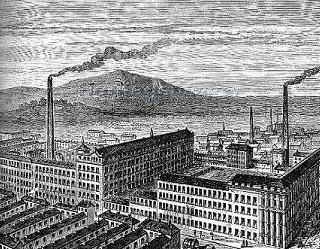
| York Street Flax Spinning Co. mill circa early 1880s |
In his son Thomas' wedding record
from 1868 he is noted as a teacher - despite the difference here, there is in fact a family tradition that Thomas
did work as a teacher, as recalled by our cousin Renee Fisher in 2005. In what capacity he worked as a teacher is unknown
- it is possible that it meant that he was an instructor in the factory, as opposed to school teaching. In 1870 Thomas was then noted as a reeling master
at 92 Henry Street (Source: PRONI www.proni.gov.uk).
From his daughter Wilhelmina's birth
certificate in February 1871 it is noted that Thomas was a 'railing master' (sic) resident at 38 Ship Street in the Shankill
District of Belfast, Ireland, and was Church of Ireland by way of religion. On September 6th 1871 he is further noted in
the death certificate of his 1 year old granddaughter Alice as living at 2 Canning Street, and in November he was residing
at 206 York Street, as noted in the death certificate of his son Albert, the record also noting that he was
a 'mill worker'.
Thomas worked for the York
Street Flax Spinning Company Ltd, founded in Henry Street in the 1820s, and which by the 1860s was one of the largest
flax spinning mills in the world. A description of the mill from 1888 was recorded by the Institution of Mechanical Engineers and
can be read here. We know that Thomas worked for the firm because on 26 NOV 1872 he was prosecuted by Edward Orme Esq. R.M. and John Preston
Esq. J.P. at Belfast Petty Sessions Court for "employing six females in reeling room after 6pm on November 12th", a breach
of the Factory Act. An HM Factories Inspectorate report for the half year ending April 1873 (sourced here via Google Books) details the case. It states that
The Defendants having proved that the offences were committed by the overlooker
(Thos. Graham) in contravention of their positive orders, and without their knowledge, consent, or connivance, and having
summoned Graham into Court to answer the charge, the offences were transferred to him.
It seems that Thomas was only formally prosecuted for employing two of the six women
late, and was fined £2 penalty and 6s 6d in costs. His defence was noted as follows:
The Defendant who has held his present position as overlooker for
20 years without previous offence, acknowledged that he was in fault, and urged extenuating circumstances.
The judge was lenient. For the charges concerning the other four women he stated that they
were
Withdrawn on payment of costs, as I considered a fine of £2 14s 6d sufficient punishment for a working
man.
In the 1877 street directory for
Belfast Thomas was again noted as a reeling master at 206 York Street, and in 1880 he is still there but listed as an overlooker.
In his son William's marriage record from 1885, Thomas is again noted as a reeling master (Source: RootsIreland).
It is known that Thomas, like his sons and grandsons in the shipping industry regularly travelled across the Irish Sea
to look for work in the Barrow in Furness, Liverpool and Belfast. From the 1881 census for
Barrow in Furness, Lancashire, England, Thomas was listed as a 60 year old clerk from Ireland, married to a 50 year Eliza,
also from Ireland, and with three children present - shipwrights Edwin (aged 19) and William
(aged 16), and scholar Wilhelmina (aged 10), all born in Ireland. This record would place Thomas'
birth year in either 1820 or 1821 (Source: 1881 census England and Wales, RG11/4291/55/p.11, Barro in Furness). The marriage
certificate of his son Edwin on 27 JUN 1881 in Barrow also notes Thomas' occupation as a clerk.
There is, however, a bit more going on within the same page - Thomas next door neighbour, at 80 Marsh
Street, is a Samuel Lunn and his wife Annie - this is in fact Thomas' daughter, Annie
Graham, who had married Samuel Lunn in 1869. Her census entry notes that of her five children present, two were born
in Barrow-in-Furness - Thomas Lunn, born about 1874, and Annie Lunn, born about 1876. Whether
the Lunns sailed across the Irish Sea to England first, or whether Thomas and his family accompanied them, or perhaps themselves
crossed the water first, is as yet unknown. Thomas is recorded in the 1877 street directory for Belfast as the occupant, but
that may equally have been a house supporting members of his household whilst he worked in England.
In Belfast it is known that Thomas and his family regularly worshipped in St. Pauls Church of Ireland
on the York Road, Belfast. As well as living at 206 York Street, family tradition has it that they may have
also possibly resided at some point at Brougham Street.
Thomas died between approximately 1881, when he was noted in the census in Barrow in Furness in England,
and 1901, when his wife Eliza was noted in the 1901 census as a 75 year old widow (and again as a widow in her death record
in 1904). His death record cannot be located in Belfast, and as such, it is possible that he may have passed away in
England. If so, the likeliest candidate for a death record entry is that indexed for a 71 year old Thomas Graham
in 1885 Q1 Barrow-in-Furness Vol 8e p.565, though the age is a few years out from that given in the 1881 census.
From a document held by Thomas' grandson Brian, concerning a grave purchased by Thomas in 1871, several
children, and one grandchild, have been identified.
CHILDREN of THOMAS GRAHAM and ELIZA TAYLOR:
Thomas Graham
b: abt 1846 d: 20/5/1882
It is not yet known exactly when, or indeed where, Thomas was born, though it seems likely to have
been in Belfast, Co. Antrim, Ireland, in approximately 1846.
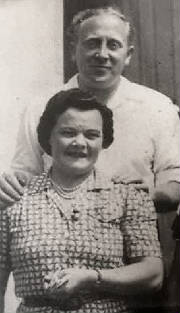
|
|
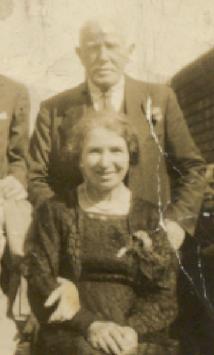
| Thomas' wife Anna with their five grandchildren, taken in Belfast 1906 (Courtesy Bob McConnell) |
Thomas married Anna Robinson in an Anglican
ceremony on 13 JUN 1868 at Trinity Church in Belfast. Thomas was noted as being of full age, and a mechanic, whilst Anna was
a minor. Thomas was the son of Thomas Graham, a teacher, whilst Anna was the daughter of John Robinson,
a linen bleacher (Source: GRONI M/1868/B1/464/2/176).
Despite his father's occupation as a teacher, and not a reeling
master, this does appear to be the correct relationship, as following their marriage, Thomas and Anna had a baby who died
in infancy, and who was buried in the Graham family plot in Belfast City cemetery - owned by Thomas Graham, reeling master.
Thomas died on 20 MAY 1882 at Lilliput Cottage, Belfast,
aged 36. The cause of death was heart disease, and he was noted as a plaiter. The informant two days later was a Robert
Mahaffey, of 15 Bentnick Street, Belfast, who was present at the death (Source: GRONI D/1882/48/1007/20/446 Belfast
Urban 2). He was buried on 23 MAY 1882 at Belfast
City Cemetery in grave D72, with the entry noting that Lilliput Cottage was on Greenmount Road (Source: Belfast City Council
burials database).
Thomas' death was reported in the main Belfast newspapers:
GRAHAM -May 20, at Lilliput Cottage, suddenly, Thomas Graham, aged 36 years.
The remains of my beloved husband will be removed for interment in the Borough Cemetery, to-morrow (Tuesday) afternoon, at
three o'clock. Friends will please accept this intimation. Anna Graham.
(Belfast Newsletter, Mon May 22 1882)
FUNERAL OF A QUEEN'S ISLANDMAN.- Yesterday, at three o'clock, the remains
of Thomas Graham were removed from Lilliput Cottage for interment in the Borough Cemetery. The deceased entered the employment
of Messrs. Harland & Wolff some twenty years ago, and for thre past four years had been employed by the same firm
as foreman plater. On Saturday he was at work in his usual state of health, and in the evening went out for a short time.
He had only returned for a few minutes when he suddenly took ill. Dr. Strahan was immediately sent for, but when he arrived
life was all but extinct, and death resulted in a few seconds. Heart disease was the cause. The deceased was a great favourite
with the men engaged in all departments of ship-building and foundry work in town, and the funeral was attended by upwards
of 4,000 men. The employees of Messrs. Harland & Wolff, MacIlwaine & Lewis, Workman, Clark & Co., and John Rowan
& Sons, Limited, left off work at twelve o'clock for the purpose of being present. The members of the firm present were
Mr. Wilson and Mr. Perry. Mr. Carlisle, manager, and Mr. Wm. Houston, head foreman, were also amongst those present. The coffin
was borne behind the hearse, which was drawn by four horses, by relays of the fellow-workers of the deceased. Rev. Robert
Crawford officiated at the grave. The deceased was a respected member of L.O.L. 634. He leaves behind him a widow and two
children.
(Belfast Newsletter, Wed, May 24, 1882)
AN ORANGEMAN'S FUNERAL
Yesterday evening, the remains of Mr. Thomas Graham - for many years a
respected member of L.O.L. 634 - were removed from his residence, Liliput Cottage, North Queen Street, for intermment in the
Bororugh Cemetery. The deceased entered the employment of Messrs. Harland & Wolff some twenty years ago, and for the past
four years had been employed by the same firm as foreman plater. On Saturday he was at work in his usual state of health,
and in the evening went out for a short time. He had only returned for a few minutes when he suddenly took ill. Dr. Strahan
was immediately sent for, but when he arrived life was all but extinct, and death resulted in a few seconds. Heart disease
was the cause. The deceased was a great favourite with the men engaged in all departments of shipbuilding and foundry work
in town, and the funeral was attended by upwards of 4,000 men. The employees of Messrs. Harland & Wolff, Messrs. MacIlwaine
& Lewis, Workman, Clark & Co., and John Rowan & Sons, Limited, left off work for the purpose of being present.
The members of the Queen's Island Shipping firm present were Mr. Wilson and Mr. Perry. Mr Carlisle, manager, and Mr.
Wm. Houston, head foreman, were also amongst those present. The coffin was borne behind the hearse, which was drawn by four
horses, by relays of the fellow-workers of the deceased. Rev. Robert Crawford officiated at the grave. Deceased leaves a widow
and two children to mourn his loss.
(Belfast Telegraph, Wed May 24 1882)
Thomas' widowed wife Anna Graham remarried to 60 year
old widower David Wilson, gardener, on 9 MAR 1885. His father was James Wilson, farmer, and Anna's
confirmed again as John Robinson, farmer. The wedding took place at Albert Street Church after license, and
the witnesses were a James Davidson and Catherine Martin (Source: GRONI M/1885/B1/474/2/187
Belfast).
Anna was later noted in the 1901 census as being aged
50, and residing on the Limestone Road, Belfast, with her husband David (retired grocer, 60), son Thomas
(unemployed engine fitter, ill, aged 30) and his wife Edith Mary (25), her grandson Thomas Graham
age 1, and daughter Elizabeth Whyte (31) and her husband Thomas Whyte (31, limited company
secretary in the printing business). (Source: National Archives of Ireland, 1901 census).
In the 1911 census, 75 year old David Wilson and 60 year old Anna,
both from County Down, were noted at Oldpark Road, Belfast. Anna was described as having been married for 26 years, and as
having had five children in her present marriage, of whom only one was still alive. Also present were David's daughter,
39 year old restaurant keeper Alicia Wilson, and Anna's grandchildren, 11 year old Thomas Campbell
Graham, and 9 year old William Francis Graham, both scholars. Her son Thomas was by then deceased,
with her 35 year old daughter-in-law Mary Edith Graham also present, noted as a mercantile clerk. All were
Presbyterian and all could read and write (Source: 1911 Census, National Archives of Ireland).
As Anna Wilson, she was noted in the probate calendar entries as having died on 1 JUL 1914, leaving
her daughter Elizabeth £936 10s 2d, granted in Belfast on 18 SEP 1914. Anna's address was Baroda, Oldpark Road, Belfast (Source:
PRONI wills calendar database). She was buried alongside her first husband Thomas in Belfast City Cemetery on 4 JUL 1914,
and noted as age 63 at time of death (Source: Belfast City Council burials database).
Anna's husband David later died on 6 FEB 1918, aged 83, and in the probate calendar entry for him
he is noted as having been a retired landsteward - his home at 'Baroda' was noted as being at Cliftonville Circus in
Belfast (Source: PRONI wills calendar database)
A huge thanks to Bob McConnell, who in September 2014 granted permission for us to use a set of images
relating to Thomas' wife and grandchildren, which he had initially placed onto the website Ancestry.co.uk.
The story of Thomas Graham does not end here, however, because he may have popped back for a bit 44
years after his death! Thomas' brother Edwin, in July 1926, helped to organise an experiment with the Ulster Christian Spiritualists
Association, of which he was the Secretary. On August 18th, in an article in the Northern Whig recalling the aftermath
of the incident ("Spirit Photography"), Edwin stated that amongst the photographs taken by his society was one which included
his brother Thomas in spirit form:
Edwin Graham. secretary of the Association, referring to the second print,
declared:- "I am able to identify my brother Thomas, who passed out of the body 44 years ago. I recognise the hair, eyes,
and beard, and I have no doubt that it is him."
I leave it to others to play with that one!
Children of THOMAS GRAHAM
and ANNE ROBINSON:
Elizabeth Frances
Graham
b: 6/7/1869 d: 24/10/1959
Elizabeth was born on 6 JUL 1869 at 152 Corporation
Street, to Thomas Graham plater, and Letitia Anne Robinson. The informant to the registrar on
15 JUL 1869 was Eliza Robinson, of 15 Boyds Street, who was present at the birth. In the record she is actually noted and
indexed under the name of Letitia Anne Graham, but this is also given as the name of her mother and
would appear to have been a mistake. A separate and later baptismal record sourced from Roots Ireland notes her as Elizabeth
Frances Graham (Source: GRONI U/1869/47/1007/7/108 Belfast Urban 1).
Elizabeth married newspaper manager Thomas Whyte
on 14 FEB 1899 at Mariners Church of Ireland. Elizabeth was noted as being of full age, the daughter of Thomas Graham,
plater, a shop assistant of full age, and resident at 9 Somerville Gardens. Thomas was also of full age, the son of Patrick
Whyte, carpenter, and was resident at 82 Springfield Road. The witnesses were James Spence
and Frances Graham (Source: GRONI M/1899/B1/413/4/192 Belfast).
In the 1911 census Elizabeth is noted as residing on Oldpark
Avenue, Belfast, and as a 41 year old wife, married for 12 years and with three children, all scholars - Thomas
Graham Whyte, aged 9, Eileen Annie Whyte, aged 8, and John George Whyte, aged 4.
Husband Thomas is noted as a 41 year old secretary of a limited company. All were Presbyterian and born in
Belfast, and with the exception of John, all could read and write (Source: National Archives of Ireland, 1911 census).
Elizabeth's mother Anna left her £936 10s 2d fllowing her death in 1914, with probate
granted in Belfast on 18 SEP 1914 (Source: PRONI wills calendar database).
Elizabeth eventually died at the age of 90 on 24 OCT 1959
at 33 Ashley Gardens, Belfast, Co. Antrim, Northern Ireland. She was buried 2 days later in Belfast City Cemetery in Lair
F2 180. Following her death, her estate, valued at £1909 5s 11d was conveyed to her daughter Eileen on 2 DEC 1959 (Source:
PRONI wills calendar).
Elizabeth's husband Thomas, who predeceased
her on 31 AUG 1953, aged 84, was also buried previously in the same lair on 2 SEP 1953. He had been resident at the same
address, but had died in Purdysburn Hospital (Source: Belfast City Council burials database). Following his death Thomas left
estate valued at £273 17s 4d, with his daughter Eileen noted as the executor, and as a spinster - probate was granted on 16
SEP 1953.
CHILDREN of ELIZABETH GRAHAM
and THOMAS WHYTE:
Thomas Graham Whyte
b: 1/7/1901 d: 3/5/1953
|
|
| Image of Thomas Graham Whyte, taken in Belfast (courtesy Bob McConnell) |
Thomas was born in Belfast on 1 JUL 1901 (Source: GRONI U/1901/48/1007/82/167
Belfast).
In the 1911 census Thomas was noted as a nine year old scholar,
resident with his parents at Oldpark Avenue, Presbyterian, able to read and write, and born in Belfast (Source: National Archives
of Ireland, 1911 census).
Thomas died on 3 MAY 1953 at 3 Castlemaine Avenue, Ewell,
Epsom, Surrey, England. The GRO reference for his death certificate is GRO D 1953 Q2 Surrey.Mid.E Vol 5g p.149 - however he
left estate valued at £129 13s to his widow Margaret Elizabeth Gibson Whyte, which was recorded on the PRONI
wills calendar database in Northern Ireland, and which notes his date of death. Probate was granted on 19 AUG 1953 at
Belfast (Source: PRONI wills calendar database). The same record was resealed through the English probate system in London
on 1 SEP 1953 (Source: England and Wales, National Probate Calendar, Ancestry.co.uk).
Many thanks to Bob McConnell for permission granted in September 2014 to use the adjacent image of
Thomas.
Eileen Annie Whyte
b: 11/3/1903
|
|
| Eileen Annie Whyte and Thomas Graham Whyte |
Eileen was born in Belfast on 11 MAR 1903 (Source: GRONI
U/1903/49/1007/114/241 Belfast).
In the 1911 census Eileen was noted as an eight year old
scholar, resident with her parents at Oldpark Avenue, Presbyterian, able to read and write, and born in Belfast (Source: National
Archives of Ireland, 1911 census).
On 16 SEP 1953 Eileen was made the executor of her father's will in Belfast,
his estate being valued at £273 172 4d. In the will calendar abridgement, she is noted as a spinster. Following her mother's
death, Eileen, still a spinster, was again called upon to act as an executor, with probate granted on 2 DEC 1959
- her mother's estate was valued at £1909 5s 11d (Source: PRONI wills calendar database).
Inthe 1961 Belfast street directory, Eileen was recorded as Miss E. A. Whyte, and as residing at 33
Ashley Gardens, located in Duncairn.
When Eileen's brother John died on 3 SEP 1962, he left estate valued at £3677 18s to Eileen,
the probate being been granted to her on 24 OCT 1962. She was again noted as being a spinster (Source: PRONI wills calendar
database).
Thanks to Bob McConnell who in September 2014 granted us permission to use an image he holds of Eileen
and her brother Thomas taken in Belfast in approximately 1906.
John George Whyte
b: 28/6/1906 d: 3/9/1962
|
|
| John George Whyte, 1906 Belfast (courtesy Bob McConnell) |
John was born in Belfast on 28 JUN 1906 (Source: GRONI U/1906/49/1007/124/62
Belfast).
In the 1911 census John was noted as a four year
old scholar, resident with his parents at Oldpark Avenue, Presbyterian, unable to read and write, and born in Belfast (Source:
National Archives of Ireland, 1911 census).
John died on 3 SEP 1962, his home address in the probate records noted as 108 Serpentine Road, Whitewell,
Belfast, and his career as an aircraft inspector. He left estate valued at £3677 18s to his unmarried sister Eileen, the probate
having been granted to her on 24 OCT 1962 (Source: PRONI wills calendar database).
Thomas Graham
b: 24/9/1870 d: 22/9/1901
Thomas was born on 24 SEP 1870 at 38 Ship Street,
Belfast, Co. Antrim, Ireland. His father was noted as a plater, and his mother as Annie Grahams was recorded
as the informant on the 30th (Source: GRONI U/1870/47/1007/8/426 Belfast Urban 1).
Thomas married Mary Edith Campbell
on 19 FEB 1896 at Christ Church of Ireland, Belfast. He was noted as a marine engineer of full age and resident on the Falls
Road, whilst she was 20 years old and resident at 37 Glenwhirry Street. Her father was a land steward, whilst Thomas's
was a plaiter. The witnesses were Harry L. Davis and Agnes Morrow (Source: GRONI M/1896/B1/393/6/149
Belfast).
The couple produced two sons, but the marriage was to be short. Thomas contracted tuberculosis
in 1900, and eventually passed away on 22 SEP 1901 at 76 Limestone Road. His death record noted that he was married, aged
30, and an engine fitter. The official cause of death was phthisis pulmonala, 1 year, and tubercular peritonitis. His brother
in law Thomas Whyte informed the Belfast registrar the following day (Source: GRONI D/1901/48/1007/56/43
Belfast Urban 2). Thomas was buried on 24 SEP 1901 at Belfast City Cemetery, in lair F2 179 (His son Thomas and daughter-in-law
woud be buried alongside him many years later). Following his death, his wife, noted as Edith, was granted probate of his
estate on 20 SEP 1905, valued at £481 4s. Thomas was noted in the will calendar as being an engineer, resident at 76
Limestone Road (Source: PRONI wills calendar database).
In the 1911 census, Thomas' widow Mary Edith Graham is noted as residing
with his step-father, 75 year old David Wilson, and his mother, 60 year old Anna, both
from County Down. Anna was noted as having been married for 26 years, and as having had five children, of whom only 1 was
still alive. Also present were David's daughter, 39 year old restaurant keeper Alicia Wilson, and Thomas'
children, 11 year old Thomas Campbell Graham, and 9 year old William Francis Graham, both
scholars. All were Presbyterian and all could read and write (Source: 1911 Census, National Archives of Ireland).
In September 2014 Bob McConnell granted us permission to use images he had placed onto the
Ancestry website depicting Thomas' children, for which we are grateful. The images were given to Bob in 2010.
CHILDREN of THOMAS GRAHAM and MARY CAMPBELL:
Thomas Campbell Graham
b: 26/8/1899 d: 21/5/1976
Thomas was born at 32 Edlingham Street, Belfast, on 26 AUG 1899. His father Thomas
Graham was noted as an engineer, and his mother as Edith Campbell. The informant to the registrar at Belfats Urban District
2 on 15 SEP 1899 was Ellen McBlain (GRONI B U/1899/48/1007/76/122 Belfast).
|
|
| Thomas Graham in 1906, Belfast (courtesy Bob McConnell) |
He was photographed with his grandmother Anna Wilson, formerly Graham (nee Robinson),
in Belfast in approximately 1906, alongside his brother William and cousins Thomas, Eileen
and John Whyte. It is likely that at this point he may have been living with his grandmother, following the
death of his father in 1901 - the family were certainly recorded as residing with them in Oldpark Road in the 1911 census.
This noted Thomas living with his mother and brother, as well as his grandmother Anna, step grandfather David
Wilson, and step-aunt Alicia Wilson. Thomas was aged 11, and a Presbyterian scholar who
could read and write.(Source: 1911 Census, National Archives of Ireland).
In September 2014 Bob McConnell granted us permission to use images he had placed onto the
Ancestry website depicting Thomas' children. The images were given to Bob in 2010, and he recalled by email that he used to
stay with Thomas' son Thomas Campbell Graham in his youth, after Thomas had married Bob's
first cousin Jane Britton Long. A huge thank you to Bob for allowing us to include the images on this
site.
Thomas eventually passed away on 21 MAY 1976. his home address at the time being 10 Ashfield
Drive, Belfast. He was buried two days later at Belfast City Cemetery, alongside his father, in
lair F2 179. His wife Jane survived until 11 JUN 1988, when she passed away at the same address. She was aso buried in the
same lair, a month later on 11 AUG 1988 (Source: Belfast City Council burials database).
The following probate entry was recorded shortly after (Source: PRONI, Northern Ireland probate
calendar, 1976):
GRAHAM Thomas Campbell of 10 Ashfield Drive Belfast retired sales
representative died 21 May 1976 at Purdysburn Hospital Saintfield Rd Belfast Probate Belfast 3 September to Jane Graham the
widow. Effects £13241.13
William Francis Graham
b: 22/4/1901
|
|
| William Francis Graham, 1906 in Belfast (courtesy Bob McConnell) |
William was born on 22 APR 1901 in Belfast (Source: GRONI B U/1901/48/1007/81/405).
In 1906 William was photographed with his grandmother Anna Wilson, formerly Graham
(nee Robinson), in Belfast, alongside his brother Thomas and cousins Thomas,
Eileen and John Whyte.
In the 1911 census William was living with his mother and brother, as well as his
grandmother Anna, step grandfather David Wilson, and step-aunt Alicia Wilson, at Oldpark
Road, Belfast. William was aged 9, and a Presbyterian scholar who could read and write (Source: 1911 Census,
National Archives of Ireland).
It is not yet known what became of William after this.
Alice
Graham
b: 1/10/1871 d: 8/9/1872
Alice
was born on 1 OCT 1871 at 2 Tramway Street, Belfast, Co. Antrim, Ireland. Her father was noted as a plater, and her mother
was the informant on 19 OCT 1871 (Source: GRONI U/1871/48/1007/9/132 Belfast Urban 2).
Alice
did not survive long, dying on September 6th 1872, the cause of death not listed in her burial certificate. Her address was
2 Canning Street, and no religion was listed for her either. She was buried at 2pm at Belfast City Cemetery just two
days later, at a cost of 7s 6d, with the lair registered to Thomas Graham, Alice's grandfather, who had purchased
the lair a year before for the burial of his 15 years old son Albert. The grave was in Section B, lair 512 (Belfast City
Council: Order for Burial).
William Graham
b: abt Nov 1848
William was baptised on November 3rd 1848 at St. Anne's in
the parish of Shankill in Belfast, County Antrim, Ireland. He was noted as Church of Ireland by way of his denomination, and
the officiating minister was the Reverend Henry Alexander Burrowes.
With another of Thomas's son baptised as William in 1864,
it would seem that this first William died in infancy.
John Graham
b: abt Feb 1851
John was baptised on February 7th 1851 at St. Anne's
in the parish of Shankill in Belfast, County Antrim, Ireland. He was noted as Church of Ireland by way of his denomination,
and the registrar was noted as C. Allen.
When Edwin travelled to the United States in 1913 he listed
his brother John's address as Lilliput Street, Belfast in the passenger manifest.
Anna Maria Graham
b: abt Sep 1852 d: 27/10/1889
Anna Maria was baptised on September 3rd 1852 at St. Anne's
in the parish of Shankill in Belfast, County Antrim, Ireland. She was noted as Church of Ireland by way of her denomination,
and the registrar was G. F. Mathews (Source: RootsIreland.ie).
More colloquially known as Annie, on 18 SEP 1869, and at the age of 17, she married a 23 year
old carpenter called Samuel Lunn, the son of shoemaker James Lunn. Annie was noted as the
daughter of Thomas Graham, reeling master, and as with Samuel, she resided in Belfast. The wedding took place
at St. Anne's Cathedral Church of Ireland, and the witnesses were a Henry McAteer and a Mary Ann
Close (Source: GRONI M/1869/B1/418/32/101 Belfast).
The 1881 Census for Barrow-in-Furness in England shows that Samuel and Annie were resident at
80 Marsh Street, next door to Annie's father Thomas. Also present in their household were five children, William J
Lunn, aged 11, Elizabeth, aged 9, Thomas, aged 6, Annie, aged
4, and Emily F Lunn, aged 2. Both Thomas and Annie were born in Barrow-in-Furness, with the rest of the children
noted as being Irish. This suggests that Samuel and Annie may have moved to England between 1871 and 1874. Samuel was noted
as a 40 year old ship wright, and Annie as aged 28 - twice the age gap as noted in the marriage register (FindmyPast 1881
census: Barrow, ED23, RG11, piece 4291, folio 55, p.11).
Annie died at 22 Greenmount Street, Belfast, on 27 OCT 1889, shortly after the birth of her daughter
Wilhelmina earlier in the day. In her death record she was noted as aged just 36, and the wife of Samuel Lunn, a shipwright.
The cause of death was puerperal convulsions, suffered for 3 days. Her husband was the informant on 28 OCT 1889 (GROI/IrishGenealogy
D 1889 Group Reg ID 5876273).
CHILDREN of ANNIE GRAHAM and SAMUEL LUNN:
William James Lunn
b: 2/11/1870
William was born in Belfast on 2 NOV 1870 (Source: GRONI U/1870/47/1007/8/490 Belfast)
William was further noted as having been born in Belfast and as being aged 11 in the 1881 census for
Barrow in Furness, England (FindmyPast 1881 census: Barrow, ED23, RG11, piece 4291, folio 55, p.11).
Elizabeth Lunn
b: 1/7/1872
Elizabeth was born in Belfast on 1 JUL 1872 (Source: GRONI U/1872/48/1007/10/77 Belfast)
Elizabeth was further noted as having been born in Belfast and as being aged 9
in the 1881 census for Barrow in Furness, England (FindmyPast 1881 census: Barrow, ED23, RG11, piece 4291, folio 55, p.11).
Thomas Lunn
b: abt 1874
Thomas was noted as born in Barrow in Furness, England, and aged 6 in the 1881 census for
Barrow (FindmyPast 1881 census: Barrow, ED23, RG11, piece 4291, folio 55, p.11).
Annie Lunn
b: abt 1876
Annie was noted as born in Barrow in Furness, England, and aged 4 in the 1881 census for
Barrow (FindmyPast 1881 census: Barrow, ED23, RG11, piece 4291, folio 55, p.11).
Emily Frances Lunn
b: 21/9/1878
Emily was born in Belfast on 21 SEP 1878 (Source: GRONI U/1878/48/1007/18/404 Belfast)
Emily was noted as having been born in Belfast, and as being aged 2, in the 1881 census for Barrow in Furness,
England (FindmyPast 1881 census: Barrow, ED23, RG11, piece 4291, folio 55, p.11).
Robert Hall Lunn
b: 26/9/1880
Robert was born in Belfast on 26 SEP 1880 (Source: GRONI U/1880/57/1007/24/116 Belfast Urban 11).
Robert did not live long, dying on 22 OCT 1880 (Source: GRONI D/1880/57/1007/13/236 Belfast Urban 11).
Samuel Lunn
b: 11/7/1885
Samuel was born on 11 JUL 1885 in Belfast (Source: GRONI U/1885/48/1007/34/242 Belfast Urban 2).
Robert Lunn
b: 31/7/1887
Robert was born in Belfast on 31 JUL 1885 (Source: GRONI U/1887/48/1007/39/297 Belfast Urban 2)
Wilhelmina Graham Lunn
b: 27/10/1889
Wilhelmina was born at 22 Greenmount Street, Belfast, on 27 OCT 1889 in Belfast, Co. Antrim, Ireland. Her birth record
is the only Irish record to state her mother's name as Anna Maria, as opposed to Annie. Her father was noted as a carpenter (Source:
GRONI U/1889/48/1007/45/152 Belfast Urban 2).
Albert Graham
b: 1856 d: 30/11/1871
Albert is listed on a grave lair paper held by Renee Fisher
as a 15 year old child buried by Thomas at Belfast City Cemetery on December 2nd 1871.
Albert died at 206 York Road on 25 NOV 1871, aged 15. The cause of death was phthisis, as suffered
for 6 years, and the informant to the registrar on 12 DEC 1871 was Annie Graham, of 206 York Road (possibly
his older sister, though she had married by then) who was present at the death. Although his father Thomas was not noted on
the certificate, it did state that Albert was the son of a mill worker (Source: GRONI D/1871/48/1007/8/286 Belfast Urban 2).
Emily Frances Graham
b: abt 1857 d: 15/4/1941
Emily's connection to our family was first identified in JUN 2017, thanks to an AncestryDNA connection,
via a tree managed by Paul Quirk, to whom thanks is given.
According to the 1901 census, Emily was born in Belfast in approximately 1860. However, in her marriage
record in 1878, she was noted as being of full age - indicating that she was at least 21.
Emily married Robert Mehaffy, mechanic, son of James Mehaffy, porter,
on 22 NOV 1878 at Berry Street Presbyterian Church, Belfast, Ireland. She was noted as being resident in Belfast, and the
daughter of Thomas Graham, reeling master. Both were of full age. The witnesses were John Graham and Anne
Dempster (Source: GRONI/GENI M/1878/B1/483/6/91 Belfast, Berry Street Presbyterian).
In the 1901 census, Emily was found at 17 Argyle Street, Londonderry, Co. Londonderry, listed as a
41 year old married Presbyterian, able to read and write and having been born in Co. Down. Her husband Robert was a 42 year
old engine fitter at works, from Co. Antrim, and also able to read and write. The couple had seven children resident with
them - James, aged 21 and an engine fitter, Robert, aged 19 (same occupation), Thomas,
aged 17 (same occupation), Rachel, a 15 year old seamstress, Emily, a 13 year old scholar,
Wilhelmina, an 8 year old scholar, Edith Mable, a 3 year old scholar, and Ida,
aged 1. All bar the last two were born in Belfast, with Edith and Ida born in Londonderry, and all bar the last two were literate.
The landlord for the property was James Mehaffey, presumably Robert's father (NAI: 1911 Census, Londonderry).
Robert died on 1 MAR 1913 at 125 Park Avenue, aged 54, and was buried two days later at Dundonald
Cemetery, Belfast. Emily survived until 15 APR 1941, before passing away at 51 Mountcollyer Street, age 83. Both were buried
in lair number F4 620 (Source: Belfast City Cemetery burials database).
CHILDREN of EMILY GRAHAM and ROBERT MEHAFFY:
James Mehaffey
b: 19/10/1879
James was born at 206 York Street, Belfast, on 19 OCT 1879. His father, who informed the registrar
on 25 OCT, was noted as Robert Mehaffey, a mechanic (Source: GROI B Group Reg ID 10030899 Belfast).
Robert Mehaffey
b: 15/5/1881
Robert was born at 15 Bentinck Street, Belfast, on 15 MAY 1881. His father, who
informed the registrar on 21 MAY, was noted as Robert Mehaffey, an engine fitter (Source: GROI B Group Reg ID 9785843
Belfast).
Thomas Mehaffy
b: 26/10/1883
Thomas was born at 9 Stratheden Street, Belfast, on 26 OCT 1883. His father was
noted as Robert Mehaffy, an engineer. The informant to the registrar was E. J. Kidd, of 10 Stratheden Street, who was present
at the birth (Source: GROI B Group Reg ID 9379012 Belfast).
Rachel Elizabeth Mehaffy
b: 23/2/1886
Rachel was born at 16 Bentinck Street, Belfast, on 23 FEB 1886. Her father was
noted as Robert Mehaffy, an engineer. The informant to the registrar on 27 FEB was Elizabeth Graham, of 16 Bentinck
Street, who was present at the birth (Source: GROI B Group Reg ID 11073311 Belfast).
Emily Frances Mehaffy
b: 28/11/1887
Emily was born at 16 Bentinck Street, Belfast, on 28 NOV 1887. Her father
was noted as Robert Mehaffy, an engineer. The informant to the registrar on 3 DEC was Elizabeth Graham,
of 16 Bentinck Street, who was present at the birth (Source: GROI B Group Reg ID 8964162 Belfast).
Wilhelmina Mehaffy
b: 24/7/1892
Wilhelmina was born at 52 Canning Street, Belfast, on 24 JUL 1892. Her father
was noted as Robert Mehaffy, an engineer. The informant to the registrar on 30 JUL was Eliza Graham,
of 44 Canning Street (possibly her grandmother), who was present at the birth (Source: GROI B Group Reg ID 9749231
Belfast).
Edith Mabel Mehaffey
b: 14/3/1898
Edith was born at Upper Prehen, Londonderry, on 14 MAR 1898. Her father was
noted as Robert Mehaffey, an engineer. The informant to the registrar on 25 MAR was Eliza Howard,
of Barnwall Place, Londonderry, who was present at the birth (Source: GROI B Group Reg ID 10255918 Londonderry).
Ida Mehaffy
b: 19/8/1899
Ida was born at Tamnamore, Londonderry, on 19 AUG 1899. Her father was noted
as Robert Mehaffey, an engine fitter. The informant to the registrar on 23 AUG was Mary McCafferty,
of Fountain Hill, Londonderry, who was present at the birth (Source: GROI B Group Reg ID 8493854 Londonderry).
John Alexander Mehaffy
b: 7/6/1902
John was born at 44 Phillip Street, Londonderry, on 7 JUN 1902. His father was noted
as Robert Mehaffy, a ship's engineer. The informant to the registrar on 26 AUG was his mother, Emily J. Mehaffy (Source:
GROI B Group Reg ID 7178312 Londonderry Urban 2).
David Herbert Mehaffey
b: 10/8/1904
David was born at Collin, Londonderry, on 10 AUG 1904. His father was noted as Robert
Mahaffey, an engineer. The informant to the registrar on 20 OCT was his mother, E. J. Mehaffy (Source: GROI
B Group Reg ID 4687977 Londonderry Lower Liberties).
Edwin Graham
b: 28/3/1862 d: 31/1/1943
Calum's and Jamie's three times great grandfather - see
below.
William Graham
b: 18/11/1864 d: after 1881
William was born on 18 NOV 1864 at 86 Henry Street, Belfast. He was noted as the son of a millworker,
with his mother given as the informant on 7 DEC 1864 (Source: GRONI U/1864/48/1007/1/338 Belfast Urban 2).
William worked in life as a shipwright and boilermaker, and is located at 82 Marsh Street in
Barrow in Furness, Lancashire, in the 1881 English census (RG11/4291/55/p.11).
William married Margaretta McCall by license
on April 27th 1885 at Saint Paul's Church of Ireland in the parish of Shankill, Belfast.
At the time he was resident at 16 Bentick Street and was a 22 year old ship plater. His father was Thomas Graham,
a reeling master. Margaret was 21 and noted as the daughter of pork cutter John McCall, resident at 27 Israel
Street. The witnesses were George Subman and Margaret Ferguson, and the minister Rev C. Scott. (Source: RootsIreland).
In the 1901 street directory for Belfast, William was listed as resident at 7 Shandon Street. In the
census for the same year, William was noted as a 36 year old boilermaker, born in Belfast, able to read and write, no knowledge
of the Irish language and Church of Ireland by way of religious persuasion. Margaret was noted as 35 and from Belfast, whilst
several children were also listed. 13 year old daughter hester was a biscuit packer, 11 year old Thomas was
a scholar, 10 year old John was a scholar, as were 8 year old Margaret, 6 year old Maryann
and 4 year old William. All were born in Belfast, and all could read and write except for Margaret, who could
only read, and the two youngest, who could do neither (Source: 1901 Census, National Library of Ireland).
On June 15th 1904 William's wife Margaret passed away, though the certificate does not list a reason
for her death. At the time of her death, Margaret was 39 and lived at 32 Ballynure Street, Belfast. From family burial papers
held by Thomas Graham's granddaughter Renee Fisher, it is known that Margaret
was buried in the Graham family plot at the City Cemetery on the 18th. The costs of her burial was 7s 6d, as noted on her
death entry, and the owner of the grave was stated to be William Graham, which would seem to confirm that Thomas was by now
deceased.
In the 1907 street directory for Belfast, William was still listed at 32 Ballynure Street, and as
a boilermaker. In the 1911 census, William was still on Ballynure Street, though by now at number 17. He was listed as a 45
year old boilermaker and a widower, born in Belfast City, and could read and write. Also present were his three daughters
Hessie, Margaret and Mary, and son John. The census also records that
William had eight children, with seven still alive in 1911 (Source: 1911 Census, National Library of Ireland).
It is not yet known what became of William after this.
CHILDREN of WILLIAM GRAHAM and MARGARET McCAULL:
Hester Graham
b: 8/8/1887
Hester was born on August 8th 1887 at 33 Killarney Street in Belfast, Urban District 3. Her father
was noted as William Graham, a plater, and mother Margaret McCaull. Margaret was the informant to assistant registrar S. Mercer
(Source: GRONI U/1887/49/1007/67/490 Belfast).
In the 1901 census, Hester was noted as residing at 14 Ballynure Street with her family, and
as being a biscuit packer. In a 1901 street directory, Hester (Hessie) was noted as residing at 14 Ballynure Street, Belfast.
She was still there in the 1910 directory.
Known more colloquially as 'Hessie', she was then listed in the 1911 Belfast census at 17
Ballynure Street, Clifton, and as a biscuit packer at the local factory. She was born in Belfast, and could read and write.
Thomas Graham
b: 24/4/1889
Thomas was born 24 April 1889 at 31 Killarney Street, Belfast. His father was William Graham, plater,
and his mother Maggie Graham - she also acted as the informant to thr Belfast registrar on 8 May 1889 (GRONI B 1889 Belfast
Urban No. 3).
Thomas was with his family in the 1901 census at Shandon Street, where he was noted as a scholar.
John Graham
b: 5/10/1890
John was born on 5 OCT 1890 in Belfast, Co. Antrim, Ireland (Source: GRONI U/1890/49/1007/76/383 Belfast).
In the 1901 census John was noted as a ten year old scholar living with the family at Shandon
Street, Belfast.
In the 1907 street directory for Belfast, John was noted as a labourer residing at 14 Ballynure
Street, having taken over the occupancy from his sister Hessie Graham, his sister. John was recorded
in the 1911 Belfast census at 17 Ballynure Street, Clifton, and as a machine tender at a factory. He was born in Belfast,
and could read and write.
Maggie Graham
b: 18/5/1892
Maggie was born on 18 MAY 1892 in Belfast, Co. Antrim, Ireland (Source: GRONI U/1892/49/1007/81/324
Belfast).
In the 1901 census she is noted as Margaret, an eight year old scholar living with the family at Shandon
Street, Belfast.
Also as Margaret she was further recorded in the 1911 Belfast census at 17 Ballynure Street, Clifton,
and as a flax spinner at a mill. She was born in Belfast, and could read and write.
Mary Ann Graham
b: 1/8/1894
Mary was born on 1 AUG 1894 in Belfast, Co. Antrim, Ireland (Source: GRONI U/1894/48/1007/59/183
Belfast).
In the 1901 census, as Maryann she was noted as a six year old scholar living with the family
at Shandon Street, Belfast.
Mary was further recorded in the 1911 Belfast census at 17 Ballynure Street, Clifton, and as a flax
doffer at a mill. She was born in Belfast, and could read and write.
William Graham
b: 21/5/1896
William was born on 21 MAY 1896 in Belfast, Co. Antrim, Ireland (Source: GRONI U/1896/48/1007/65/140 Belfast).
In the 1901 census William was noted as a four year old scholar living with the family at Shandon Street, Belfast.
Ellen Morrow Graham
b: 10/4/1898 d: 28/5/1899
Ellen was born on April 10th 1898 at 7 Bentinck Street, Belfast. Her father William was a boilermaker, and her mother
was Maggie McCall. The informant was Mary Ann Maginess.
Ellen tragically died in infancy on 28 MAY 1899, aged just one year and a month, at 51 Conlon Street. She was buried
in the Graham family plot at City Cemetery, in lair B512 (Source: Belfast City Council burials database).
Albert Edward Graham
b: 21/10/1901
Albert was born at 7 Shandon Road, Belfast, on 21 OCT 1901 in Belfast, Co. Antrim, Ireland. His father William
was noted as a boilermaker, resident at the same address, and his mother as Maggie McCall. The informant
to the registrar was a Mary Ann Maginnes, who was present at the birth (Source: U/1901/48/1007/83/265
Belfast Urban 2).
In 1911, Albert was noted in the census as a pupil at Balmoral Industrial Boarding School, Balmoral, Belfast. He
was Presbyterian, aged 9, was able to read and write, and was born in Belfast (Source: 1911 Census, National Library of Ireland;
Line 327 of the entry).
b: 24/2/1871 d: 18/8/1938
Wilhelmina was born at 38 Ship Street, Belfast, Ireland on February 24th. Her forename was
left blank in the register, whilst her father was noted as Thomas Graham, reeling master, and her mother
as Eliza Taylor. The informant to the registrar was Annie Graham, also of 38 Ship Street,
who was present at the birth. The event was registered in Belfast on 16 March 1871.
Wilhelmina was christened at St. Anne's Church of Ireland in the Shankill by the Reverend Henry
Alexander Burrowes on March 31st just a few weeks later. Her father was listed as Thomas Graham, a reeling master, whilst
her mother was Eliza Taylor (Source: RootsIreland).
Wilhelmina is located as a scholar at 82 Marsh Street in Barrow in Furness, Lancashire, in the
1881 English census (Source: 1881 E&W RG11/4291/55/p.11).
On 30 APR 1898 Wilhelmina, aged 26 and by then a stitcher, married 22 year old joiner James
Campbell, son of James Campbell, joiner. James was resident at 10 Broadbent Street, Belfast, whilst
Wilhelmina, noted as daughter of Thomas Graham, reeling master, was resident at 131 Nelson Street. The marriage
was performed at St. Anne's Church of Ireland, after license, and the witnesses were James Carson and Lilly D. Jackson (Source:
GRONI M/1898/B1/418/92/153 Belfast).
The 1901 census notes the couple resident at Hillman Street, in Belfast's Dock Ward. Wilhelmina was
aged 27, from Belfast City, Presbyterian and able to read and write. Her husband James was aged 23, a joiner, Presbyterian,
also able to read and write, but from Co. Tyrone. Also present was their 2 year old son James, born in Belfast
(Source: National Archives of Ireland 1901 census).
The 1911 census reveals that Wilhelmina was now residing at 4 Moyola Street, in the Duncarin ward
of Belfast. She was noted as aged 39, from Belfast, Presbytyerian, able to read and write, 13 years married and the mother
of six children, all of whom were still alive. James was aged 33, a joiner in the shipyard, from Tyrone, and there were six
children present, all from Belfast - 12 year old James (scholar), 9 year old Norman
(scholar), 7 year old Violet (scholar, unable to read or write), 5 year old William (scholar,
unable to read), 3 year old Robert and 1 year old Bessie (Source: National Archives of Ireland
1911 census).
James died aged 56 on 17 MAY 1934 in Belfast, and was buried in City Cemetery two days later in lair
K2 267. His last address was 95 Deerpark Road in the city.
Wilhelmina died just four years later, as noted in the Northern Whig of Friday 19 AUG 1938:
CAMPBELL - August 18, 1938, at her residence, "Northdene," 95, Deerpark
Road, Wilhelmina, dearly beloved wife of the late James Campbell. Funeral from above address to-morrow (Saturday) at 2.30pm,
to City Cemetery.
Wilhelmina was buried two days later in the same lair. (Source: Belfast City Council burials database).
Wilhelmina left an estate of £163 16s 6d, with its administration granted to her daughter Violet
Wilhemina Campbell, spinster, on 8 MAY 1942 in Belfast.
CHILDREN of WILHELMINA GRAHAM and JAMES CAMPBELL:
James Campbell
b: 12/3/1899
James was born on 12 MAR 1899 in Belfast, Co. Antrim, Ireland (Source: GRONI U/1899/48/1007/74/365
Belfast).
The 1901 census noted James as resident with his parents at Hillend, Docks ward, Belfast. In 1911
he was noted at 4 Moyola Street, Duncairn ward, Belfast, as a 12 year old scholar.
Norman Campbell
b: 14/5/1901
Norman was born on 14 MAY 1901 in Belfast, Co. Antrim, Ireland (Source: GRONI U/1901/48/1007/81/493
Belfast). NB: The birth record notes his name as William.
The 1911 census noted Norman at 4 Moyola Street, Duncairn ward, Belfast, as a 9 year
old scholar.
Violet Wilhelmina Campbell
b: 24/4/1903
Violet was born 24 APR 1903 in Belfast, Co. Antrim, Ireland (Source: GRONI U/1903/48/1007/88/188 Belfast).
The 1911 census noted Violet at 4 Moyola Street, Duncairn ward, Belfast, as a 7 year
old scholar.
William Campbell
b: 13/6/1905
William was born on 13 JUN 1905 in Belfast, Co. Antrim, Ireland (Source: GRONI U/1905/48/1007/95/80
Belfast).
The 1911 census noted William at 4 Moyola Street, Duncairn ward, Belfast, as a 5 year
old scholar.
Robert Campbell
b: 19/5/1907
Robert was born on 19 MAY 1907 at Belfast, Co. Antrim, Ireland (Source: GRONI U/1907/48/1007/100/291
Belfast).
The 1911 census noted Robert at 4 Moyola Street, Duncairn ward, Belfast.
Bessie Irene Campbell
b: 17/9/1909
Bessie was born on 17 SEP 1909 in Belfast, Co. Antrim, Ireland (Source: GRONI U/1909/48/1007/106/384
Belfast).
The 1911 census noted Bessie at 4 Moyola Street, Duncairn ward, Belfast.
Unnamed Campbell
b: 29/12/1911 d: 30/12/1911
This unchristened child of James and Wilhelmina was stillborn on 29 DEC 1911 in Belfast, Co. Antrim,
Ireland, and buried a day later at City Cemetery's Public Ground. The couple were resident at 128 Spamount Street. The child's
sex is not recorded on the Belfast City Council burials database.
Edwin Graham
28/3/1862 - 31/1/1943
Edwin was Calum's, Jamie's and Pippa's
three times great grandfather.
|
|
| Edwin, aged 76, and third wife Sarah Ann, taken in Belfast 1939 at his son Brian's wedding. |
Edwin was born on 28 MAR 1862 at Henry Street, within the parish of Shankill in Belfast, and baptised within
the Church of Ireland faith on 14 MAY 1862. In the baptismal record Edwin's parents were noted as Thomas Graham,
mill worker, and Eliza Taylor (Source: RootsIreland). Edwin's birth date was also noted in documents held
by his son Brian, which were discovered by his
daughter Renee following his death in 2007.
The earliest record discovered so far concerning Edwin is the 1881 census
for Barrow in Furness, England, where he was listed as a 19 year old shipwright living at 82 Marsh Street, the house of his
father Thomas and mother Eliza. Also present were his younger brother William
and sister Wilhelmina. His next door neighbours were the family of his sister Annie, married
to Samuel Lunn and with five children (Eng 1881 census: Barrow, ED23, RG11, piece 4291, folio 55, p.11).
Edwin married three times in his lifetime, the first time to Florence
Teresa Halliday, on June 27th 1881. In this record Edwin is again noted as a 19 year old riveter from 82 Marsh Street, and
the marriage took place at Trinity Presbyterian Church, Barrow-in-Furness. The minister was the Reverend William Ferguson,
and the witnesses were Samuel and Annie Lunn, his sister and brother-in-law (GROEW:
M 1881 Q2 Vol 8e p.119).
With Florence he had seventeen children, though only eight of these survived
infancy. Not long after their marriage the couple moved to Scotland, settling at 84 Merkland Street, Partick, Renfrewshire,
where Edwin worked in the local shipyards - in the death record of his son William in December 1883, Edwin
is listed as a rivetter, as he is again in the birth certificate of his son Edwin, born there in
February 1884.
Within the next two years the family were back in England, this time in
Horwich, Bolton, in Greater Manchester, where on 19 NOV 1885 another son, Robert, was born. The family were
resident at Fells Terrace in Horwich, where Edwin was noted as a rivetter.
From mid to late 1887, the family appear to have resided mainly in Belfast,
although it is believed that Edwin may have travelled at one point to Passage West shipyard in Cork, Ireland, for a brief
period for work. On 18 OCT 1887 Edwin joined the Belfast No. 1 branch of the United Society of Boilermakers and Iron Shipbuilders
(Source: MSS.192/BM/2/2/5, Modern Records Centre; FMP).
From Edwin's granddaughter Renee Fisher, it is known
that he regularly travelled from one side of the Irish Sea to the other to take up shipbuilding work at both Belfast and Barrow-in-Furness.
At one stage in his life he also travelled to Boston in the US state of Massachussetts to find work in the shipyards, but
returned after an unknown period away.
In 1890 Edwin is listed in the Belfast and Ulster Street Directory as residing
at 12 Garden Street in Belfast. The birth record for his son Thomas on 30 JUL 1891 lists the family residence
as 44 Upper Canning Street (subsequently confirmed in the 1892, 1894 and 1895 directories).
On 2 AUG 1893, Edwin is noted as a witness to the wedding of another Belfast
based rivetter, John Carson, to Bella McVeigh, at a service at Newington Presbyterian Church (RootsIreland).
By 1896 Edwin had relocated with his family to 35 Upper Canning
Street. The 1901 street directory for Belfast
also records Edwin at number 35 Upper Canning Street, but the 1901 census has the family listed as
living at 30 Upper Canning Street. In this Edwin was recorded at Upper Canning Street as a 39 year old married
steam vessel rivetter, born in Belfast, and Church of Ireland by religion. His 37 year old wife Florence
was noted as Church of Ireland and as born in Gibraltar. Also present were eight children: 17 year old steam vessel rivetter
Edwin, 15 year old Robert, 13 year old John, 11 year old William,
9 year old Thomas, 7 year old Ernest, 6 year old Florence and 4 year old
Gerald. All were scholars, and all could read and write, with the exception of Florence, who could only read,
and Gerald, who could do neither. All were also born in Belfast except for Edwin junior, born in Glasgow, and Robert, born
in Lancashire. Robert was also noted as being deaf and dumb.The family
were still there by January 1905, as that address was listed by the authorities for Edwin on his daughter Florence's death
certificate, she having died tragically at the age of ten from enteric fever.
Edwin appears to have had an interest in fishing, as the following short adbert from the Sheffield
Telegraph (Sat, Sep 19 1903) of all places reveals:
Address of a dealer in second hand fishing tackle wanted by E.Graham, 35
Upper Canning Street, Belfast
In 1907, Edwin is recorded as living back at 35 Upper Canning Street in the
Belfast Street Directory, but a newspaper advert in the Belfast Telegraph from 19 MAY 1909, placed by his son John, shows
the family to have relocated to 67 Duncairn Gardens by this point. In the 1910 Belfast directory,
Edwin is found at this address, and it is here that the family was also recorded in the 1911 census for Belfast, with a 49
year old Edwin listed as a rivetter, able to read and write, and as an adherent of the Church of Ireland.
On September 18th 1911, Edwin's first wife Florence died, leaving him as
a widower. The cause of her death was chronic nephritis, basically a kidney disease, and from her statutory death register
entry, it is known that the family were still resident at 67 Duncairn Gardens. An announcement about
Florence's death was placed in the Belfast Telegraph by Edwin on Monday 18 SEP 1911:
GRAHAM-September 18 1911, at her late residence, 67 Duncairn Gardens, Florence,
the beloved wife of Edwin Graham. Her remains will be removed from above address, for interment in the City cemetery, on Wednesday,
at 11.0am. Friends will please accept this (the only) intimation. EDWIN GRAHAM.
Florence was buried in Belfast's City Cemetery, and it is noted in her death entry that she was
Church of Ireland by way of religion. Edwin's great niece Renee has grave papers dated September 20th
1911 concerning Florence's burial in the City Cemetery of Belfast, some two days later. Renee very kindly visited the
cemetery in January 2009 and located the grave (which also contains the couple's daughter Florrie) and photographed the
headstone to her grave which has unfortunately fallen over. On a subsequent visit in 2011, Calum's and Jamie's father also
visited the cemetery and took additional photos (see right).
The inscription on the headstone reads as follows:
FLORENCE
The Beloved Wife of
EDWIN GRAHAM
Died 18th Sept 1911
Also FLORRIE their daughter
Died 3rd Jan 1905
A year later, Edwin signed the Ulster Covenant, on Saturday, September 28th 1912, also known as "Ulster
Day". This document was signed by almost a quarter of a million adult Protestant men, whilst a further quarter of a million
women signed an equivalent document, a declaration of loyalty to the Crown. Edwin signed the covenant at the North East Unionist
Association Rooms on Brougham Street, in the district of Duncairn. At this time, he was recorded as living at 70 Mountcollyer
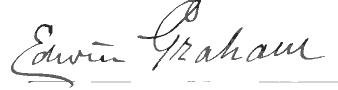
Street, just off York Street in North Belfast. The fact that Edwin senior signed it, as opposed to his son Edwin, is
confirmed from the signature itself, which matches Edwin senior's signature on a letter to the Tank Corps in 1920 (see below).
His son Ernest also
signed the document(PRONI:D1327/3/4339).
BEING CONVINCED in our conscience that Home Rule would be disastrous
to the material well-being of Ulster as well as of the whole of Ireland, subversive to our civil and religious freedom, destructive
of our citizenship, and perilous to the unity of the Empire, we, whose names are under-written, men of Ulster, loyal subjects
of His Gracious Majesty King George V, humbly relying on the God whom our fathers in days of stress and trial confidently
trusted, do hereby pledge ourselves in solemn Covenant, throughout this our time of threatened calamity, to stand by one another
in defending, for ourselves and our children, our cherished position of equal citizenship in the United Kingdom, and in using
all means which may be found necessary to defeat the present conspiracy to set up a Home Rule Parliament in Ireland. And in
the event of such a Parliament being forced upon us, we further solemnly and mutually pledge ourselves to refuse to recognise
its authority. In sure confidence that God will defend the right, we hereto subscribe our names.
And further, we individually declare that we have not already signed
this Covenant.
|
|
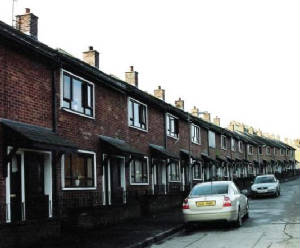
| Mountcollyer Street, Belfast - Feb 2006 |
Also from the same house was a signatory to the women's
equivalent of the Covenant, the Declaration of Loyalty - Matilda Graham. It has taken some time to establish
who this was, but thanks to a tip off from a contributor to Ancestry.co.uk (bobandmarie1971, in New South Wales), it has now
been established that this was in fact Edwin's second wife - though when she signed the Declaration of Loyalty, she was
in fact on the point of marrying Edwin, and was therefore not quite a Graham yet! Just two days after signing the covenant,
Edwin and Matilda Blair, daughter of John Blair and Mary Ann McMichael, married
on September 30th 1912 at Fortwilliam Presbyterian Church in Belfast, within the parish of Shankill. The witnesses to the
wedding were Charles and Sarah Richardson. Edwin was noted as a rivetter and a widower, whilst Matilda was
a spinster. Matilda was baptised in Lismoney, Moneymore, Co. Londonderry on March 13th 1871. William's father was Thomas
Graham, deceased, whilst Matilda's father was John Blair, also deceased (Source: GRONI M/1912/B1/511/7/55).
In the 1913 Belfast street directory, Edwin was again listed
at 70 Mountcollyer Street, with his job description given as a rivetter, and was almost certainly working at Harland and Wolfe
at this point, like his son, and may therefore have worked in the previous years on the Titanic.
On April 26th 1913 Edwin sailed to the United States with
his wife Matilda and 9 year old son Harold, arriving at Ellis Island on May 5th. In the records Edwin was noted as being a
35 year old boilermaker from Belfast, and Matilda as a 30 year old housewife from Ballygowan. Their destination was to Brooklyn,
where they stayed with Edwin's brother-in-law John T. H. Walsh, at 912 40th Street. The
record also noted that Edwin's brother was his nearest relative in the country from 'whence he came', and that John was resident
at Lilliput Street, Belfast (Source: EllisIsland.org). Passage for the three was paid by Edwin's brother-in-law John J. H.
Walsh, based at 912 40th Street in Brooklyn. In the record Edwin is noted as having a fresh complexion with sandy hair
and blue eyes, and as being five feet six inches tall, whilst Matilda had a fresh complexion, fair hair and blue eyes, and
was five feet three inches in height. Harold was also noted as being fair haired and with blue eyes.
Just a few months later in September, Edwin's son Thomas
joined him in New York, where Edwin's address was now noted as 912 40th Street, Brooklyn - the address previously given for
Edwin's brother-in-law John Walsh. It is not known how long Edwin remained in the States, as a return manifest has as yet
to be located, but he was certainly back by late in 1914.
By 1914 Edwin and Matilda
had moved back to Bootle, near Liverpool, England. We know this for the simple tragic fact that Matilda died there of pulmonary
tuberculosis on December 17th 1914. Her body was conveyed by the Liverpool boat back to Belfast where she was then interred
at Belfast City Cemetery (section MI, class 2, number 939). Matilda's burial record, obtained from Belfast City
Council, notes that she had been residing at March Lane in Bootle, and that the grave was owned by the same Charles Richardson
who had witnessed her wedding.
In 1915 Edwin was still living in England, at 7 Grey Street in
Bootle. It was from here that some of his sons went to war, signing up in different regiments. With two infants at least in
the house, Edwin soon remarried for a third time, to a widow and mother of two by the name of Sarah Ann Wilson.
Her previous husband, James McLean Stitt, had died in 1905 aged 29, just a month before
her second child had been born. The couple had married at Saint Patrick's Church of Ireland, Ballymacarrett, Knockbreda,
Belfast, on July 6th 1902 (source: Emerald Ancestors website). At the time of James' death, Sarah-Ann was only 23, and was left to bring up her two young
children by herself for the next 10 years.
Sarah-Ann sailed from Belfast with her two small children aged 10
and 8 to Liverpool to be married to Edwin, and was fortunate to reach him alive. On the night
she sailed from Belfast to Liverpool in 1915, the Lusitania was sunk by German U-boats just off the south coast of Ireland
with a huge loss of life. The Lusitania had also been heading
for Liverpool docks. This dates her voyage to England to approximately May 7th 1915. After
joining the Grahams at 7 Grey Street, Bootle, Sarah Ann and Edwin were
married in West Derby registration district, Lancashire (1915 M Jul-Sep Vol 8B, p886), and shortly after had three children in Bootle. A note found
in Edwin's son's Brian's papers after his death in 2007 noted that Edwin had been living at 24 Irving
Street, Litherland, Liverpool, on 26th July 1916, when daughter Maureen was born, and that Edwin
was listed at that point as a Boilermaker (Journeyman).
On July 2nd 1919, Edwin was again listed as a riveter on his son Ernest's
marriage entry in the Belfast register.
On July 31st, Edwin wrote to the Tank Corps with regards to his son John's
medal entitlement. The following is the letter, in which Edwin mentions that his son was cuirrently at sea, in fact on his
way to the United States:
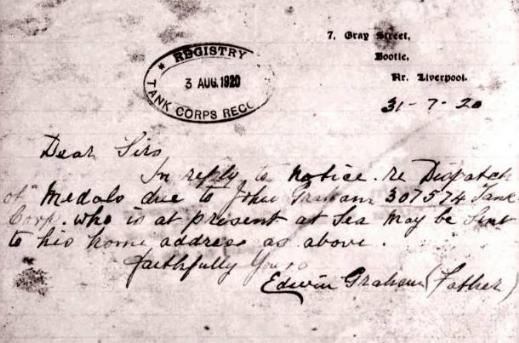
In the 1921 English census, recorded June 19th, Edwin
and his family were found at 7 Grey Street in Bootle. Edwin was aged 59 years and 3 months, married, born in Belfast,
Co. Antrim, was a British citizen, and an unemployed boilermaker who normally worked for Harland and Wolff Shipwrights,
at Regent's Road in Bootle. His wife Sarah was a 39 year old married housekeeper from Belfast, Co. Down.
Also present were four of Edwin's children (three of them with Sarah) - Harry, aged 18, from Belfast, and
an unemployed rivet heater also working for Harland and Wolff, 5 year old Noreen Maureen, born Litherland,
Lancashire, 3 year old Brian, also from Litherland, and 1 year old Desmond, from Litherland.
There are also two step-children to Edwin, both of them children to Sarah from her first marriage - Sarah Stitt,
a 17 year old cinema attendant, who worked for the Stanley Road Bootle Picture Drome Company, and 19 year old James
Stitt, an office boy for Harland and Wolff Shipwrights. Both were unmarried, and originally from Belfast. (Source:
1921 English census RD 455, RSD 5, ED 28, Bootle)
The family later returned
to Belfast in approximately 1923/1924, but at this point they were no longer Irish citizens, but Northern Irish citizens,
the island having been partitioned by the British in mid-1921.
By this stage, Edwin and Sarah were heavily involved with the Belfast Christian Spiritualist Association, a highly
controversial body at the time with its beliefs in the power of mediums to contact the dead. It may well be that Edwin and
Sarah became interested in the discipline whilst living in England. An article from the Northern Whig on Mon 25 JAN
1926 ('Psychic Phenomena', p.11) noted that the association met in a hall on Victoria Street, and was exceptionaly popular,
with four separate meetings on the previous day, each attended by a congregation of between 150-200 people. The article described
how the service was much like any evangelical Christian service, with the exception of apparent psychic 'demonstrations' performed
by its 'test medium' and president John McDermaid, in which he claimed people were speaking to him and passing on messages,
as the congregation sang hymns. The article also noted the following:
The word 'death' is never used by the Spirtualists. Mr McDermaid spoke
of people having 'passed out of the body' and declared his firm conviction that there is no such thing as death.
Just six months later the Association was about to make headlines across the British Isles. The following article from
the Irish Weekly and Ulster Examiner on Saturday July 31st 1926 records a remarkable occurrence involving Edwin:
Saturday, July 31st 1926
CITY CEMETERY SCENE
Cameras Used to "Take" Spirits of Deceased Persons
A weird scene was witnessed in the Belfast City Cemetery on Monday
when a number of members of an organisation called the Belfast Christian Spiritualists Association assembled for the purpose
of conducting a service at the graveside of a woman, who, it was stated, had been a member of that body. Though said to be
an evangelistic service the occasion was availed of by several of those present to demonstrate the idea propounded by
that peculair cult that the spirits of the dead can be photographed, and, consequently, several of those present came armed
with cameras. The service was conducted by Mr. John McDermott, and the grave was that of his mother, who had died a couple
of weeks ago. Over a hundred persons were present, and hymns were sung and prayers recited. In the middle of the service there
was a tense pause when the possessors of cameras carefully directed the lenses towards the grave and snapped the shutters.
An address having been delivered, the party dispersed. The secretary of the organisation, Mr. Edwin Graham, stated afterwards
that it was intended to develop the negatives in a day or two.
The story was also covered by Irish Times three days earlier:
Wednesday, July 28th 1926
PHOTOGRAPHING SPIRITS
Remarkable
Service in Belfast Cemetery
Our Belfast correspondent states that unusual scenes were witnessed at
a Service held yesterday at the City Cemetery under the auspices of the local Christian Spiritualists' Association. The Service
took place around the grave of Mrs McDermott, mother of Mr John McDermott, medium of the Association, who died about three
weeks ago. Upwards of a hundred spiritualists, some of them carrying cameras, wre present and during the singing photographs
were taken. Mr McDermott conducted the Service, which consisted of prayer, singing and an address.
Mr. Edwin Graham,
secretary of the Association, explained that the Service was purely evangelical, and that many photographs had been taken
with the object of photographing the spirits of departed friends of persons present at the grave. "It is a very hard thing,"
he added "to obtain spirit photographs". He added that when the photographs were developed, in a day or two, they would know
whether they had succeeded in their object. Mr Graham explained that a special Service for Mrs McDermott had been held previously
in the Hall. She was a native of Glasgow but had been in Belfast for the past year.
The story was not just confined to Ireland! In the Manchester
Guardian, on the 28th July 1926 (p.9), we get a little more detail about the extraordinary meeting:
SPIRIT PHOTOGRAPH IN CEMETERY
(From our Correspondent)
BELFAST, TUESDAY
The Belfast City Cemetery was the scene of a remarkable incident yesterday.
About one hundred members of the local branch of the Christian Spiritualists' Association gathered round the grave of one
of the members who died three weeks ago, and after a short service a dozen of the Spiritualists produced cameras for the purpose,
they said, of taking photographs of the spirits of the people interred in the graves around. While the cameras clicked hymns
were sung.
The story was also covered by the Ballymena Weekly Telegraph
on 31 JUL 1926:
SPIRITUALIST SERVICE AT GRAVESIDE IN BELFAST CEMETERY
PHOTOS OF THE DEPARTED TAKEN DURING THE SINGING
Somewhat unusual scenes were witnessed at Belfast City Cemetery on Monday afternoon at a service under
the auspices of the Belfast Christian Spiritualists' Association.
The service was held around the grave of Mrs McDermott, mother of Mr John McDermott, medium of the association,
who died about three weeks ago.
Upwards of a hundred spiritualists were present. Some of them had cameras, and during the singing photographs
were taken, as an official stated, of the spirits of the departed of those around the grave.
The service was conducted by Mr. McDermott, and consisted of prayers, singing, and an address.
In the course of an interview with a "Telegraph" representative, Mr. Edwin Graham, secretary of the association,
said the service was purely evangelical.
"Numerous photographs were taken" he said, "and it may prove unusual, however, if we obtain what we expect,
viz. photographs of the spirits of the departed friends of those about the grave, or some of them."
"It is a very hard thing to obtain spirit photographs," he added. "We have not yet developed them, but
we shall do so in a day or two, and we shall then see how successful we have been."
Mr. Graham also stated that a special service had previously been held in the hall for Mrs. McDermott,
who was a native of Glasgow, but had been in Belfast for the past year.
The Northern Whig newspaper followed up the story on 18
AUG 1926:
"SPIRIT PHOTOGRAPHY"
CLAIM TO HAVING PHOTOGRAPHED THE DEAD
Strange Belfast Experiment
"I am perfectly satisfied that we have succeeded in taking photographs
of those who have passed out of the body or who are what is commonly called dead."
This remarkable statement was made to a Northern Whig reporter
yesterday by Mr John McDermaid, president of Ulster Christian Spirtualist Association.
The photographs on which the astonishing claim is based were taken
recently by Mr Hugh Robinson as part of his investigation of Spiritualism in the Association's Hall, 63, Victoria Street,
Belfast, and by the side of the grave of Mr McDermaid's mother in the City Cemetery.
Two of the prints were offered to the Northern Whig for publication,
but were not suitable for reproduction. On the one of the graveside scene are three cloud-like effects, and on that showing
the interior of the hall two similar effects.
Referring to the first print Mr McDermaid said:-"I can clearly
identify my mother, and beside her is my little baby sister. There is also a vision of my father, Mr. Frank McDermaid, who
passed out of the body 23 years ago. I can recognise their features with certainty. The other form on the print is a 'spirit
cloud,' which comes as a spirit is beginning to manifest. If the exposure had been made a few moments later it is possible
that the spirit form would have more completely developed and a more distinct impression would have been obtained. The three
forms appear on the sky just above the heads of the people standing by the grave, and there must have been something there
or nothing would have appeared on the photograph."
Mr. Edwin Graham, secretary of the Association, referring to the
second print, declared:-"I am able to identify my brother, Thomas Graham, who passed out of the body 44 years ago. I recognise
the hair, eyes and beard, and I have no doubt it is him."
Mr. McDermaid added that the taking of the photographs was simply
an experiment, and he was much gratified that it had been successful. He regarded the results as furnishing additional proof
of Spiritualism, and stated that he is prepared to allow any genuine investigator to see the photographs of (sic)
make prints from the negatives.
(The Irish Times also followed up the story on August
18th with a shorter, but similar, piece). In August 1926, John McDermaid or McDermott was later
prosecuted in Belfast for fraud. The following is to be found at the Glenravel Family History Project website's Belfast
Timeline section:
John McDiarmad, of Ava Street, who is president of the Belfast Christian Spiritualist Association was
charged that he “did pretend to tell fortunes to deceive and impose on his Majesty’s subjects.” He was put
under bail of £10 for his future good behaviour.
Spiritualism in Northern Ireland started amid the furore of religious and
political activity surrounding the covenant of 1912. Although war was brewing in Europe, a few people in Belfast were quietly
but earnestly seeking another very important aspect of human expression much frowned upon, especially in the intense
atmosphere that prevailed in a country of such deep religious feelings.
In the area of the Custom House steps, renowned for many years as the Speakers
Corner of Belfast, various people gathered to discuss almost every subject under the sun, those few initial pioneers of the
Spiritualist movement - Mr Morrison, Mr Moore, Mr McCormick and Mr Skelton got together to discuss the many aspects surrounding
psychic matters.
They eventually rented a room in Victoria Street to study, practice and
investigate psychic phenomena, thus the Spiritualist movement was born in Belfast and Ireland.
Their little gatherings continued to grow as they merged with similar groups
to become known as the Belfast Spiritualist Alliance, holding regular Sunday meetings aswell as mid-week activities
in a top floor room at 39 High Street.
As interest in Spiritualism spread, they moved first to Chichester Street
and then to Central Hall in Rosemary Street where the group flourished until the property was bombed in the Easter Monday
air raid in 1941.
The Alliance then accepted an invitation from a group meeting at 45 May
Street which was functioning well under the leadership of a truly excellent Medium of high spiritual character, Sarah
Graham.
There are several further references to the Grahams involvement with the
Spiritualist movement in the Belfast Telegraph. On 7 MAR 1931, Sarah was advertising as a clairvoyant:
Belfast Christian Spiritualist Mission, 5 Rosemary St.-Services To-morrow:
11.30, 3.30, 7. Mrs Graham, Clairvoyante, Trance Address at 7. Silver Collection. Doors closed when half full.
And another from 10 OCT 1931:
Belfast Christian Spiritualist Mission, 63 Victoria St.-Sunday:
11.30, 3.30, and 7.0; Monday, 3.15; Wednesday, 8. Clairvoyance and Address at each service. Mrs GRAHAM, Clairvoyante.
On 15 OCT 1932, Edwin wrote a letter as part of an ongoing debate about the validity of spirit
photography, in which he revealed his brother Thomas had again allegedly reappeared from beyond the grave in another photograph
taken six years earlier:
VIEWPOINT OF READERS
SPIRIT PHOTOGRAPHY.
REMARKABLE EXPERIENCES.
LIKENESS OF LONG DEAD BROTHER.
Sir, Six years ago a floral service was held at our mission hall,
63 Victoria Street, Belfast, the platform of which was so tastefully decorated that three of our members volunteered
to photograph it from different angles of the hall after the service. The results from two were fairly good, but the third
(a 1/4 plate camera), to my astonishment, contained a very good likeness of my brother who "died" in 1882. Might I inform
"Old Photographer" there was no "double exposures" or other fake methods used, as we merely tried to get the display of the
beautiful decorations. Will "Old Photographer" please explain this occurrence, as there is no photo or painting of my brother
in our possession. I would like to advise "Old Photographer" not to be so ready to rush into print regarding matters he knows
nothing about, but try and investigate this wonderful mystery.
Yours etc.,
EDWIN GRAHAM, Belfast Christian Spiritualist Association.
The debate continued, with a letter from 'Old Photographer' published on 22 OCT 1932. Towards
the end of the letter, he responded to Edwin directly:
As to Mr Edwin Graham, I must ask him if his negatives are genuine,
to do the same, and bring them in on loan to you for examination. The great weakness of spiritualists - like some politicians
- is the faculty of believing what they want to believe, and resemblance of spirit photographs of relatives gone into the
spirit land are often claimed on little foundation, if I may believe mutual friends who could see no such resemblance. Now
he charges me with rushing into print. Did he wish me to abstain from exposing a clumsy fake? If so, I do not envy him his
mentality. I have an open mind on the subject and am quite prepared to admit there may be spirit photographs when I have clear
definite proof that such are genuine; but mere emanations do not convince me. Electricians, I have no doubt, might explain
much there.
Edwin eventually died at 39 Upper Frank Street, Belfast, on January
31st 1943, aged 80 years of age, and noted as a boilermaker. The cause of death was myocarditis. His widow, Sarah,
was the informant on 1 FEB, and was also noted as resident at 39 Upper Frank Street (Source: GRONI D/1943/57/1007/80/244 Belfast
Urban 11).
Edwin was buried in the City Cemetery on February 2nd at plot F2 (Class
4), number 145. The plot was previously bought by Sarah Ann for her first husband's James Stitt's funeral
on June 23rd 1905, and is shared also by her niece May Greer who died at the age of just 17 hours. The cause
of Edwin's death was again noted as myocarditis senility, and he was again noted as a bolilermaker resident at 39 Upper
Frank Street. The cost of his burial was 15 shillings (Source: Belfast City Council burials database).
Sarah Ann survived in the city until her own death on November 1st
1967, aged 85, and was also later buried in the same plot on the 4th. At the time of her death she was resident at 23 Wynchurch
Road, Belfast.
CHILDREN of EDWIN GRAHAM and FLORENCE HALLIDAY:
William Alexander Graham
b: 21/3/1882 d: 1/12/1883
William was born at 3 Florence Street,
Barrow-in-Furness, England, on 21 MAR 1882. His father was noted as a ship rivetter, and his mother as Florence Graham, m.s.
Holliday. She was the informant to the registrar on 17 APR 1882 (GROEW 1882 Q2 B Barrow, Vol 8e, p.855).
William died just over a year and half
later on 1 DEC 1883 at 54 Merkland Street, Partick, Renfrewshire, Scotland, the cause being tubercular meningitis. His father
Edwin was noted as a rivetter, and his mother as Florence Halliday. (SP/NRS D 1883 646/3 785 Partick).
Edwin Graham
b: 12/2/1884 d: 19??
Edwin was born at 11.50am on February 12th 1884 at 54 Merkland Street, Partick, Renfrewshire, Scotland.
His father was noted as a rivetter, married to Florence Halliday at Barrow-in-Furness on June 27th 1881. Florence registered
the birth on February 25th, at Partick (GROS B 1884 646/03 252).
In the 1901 Irish census, Edwin was noted with his family at Upper Canning
Street, Belfast, as a 17 year old steam vessel rivetter. He was unmarried, Church of Ireland and able to read and write. His
birthplace was noted as Glasgow (Source: National Archives of Ireland 1901 census).
In the 1911 census for Belfast, Edwin is again noted with his family
as a 27 year old brass moulder living at 67 Duncairn Gardens, a member of the Church of Ireland, and able to read and write.
His birthplace was recorded as Scotland, and his occupation as a rivetter (Source: National Archives of Ireland 1911 census).
On 16 JUL 1911, 27 year old Edwin married 23 year old Catherine Hamilton, daughter
of Abraham Hamilton, a tailor. Edwin was a rivetter, and son of Edwin Graham, boilermaker, and lived at 56
Gainsborough Drive, Belfast, whilst Catherine resided at 26 New Dock Street in the city. The marriage took place at the Mariners
Church of Ireland, was performed by Hedley Brownrigg after license, and the witnesses were Samuel Boyles
and Mary Jane Boyles (Source: GRONI M/1911/B1/413/7/144 Belfast).
On 20 MAR 1912 Edwin joined Belfast No. 3 branch of the United Society of Boilermakers and Iron Shipbuilders
(Source: MSS.192/BM/2/2/6, Modern Records Centre, FMP). The same record shows that he renewed his membership on 21 APR 1927.
Edwin was involved in an incident in October 1912, just a few days after the signing of the Ulster
Covenant against Home Rule, when Belfast's population was divided against the notion of Home Rule. The Belfast Newsletter
has the story from 26 OCT 1912:
SERIOUS ACCIDENT IN A PUBLIC HOUSE
Young Man Shot with Revolver
POLICE COURT PROCEEDINGS
In the Belfast Custody Court yesterday - before Sir Andrew Newton-Brady,
R.M. - a young man named Robert Patterson was charged with wounding another young man named John Hosie on 5th inst.
Mr. Spiller prosecuted, and Mr John Graham defended.
Edwin Graham, 13, Cosgrave Street, said on Saturday 5th inst., he was in
Bennett's public house in York Street, along with Robert Patterson, Matthew Paul, and John Hosie. They were all drinking and
chatting together. The prisoner produced a revolver to show to the others, and they all proceeded to examine it. Witness turned
his head towards the bar for a moment, and, hearing a report, he looked round and saw Patterson with the revolver in his hand,
while Hosie exclaimed, "I am done for, Ned. It can't be helped, chaps. Good-bye, Ned." He then sank on the floor. Witness
took possession of the revolver and handed it to the police. So far as witness could remember, Patterson did not say anything
about the matter. The ambulance was passing as witness and prisoner were taking out the injured man, and he was, therefore,
promptly conveyed to hospital direct. There was no quarrel or dispute among them, as they were all chums together.
In reply to Mr. Graham, witness said there had not been any bickering amongst them. Witness knew that the prisoner
and Hosie worked together, had been at school together, and had always been friends. The whole four of them had seen a revolver
that morning in a window, and Hosie having bought it, they adjourned to the public house to examine it. When the revolver
went off any one of them might as easily have been shot as Hosie, as the whole affair was a pure accident.
Edward Magee, 19 Franck Street, barman in the premises, said he supplied the four young men with stout that morning,
but did not remember which of them paid for it. He saw a revolver in the prisoner's hand, but at that moment was called to
the other end of the bar, and whn he heard a report, and looking around ssaw that one of them (Hosie) was being held up by
the others. His ompanions took him out to the door, intending to bring him to a doctor's, but as the ambulance was passing
at the time he was taken direct to hospital.
....
According to our distant cousin Renee, Edwin was an enlisted
soldier during the First World War. After the war ended, he came back to Belfast and lived in the York Street and Docks
area.
No death record for Edwin has been found at the GRONI for Northern Ireland.
CHILDREN of EDWIN GRAHAM and CATHERINE HAMILTON:
Edwin John Hartrick Graham
b: 26/6/1912
Edwin was born on 26 JUN 1912 at 13 Cosgrove Street, Belfast, Co. Antrim, Ireland. His mother was
Catherine Hamilton, and his father Edwin was noted as a rivetter, resident at the same address
- he also acted as the informant to the registrar on 18 JUL 1912 (Source: GRONI U/1912/48/1007/113/460 Belfast Urban
2).
Robert Graham
b: 19/11/1885 d: 19??
Robert was born in Fells Terrace, Horwich, Lancashire, England, on 19 NOV
1885. His father was noted as Edwin Graham, rivetter, and his mother as Florence Graham, formerly Halliday. The informant
on 22 NOV 1885 was Mary Jones, occupier of Fells Terrace (Source: GROEW 1885 Q4 Bolton Vol 8c p.439).
In the 1901 Irish census, Robert was noted with his family at Upper Canning
Street, Belfast, as a 15 year old scholar. He was unmarried, Church of Ireland and able to read and write. His birthplace
was noted as Lancashire (England). He was further noted as deaf and dumb. According to his half-brother Brian, it seems that
Robert became deaf and dumb when he was about 6 years old, it is believed from having contracted measles as a child (Source:
RF email, 27 OCT 2006).
In the 1911 census for Belfast, Robert was noted with his family as a 25
year old brass moulder living at 67 Duncairn Gardens, a member of the Church of Ireland, and able to read and write. He was
again noted as being deaf and dumb, and born in England.
On 24 DEC 1917 Robert married Isabella Wilson, daughter
of James Wilson, joiner, a spinster of full age residing at 17 Dock Street. Robert was also of full age,
a brass moulder also resident at 17 Dock Street, and son of Edwin Graham, rivetter. The marriage took place at Clifton Street
United Church of Scotland, after license, and performed by the Rev. John McKay. The witnesses were Patrick McCourt and Amelia
Montgomery (Source: GRONI M/1917/B1/713/3/95 Belfast).
CHILDREN of ROBERT GRAHAM and ISABELLA WILSON:
Mary Wilson Graham
b: 29/11/1920
Mary was born in Belfast on 29 NOV 1920 (GRONI B U/1920/47/1007/55/415 Belfast).
The Belfast Telegraph of 25 AUG 1934 carried a short article on Mary's success with studying the piano:
MISS MARY GRAHAM
Daughter of Mr. and Mrs. R. Graham, 17 Dock Street, who,
at the examination held in June in connection with London College of Music, was successful in gaining an Honours Certificate,
Senior Grade (Pianoforte Playing), this being her third certificate with Honours in succession, also a book prize. This young
pianist is only 13 years of age, and receives her tuition from Miss May Brown L.L.C.M, 4 Ratcliffe Street, Donegall Pass,
Belfast.
Mary married 33 year old painting contractor James
Taylor Nimmons, son of James Nimmons, painting contractor, at Carlisle Methodist Memorial Church,
Belfast, on 3 JUN 1943. Mary was aged 23, resident at 28 Elmgrove Street, Belfast, and the daughter of Robert
Graham, deceased. The witnesses were Harold Mahood and Norah W. Graham.
Nora W. Graham
b: 21/8/1925
Nora was born in Belfast on 21 AUG 1925 (GRONI B U/1925/47/1007/59/431 Belfast)
John Graham
b: 19/9/1887 d: 19??
John, or Jack, as he was better known, was born at 98 Cosgrave Street, in Belfast, Ireland, on
September 19th 1887 and christened on October 2nd 1887. His father, who acted as the informant to the registrar on 8
October 1887, was noted as a rivetter (GRONI B 1887 Belfast Urban 2, Roots Ireland).
In the 1901 Irish census, John was noted with his family at Upper
Canning Street, Belfast, as a 13 year old scholar. He was unmarried, Church of Ireland and able to read and write.
On 19 MAY 1909 and 3 JUN 1909 John placed adverts in the Belfast Telegraph, seeking workers for his decorating business:
PAINTERS.-Wanted, a good Brush Hand; also a good Paperhanger. Apply
at once to John Graham, 67 Duncairn Gardens. 17-3-2241.
and
PAINTERS. - Wanted two good Apprentices, 3 or 4 years served; also good
Paperhanger. Apply at once to John Graham, 67 Duncairn Gardens. 1-3-62.
In the 1911 census for the city, John was noted as an unmarried 23 year old painter,
a member of the Church of Ireland, and able to read and write.
John was an enlisted soldier during the First World War, having joined the Army Service
Corps in Liverpool at the Old Haymarket on September 8th 1914. The Long, Long Trail website describes the Corps as follows:
The unsung heroes of the British army in the Great War -
the ASC, "Ally Sloper's Cavalry" - were the men who operated the transport. Soldiers can not fight without food, equipment
and ammunition. In the Great War, the vast majority of this tonnage, supplying a vast army on many fronts, was supplied from
England. Using horsed and motor vehicles, railways and waterways, the ASC performed prodigious feats of logistics and were
one of the great strengths of organisation by which the war was won.
In his attestation papers, John's age was listed as 26 years and 356 days, placing his
birth at 16 SEP 1887, and in Belfast. His occupation was noted as a painter and decorator, he was unmarried, had never
been an apprentice, had never been sentenced to prison, was Church of England by religion, and had never before been in the
armed forces. When enlisting, John took the following oath:
I, John Graham, swear by Almighty God, that I will be faithful
and bear true Allegiance to His Majesty King George the Fifth, His Heirs, and Successors, and that I will, as in duty bound,
honestly and faithfully defend His Majesty, His Heirs, and Successors, in Person, Crown, and Dignity against all enemies,
and will observe and obey all orders of His Majesty, His Heirs and Successors, and of the Generals and Officers set over me.
So help me God.
His medical examination papers show that John was five feet
three and a half inches tall, had a 33 inch chest, and vaccination marks on both his left and right arms (having been vaccinated
as an infant). His physical development was noted as fair. On a separate document, he was noted as having fresh complexion,
blue eyes, and brown hair. His next of kin was his fater Edwin, mistakenly listed as Edward, and resident at 56 Dryden Street,
Bootle, Liverpool.
His service papers show
that John joined the 2nd New Army, as part of the Army Service Corp's 106 Company, part of the 9th Divisional Train attached
to the 9th (Scottish) Division, on September 9th 1914, and on May 8th 1915 he was promoted to Lance Corporal.
On May 10th 1915, John embraked on the S.S. Maidon
from Southampton, arriving at Havre in France the following day, and from there to his first theatre of war, where
he worked as an office clerk. On July 22nd he joined 104 Company of the 9th (Scottish) Divisional Train. This division
was involved in some of the most notorious battles of the entire war, including the Battle of Loos (1915), the Somme Battles
of Albert, Delville Wood and Le Transloy (1916), the Arras Battles of Scarpe (1st and 2nd) and Passchendale (1917). It
is not yet known if or how much John was involved at or near the front, through on October 27th 1915, he got into a spot of
bother "in the field" for "having lost his way making own attempt to front", for which he was severely
reprimanded.
From January 12th to 20th 1916, John was on leave, and again
from August 3rd to 15th in 1917, where he was still noted as part of 3 Company, 9th Divisional Train. On November 6th
1917, John was injured when a horse kicked him in the knee, sending him to hospital until the 24th, at which point he rejoined
his company.
The records are feint, and at some stage after this he voluntarily
asked to be reverted back to the rank of private. He was compulsorily transferred to the Tank Corps on January 7th 1918 and
on the 30th was noted as posted at the Depot. On February 23rd 1918 he was posted as a gunner to "Tanks No. 5 Ad. W.
R. Coy". On March 21st 1918 John was vaccinated, though the document is too faint to see against what! He was sent back to
Britain shortly after, sailing to Southampton on board S.S. Huntscraft on June 27th 1918, his total overseas service
in France having been 2 years and 242 days. A character reference on his file from this time states that he was of good
sobriety, reliable, intelligent, and a good clerk - "Pte Graham was a very reliable man and extremely trustworthy"
was the comment from Captain Walter, the officer in charge of the 9th Divisional Train. However, on July 2nd 1918, John
was deprived 8 days pay for having overstayed a leave of absence, as noted by the Captain of the Reserve Unit Tank Corps.
John was moved to "Tank 7d Btn" on November 16th 1918. On
November 20th 1918, John was again promoted to the rank of Lance Corporal, but from January 4th to 20th 1919, he was hospitalised
with the flu. On January 21st 1919 he was back at a Depot.
On March 29th 1919, John was demobilised and transferred
to Class Z, Army Reserve. His home address was recorded as 7 Gray Street, Bootle, Liverpool, but a note on his service record shows a
later address as 119 South Homan Avenue, Chicago, Illinois, USA, the first clue that showed John emigrating after the war.
Upon demobilising, John signed a form stating that he did not wish to make any claim regarding any disability that may have
been incurred during war service.
On May 7th 1920, John arrived at Ellis Island, New York.
He sailed on board the S. S. Celtic from Liverpool, and on the manifest was listed as a 32 year old unmarried painter who
could read and write in English. He was a British citizen, though Irish (born in Belfast), and was last noted as having resided
in Liverpool. The next of kin was noted as his father, Mr. E. Graham, 7 Gray Street, Bootle, Liverpool, England, and his intended
destination was 112 Sacramento Boulevard, Chicago, Illinois, the home of his brother Thomas. He paid for the ticket himself,
was carrying a sum of at least $50, and was intending to remain in the United States and to naturalise. He was not a polygamist
or an anarchist, and had no intentions of overthrowing the United States Government! He was in good health with
no disability, was five foot, six and a half inches tall, of fresh complexion, fair hair and blue eyes, and with no identifying
marks.
In August 1921, John obtained three medals for his military service, being the 1915
Star, the British War Medal and the Victory Medal.
Alexander William Graham
b: 7/9/1889 d: 12/11/1949
Alexander was more colloquially known as 'William' thoughout his life.
He was born on September 7th 1889 in Belfast, at 12 Garden Street (Belfast Urban No.2), with his father noted
as Edwin Graham, rivetter, and his mother as Florence Halliday. Florence informed the registrar, signing herself as Florence
Graham. (The fact that he was christened Alexander William would seem to confirm that his mother's father was of the same
name, despite being noted in one record as William Alexander Halliday).
In the 1901 Irish census, Alexander, noted as 'William', was with his family
at Upper Canning Street, Belfast, as an 11 year old scholar. He was unmarried, Church of Ireland and able to read and write.
In the 1911 census for Belfast, Alexander, noted as 'William', was noted as an unmarried 21 year
old boilermaker, a member of the Church of Ireland, and able to read and write.
On 7 NOV 1911, 22 year old Alexander (noted as 'William') married 23 year old Elizabeth
Boyd, daughter of ship carpenter William Boyd. Alexander was a boiler maker residing at 67
Duncairn Gardens, Belfast, whilst Elizabeth lived at 47 Lilliput Street. The wedding took place at St Anne's Parish Church,
and was performed in an Anglican ceremony by the Rev. L'Estrange after banns. The witnesses were John Fyfe and Minnie Boyd
(Source: GRONI M/1911/B1/418/125/128 Belfast).
Alexander worked as a plater/boilermaker at Harland and Wolfe. Prior
to his death in 2007, his brother Brian recalled that William lived at Lilliput Street in Duncairn. The 1943 street directory
for Belfast notes a William Graham residing at 72 Lilliput Street (Source: www.lennonwylie.co.uk).
Alexander died on 12 NOV 1949 at 72 Lilliput Street. He was noted as 'Alexander William Graham',
a 60 year old married boilermaker, who died of coronoary thrombosis and hypertension. The informant to the death was his son
S. Graham, of 113 York Park, Belfast, present at his death (Source: D/1949/48/1007/111/374 Belfast Urban
2). A look at the 1951 street directory for Belfast, on www.lennonwylie.co.uk, records a Samuel Graham at 113 York Place.
Two days after Alexander's death, a short note appeared in the Northern Whig newspaper (Mon
14 NOV 1949):
GRAHAM-The Committee of Sydenham Social Club regert to learn of the death
of Mr. Alexander Graham, brother of their esteemed member, Gerald Graham. The members are requested to attend funeral today.
The 1961 directory for the city later still notes a Mrs Elizabeth
Graham as the principle tenant at the 72 Lilliput Street address.
CHILDREN of WILLIAM GRAHAM and ELIZABETH BOYD:
William Graham
b: 7/1/1912
William was born on 7 JAN 1912 in Belfast (GRONI B U/1912/48/1007/112/227 Belfast). It is believed
that in later years he lived in the Braniel Estate in Castlereagh, Northern Ireland.
Samuel Graham
b: 1/1/1913
Samuel was born on 1 JUL 1913 in Belfast (GRONI B U/1913/48/1007/116/247 Belfast).
Samuel was the informant at his father's death, which he registered on the same date, 12 NOV 1949.
His address was recorded as 113 York Park (see above).
Thomas Graham
b: 30/7/1891 d: 19??
Thomas, or Tom, as he was better known, was born on 30 JUL 1891 at
44 Upper Canning Street, Belfast, Co. Antrim, Ireland. His father was noted as a rivetter and his mother Florence was
the informant to the registrar on 13 AUG 1891 (Source: GRONI U/1891/48/1007/50/157 Belfast Urban 2). Thomas was baptised on
Belfast on August 13th 1891, and was resident at 44 Upper Canning Street, Belfast, Co. Antrim, Ireland. His mother was the
informant to registrar J. Johnston (Roots Ireland).
In the 1901 Irish census, Thomas was noted with his family at Upper
Canning Street, Belfast, as a 9 year old scholar. He was unmarried, Church of Ireland and able to read and write.
In the 1911 census for Belfast, Thomas was noted as an unmarried 19 year old grocer, a member
of the Church of Ireland, and able to read and write.
On September 5th 1913, Tom arrived at Ellis Island in the United States, having crossed the Atlantic
from Liverpool on board the S.S. Adriatic. He was a 22 year old unmarried grocer, could read and write, was born in Belfast,
and for his nearest of kin in his home country, he listed his brother Edward Graham, residing at 190 Nelson Street, Belfast.
Tom's destination was Brooklyn, where he was going to stay with his father Edwin, who was residing at 912-40 Street in the
New York district. Tom had $24 to his name and it was his first trip to the USA. He was not a polygamist or anarchist,
and was not up for overthrowing the government. He was in good health, was not disabled, was five feet three inches tall,
had a fresh complexion, auburn hair and blue eyes, and had no distinguishing marks.
During the First World War, Tom was subject to the US military draft on 5 JUN 1917.
The surviving draft card records his address as 2414 Warwick Avenue, Chicago, Illinois, and his birth was confirmed as having
happened on 30 JUL 1891 in Belfast, Ireland. His occupation was a checker for the Border Milk Co. at Monroe and Rockwell.
He was of caucasian appearance, had red hair, and blue eyes, and was of medium height and build - he had no disabilities. Tom
had declared his intention to naturalise, and stated his nationality was now of the US, and he had no dependants requiring
support. His marital status was noted as single (Source: Ancestry US World War 1 Draft Registration cards 1917-1918, record
IL-1493580-4779, accessed 18 APR 2014)..
On May 7th 1920, Thomas was later noted as residing at 112 Sacramento Boulevard, Chicago, on the Ellis
Island immigration record of his brother John. In the 1920 US Federal Census for Illinois, Thomas is decribed
at the same address as being 28, alien (not naturalised), and born in Ireland, with his parents noted as having been
born in Ireland and Spain. His occupation was noted as a foreman in a papery (?) company. Thomas was married to Alice,
who was 25 and born in Illinois, with both parents listed as being French. Also present was Donald,
their son, aged 3 years and eleven months, and born in Illinois.
In 1930, the family are again found in Chicago, with Thomas mistakenly listed as a 36 year old man
born in New York. His 33 year old wife Alice is noted again as born in Illinois, but her father is this time German, and her
mother French. Thomas is now a salesman in laundry. Their son Donald was listed as 12 years old and born in Illinois.
In the 1940 US census, recorded on April 1st, we learn that although Tom and Alice were in Chicago
on April 1st 1935, they had now relocated to 4530 No. 27 Street, Milwaukee in Wisconsin, a rented property. 45 year old Tom
again noted his birthplace as New York, with 43 year old Alice again from Illinois. Tom was now a laundry manager, which he
had worked at for 52 weeks and had been paid $3120 (Source: Ancestry.co.uk).
CHILD of THOMAS GRAHAM and ALICE:
Donald Graham
b: abt Feb 1916
In the 1920 US Federal census Donald was noted as aged 3 years and 11 months, and as having been born
in Illinois, USA (likely in Chicago). The census was recorded over a month from Jan 5th 1920, so it is presumed that Donald
was born in about Feb 1916.
Albert Graham
b: 20/5/1893 d: 7/2/1894
Albert was the first of two twins to be born to Edwin and Florence, at 7am on 20 MAY 1893 at 44 Upper
Canning Street, Belfast, Co. Antrim, Ireland. His father was noted as a rivetter, and their mother was the informant. Ernest
was born at 7.30am (Source: GRONI U/1893/48/1007/55/330 Belfast Urban 2).
Albert tragically died in infancy on 7 FEB 1894 at the age of just 8 months, at 44 Upper Canning Street,
the cause being bronchitis, as suffered for a month and 7 days. His father informed the registrar on the following day
(GRONI D 1894 Belfast Urban No.2, 210). Albert was buried on 8 FEB 1894 at Belfast City Cemetery in lair B
512 (Source: Belfast City Council burials database).
Ernest Graham
b: 20/5/1893 d: 23/8/1942
Calum's and Jamie's great great grandfather -
see below.
Florence Graham
b: 19/3/1895 d: 3/1/1905
The existence of Florence first came to light from a family grave paper, and from a
surviving headstone.
Florence, more colloquially referred to as Florrie, was born on 19 MAR 1895 at 35
Upper Canning Street, Belfast, Co. Antrim, Ireland. Her father Edwin was noted as a rivetter, and the informant to the registrar
on the 28th was a Maggie Davidson, present at the birth, who lived at 31 Upper Canning Street (Source: GRONI U/1895/48/1007/61/170
Belfast Urban 2). Florrie was baptised on March 28th 1895 (Source: UHF births/baptisms).
In the 1901 Irish census, Florence
was noted with her family at Upper Canning Street, Belfast, as a 6 year old scholar. She was Church of Ireland and able to
read and write (Source: National Archives of Ireland, 1901 Census).
Florence died tragically at the age of ten on January 3rd 1905 from enteric fever, which
she had suffered for two months. She was buried in the Graham family plot at Belfast City Cemetery on January 4th, and was
joined in the same plot (lair B513) in 1911 by her mother. At the time of Florrie's death she was resident at 35 Upper Canning
Street.
The inscription on the stone reads:
FLORENCE
The Beloved Wife of
EDWIN GRAHAM
Died 18th Sept 1911
Also FLORRIE their daughter
Died 3rd Jan 1905
Gerald Graham
b: 11/3/1897 d: 28/11/1965
Gerald was born on March 11th 1897 in 35 Upper Canning Street, Belfast,
County Antrim, Ireland and baptised on April 22nd 1897. His father was noted as a rivetter, and his mother was the informant
to the registrar on 22 April 1897 (GRONI B 1897 Belfast Urban No.2)
In the 1901 Irish census, Gerald was noted with his family at Upper
Canning Street, Belfast, as a 4 year old scholar. He was Church of Ireland and able to read and write.
In the 1911 census for Belfast, Gerald was noted as a 15 year old messenger, a member of the
Church of Ireland, and able to read and write.
On April 10th 1919 Gerald joined the Royal Navy, spending an initial period
of training at HMS base Vivid II at Devonport, before taking his first assignment as a rating on board HMS Blenheim. On June
9th 1920 he was promoted to the role of stoker on board HMS Iron Duke.
Gerald married 24 year old Mary Elizabeth Yardley
at the parish church of St Leonards in Bootle, Lancashire, on 16 MAR 1921. At the time of the event Gerald was a 24 year old
stoker in the Royal Navy, resident at 7 Gray Street, Bootle, with his father listed as Edwin Graham, riveter. Mary was the
daughter of George Yardley, digger, and resident at 3 Wordsworth Street. The witnesses were George
Yardley and Gertrude Yardley (Source: FreeBMD.org.uk GRO M 1921 Q1 Vol. 8b p.337 W.
Derby).
The National Archives in England hold a service card for the first twelve
years of his service, and provide a wealth of information on Gerald's early naval career. He was described as being five foot
five inches in height, with a 35 inch chest, blonde hair and blue eyes, with a scar on his forehead above his nose, and faint
tattoo marks on his hands and arms.
A list of ships on which Gerald served is then listed:
|
|
| Gerald's first ship, HMS Blenheim |
HMS Vivid II base, Devonport - Apr 10th 1919 to May 28th 1919
HMS Egmont - May 29th 1919 to Jan 14th 1920
HMS Iron Duke - Jan 15th 1920 to Mar 8th 1921 (becoming a stoker on June 9th 1920)
HMS Vivid II base, Devonport - Mar 9th 1921 to Aug 14th 1921
HMS Blenheim (Torch) - Aug 15th 1921 to Sept 11th 1921
HMS Diligence - Sept 12th 1921 to Aug 31st 1922
HMS Egmont - Sept 1st 1922 to May 31st 1923
HMS Diligence - June 1st 1923 to June 30th 1923
HMS Egmont - July 1st 1923 to August 12th 1923
HMS Woolwich - Aug 23rd 1923 to Aug 29th 1923
HMS Vivid II base, Devonport - Aug 30th 1923 to Oct 23rd 1923
HMS Glorious (Dartmouth) - Oct 23rd 1923 to Jan 31st 1924
HMS Dartmouth - Feb 1st 1924 to May 27th 1924
HMS Thunderer - May 28th 1924 to Sept 26th 1924
HMS Vivid II base, Devonport - Sept 27th 1924 to Jan 5th 1925
HMS Carysfort - Jan 6th 1925 to Sept 7th 1925
HMS Cornus - Sept 5th 1925 to Jan 5th 1927
HMS Vivid II base, Devonport - Jan 6th 1927 to at least Jan 1st 1929 (when his record was transferred)
There are also listed annual appraisals for his character and ability, recorded on December 31st
of each year between 1919 and 1928. Every one of them records that he had very good character, and his ability from 1921 to
1925 was recorded as 'superior', with 'satisfactory' noted for the other years. He was also paid a war gratuity whilst on
board one of his two tours on HMS Egmont.
Gerald's brother Brian
recalled meeting him when his ship HMS Malaya docked in Bangor Bay in 1936. He continued to work as a stoker
right through the Second World War, until the point when, according to family tradition, he was captured
at Zeebrugge by the Germans, after which spent the rest of the war as a prisoner of war.
Gerald and Mary lived in the Sydenham area of Belfast. After the
birth of her fourth child, Terence, Gerald remarried to Mary's sister, Gertrude Yardley, between Oct-Dec
1938, in Crosby, Lancashire, England (Source: FreeBMD, M, Q3. 1938 Vol. 8b p.1202 Crosby). According to Gerald's granddaughter
Beverley, a third sister Sally (Nell) looked after the younger children in Liverpool, until Gerald took them
over to Belfast during the wartime evacuation. They returned to Liverpool after the war.
In the Navy, Gerald was a proficient rower, and Beverly has a silver trophy
that was presented to him with the inscription "HMS Malaya, 1931, Rodman Cup, G. Graham". A phootgraph held by Bereley also
shows Gerald to be a member of the Orange Order, although his specific lodge is not identified.
Two days after the death of Gerald's brother Alexander in 1949, a short note appeared
in the Northern Whig newspaper (Mon 14 NOV 1949):
GRAHAM-The Committee of Sydenham Social Club regert to learn of the death
of Mr. Alexander Graham, brother of their esteemed member, Gerald Graham. The members are requested to attend funeral today.
Gerald died on 28 NOV 1965 at Musgrave Park Hospital, with his death certificate noting him as a 68
year old widower and boilerman at a training school. His address was 151 Park Avenue, and the cause of death was terminal
broncho-pneumonia and carcinoma of the lung. His son G. Graham, of 30A Kirkstone Road, Liverpool North, L1,
was the informant to the registrar, and was present at his death (Source: GRONI D/1965/45/1007/14/10 Belfast Rural 3).
Gerald Graham, boilerman, is also noted in the PRONI wills database as having died on 28 NOV
1965, with a grant of probate made on 15 DEC 1965 to a Gerald Graham, clerk. Again, his address was 151 Park
Avenue, Sydenham, and he died at Musgrave Park Hospital, Belfast. He left estate to the value of £929 8s (Source: PRONI Will
calendars 1858-1965 database).
Children of Gerald GRAHAM and Mary YARDLEY:
Gerald Graham
b: June 1922 d: aft 28/11/1965
Gerald was born in West Derby, Lancashire, England, in June 1922.
Gerald was the informant to the Belfast registrar for his father's death in 1965, and executor to
his estate.
Gerald had a son Colin who sadly passed away in his early
forties.
Florence Myrtle Graham
b: 1927 d: ????
Florence was born in West Derby, Lancashire, England, in 1922.
Known more colloquially as 'Myrtle', she had three children.
Audrey Graham
b: XXXX
Terence Graham
b: 18/1/1932 d: 31 May 2001
Terence was born in West Derby, Lancashire, England, on 18 JAN 1932. He married twice, and had three
children.
Unnamed Graham
b: 24/3/1899 d: 24/3/1899
This unnamed child was stillborn and was buried in the Graham plot at City Cemetery, lair B512 on
March 24th (Source: Belfast City Cemetery).
Harold Graham
b: 5/3/1900 d: 10/3/1900
Harold unfortunately did not survive for very long. He was born on 5 MAR 1900 at 35 Upper Canning
Street, with his father registering the birth on 19 MAR (GRONI B 1900 Belfast No.2).
Harold died aged just ten days later on 15 MAR 1900, after suffering convulsions 3 hours and
syncope, His father Edwin, present at the death, registered the event on 19 MAR, shortly after recording his son's birth (GRONI
D 1900 Belfast Urban No. 2). Harold was buried two days later in the Graham family plot at the City Cemetery, in lair B 513
(Source: Belfast City Council burials website).
Frederick Davison Graham
b: 6/7/1901 d: 21/3/1902
Frederick was born on July 6th 1901 at 35 Upper Canning Street, belfast (Urban No.2)
and later baptised on July 29th. His father was noted as Edwin Graham, rivetter, and his mother as Florence Halliday, though
Florence appears to have witnessed the registration, signing herself as Florence Graham.
Frederick tragically did not survive long, dying at 35 Upper Canning Street at the age
of eight months on March 21st 1902 at 35 Upper Canning Street, Belfast. The cause was acute bronchitis, as suffered for
nine days. Frederick was noted as 'a child of Edwin Graham, a rivetter'. The informant was his mother Florence on the
following day.
Frederick was buried in Belfast City Cemetery on March 24th 1902, in lair B 513, as
noted on a lair paper held by Renee Fisher, his niece, and on the Belfast City Council cemetery database
website.
Harold Graham
b: 3/10/1903 d: 28/11/1964
This second son called Harold was born on 3 OCT 1895 at 35
Upper Canning Street, Belfast (GRONI B U/1903/48/1007/89/457 Belfast), and baptised on 24 OCT 1903. His mother was the informant
to the registrar (Roots Ireland).
In the 1911 census for Belfast, Harold was noted as an 8 year old scholar, a member
of the Church of Ireland, and able to read, but not yet write.
In April 1913 Harold accompanied his father Edwin and stepmother Matilda on a voyage across the Atlantic
to New York, to stay with Edwin's brother John in Brooklyn. It is not known how long Harold was in the US, but his parents
were certainly back in Britain by late 1914.
In 1921 Harold was noted as an unmarried 18 year old son of Edwin at his family's
home of 7 Grey Street, Bootle, Lancashire, England. Harold was an unemployed rivet heater, who normally worked for Harland
and Wolff Shipwrights at Regent's Road, Bootle (Source: 1921 English census RD 455, RSD 5, ED 28, Bootle)
Harold was a member of the Royal Scots Fusiliers in about 1925/26. In Jul-Aug 1926 he married Sarah Jane
Boyd (both pictured right) in Portsmouth, England (GRO M 1926 Q3 Vol 2B p.1240 Portsmouth). Sarah, more colloquially
known as Sadie, was born on 22 JAN 1905 at Ballyalbanagh, Ballycor, County Antrim, Ireland.
On 22 OCT 1926 the couple had their first child, Florence Graham, at Portsmouth, Hampshire, England.
From his Scottish death certificate in 1964, it is known
that Harold eventually became an assistant laboratory assistant to the Natural Coal Board, and was again noted as being married
to Sarah Jane Boyd. He was resident in Old Cumnock and died at 64 Bryce Avenue at 0.30am on November 28th
1964. His father was listed as Edwin Graham, boilermaker (deceased), and his mother as Florence Halliday (deceased). No cause
for his death was listed. The informant to the Cumnock registrar on December 3rd was his daughter Florence,
residing at 46 Bodney Road, Newport, Monmouthshire (GROS:1964/610/A/34).
Sadie eventually died on 23 MAY 1978 in Newport, Gwent, Wales. At the time of her death she was resident
at 5 Glanwern Gro, Newport.
(With thanks to Anne Taylor for the image of Harry and Sadie in March 2023.)
CHILDREN of HAROLD GRAHAM and SARAH JANE BOYD:
Florence Graham
b: 22/10/1926
Florence was born on 22 OCT 1926 in Portsmouth (GRO B 1926
Q4 Vol 2B p.638 Portsmouth).
In March 1949, Florence married Harold Denham in Newport, Wales. Harry was born in
Newport in 1926.
Florence was resident at 46 Bodney Road, Newport, Monmouthshire,
Wales in November 1964, at which point she visited Scotland to record her father's death in the Cumnock register.
Florence died on 6 APR 2003 at Newport in Wales. Her husband Harry
eventually passed away on 5 FEB 2007 in Monmouthshire, Wales.
Marion Graham
b: 18/12/1904 d: 31/12/1904
Marion was born at 35 Upper Canning Street, Belfast, on
18 DEC 1904 (GRONI U/1904/48/1007/93/299 Belfast). She was baptised on December 29th 1904 alongside her twin brother
George.
Marion died in infancy at 35 Upper Canning Street on 31 DEC
1904 (GRONI D U/1905/48/1007/61/457 Belfast). Marion was buried at Belfast City Cemetery in an earth burial on 2 JAN 1905
(Source: Belfast City Council burials database).
George Graham
b: 18/12/1904 d: 1/1/1905
George was born at 35 Upper Canning Street, Belfast, on
18 DEC 1904 (GRONI U/1904/48/1007/93/300 Belfast). He was baptised on December 29th 1904 alongside his twin sister Marion.
His father was the informant (Roots Ireland).
George only survived for two weeks, dying at 35 Upper Canning
Street on 1 JAN 1905, just two days before his sister Florence, with his cause of death being noted as 'debility
from birth'. He was buried the following day at the Belfast City Cemetery public burial ground (Source: Belfast City Council
burials database).
CHILDREN of EDWIN GRAHAM and SARAH-ANN
WILSON:
Noreen Maureen Graham
b: 26/7/1916 d: Oct 2009
Noreen was born on 26 JUL 1916, as recorded in notes kept by her brother Brian,
which were discovered by his daughter Renee following his death in 2007. In her birth record her birthplace
was recorded as 24 Irvine Street, Litherland. Her father was noted as Edwin Graham, a boilermaker journeyman,
and her mother as Sarah Ann Graham late Stitt formerly Wilson. Sarah was the informant to the registrar
on 30 AUG 1916.
In the 1921 English census Noreen was noted as a 5 year old daughter at her parents'
home of 7 Grey Street, Bootle, Lancashire, England, having been born in Litherland, Lancashire. (Source: 1921 English census RD
455, RSD 5, ED 28, Bootle)
On 17 JUL 1945, Noreen married John Cavan, a commercial traveller of full
age, resident at 106 Knockbreda Road, Belfast, and son of deceased Joseph Collins Cavan, an engineer. Noreen
was of full age, a shop assistant resident at 39 Upper Frank Street, Belfast, and daughter to Edwin Graham, boilermaker (deceased). The
wedding was at Willowfield Church, in an Anglican ceremony.(Source: GENI/GRONI M/1945/B1/468/12/79 Belfast)
The couple had two children. Noreen lived in Belfast until
she finally passed away in October 2009, aged 93.
Brian Graham
b: 3/8/1918 d: 21/8/2007
|
|
| Brian and his wife Eileen in Belfast on their wedding day in 1939. |
Brian was born at 7 Gray Street in Bootle, Merseyside, England, on 3 AUG 1918. In his
birth record his father was noted as Edwin Graham, boiler maker, and his mother as Sarah Ann Graham,
late Stitt, formerly Wilson. Sarah was the informant to the Bootle registrar on 15 AUG 1918 (GROEW West Derby,
Lancashire, Vol 8b, p.561). Brian was christened at St. Leonard's Church on August 3rd of that year, and then returned
with his family to Belfast in 1923/24 at the age of about 5 or 6.
In the 1921 English census, 3 year old Brian was noted as a 3 year old boy at his
family's home of 7 Grey Street, Bootle, Lancashire, England, and as having been born in Bootle. (Source: 1921 English census RD
455, RSD 5, ED 28, Bootle)
As a youngster, Brian visited Calum's, Jamie's and Pippa's great great grandfather Ernest
Graham and his wife Charlotte at their home in Esmond Street, Belfast, and remembers playing on
the street with Ernest junior, the boys' great grandfather.
Brian grew up to become a draughtsman at Harland and Wolff and joined the
Trade Union movement, becoming an official within it. On 10 JUL 1939 he married Alice Eileen Mary
(1920 - 11/3/2003), the record noting that he was an apprentice draughtsman resident in Belfast. Alice's father was a
collector called John, whilst Brian's father was Edwin Graham, retired boilermaker (GRONI M/1939/B1/497/8/47
Belfast). The witnesses were a Thomas Kelly and a Maureen Martha Annie McIlveen. Brian
and Eileen went on to have three daughters, and a son, who tragically died in infancy.
Brian spent his retirement living in Belfast, and at the age of 70 he completed
a degree at Queens University Belfast. His wife Eileen tragically passed away before him on 11 MAR 2003, and at the time was
noted as being resident at Apartment 105, The Belgravia, Lisburn Road
Brian sadly passed away at home in Belfast, surrounded by his family, on August
21st 2007, and was duly buried two days later in Roselawn Cemetery in lair P 3121, where his wife Eileen had previously
been buried on March 13th 2003. He had been suffering from kidney, bowel and lung cancer, which had only discovered at
the start of the year. His residence at time of death was also Apt 105, The Belgravia, Lisburn Road.
We are forever indebted to Brian for the information that he was able to share with us, without
which the Graham side of our tree would never have been anywhere near as developed.
|
|
| Brian's grave in Roselawn Cemetery |
CHILDREN of BRIAN GRAHAM and EILEEN (UNKNOWN):
i) Brian Graham
b: 6/1/1940 d: 18/4/1940
Brian was the couple's first born, but tragically died in infancy on 18 APR 1940 in Belfast,
Northern Ireland, the cause being gastro-enteritis, of which there was a epidemic at the time. According to Brian's sister
Renee, his death broke his parents' heart.
Brian was buried at lair M1 94 in the City Cemetery. His last place of residence was noted
as the Ulster Hospital and 39 Upper Frank Street, Belfast. (Source: Belfast City Council burials site).
ii) Eileen Graham
iii) Renee Graham
b: 19??
Renee currently resides in Drumbeg, Northern Ireland. She is
married to Harry and has two daughters, and currently works as a CAD/IT manager.
Renee contacted Calum's and Jamie's father in September 2006 and it is from her that much
of the Graham family's earlier years have been worked out, for which we are eternally grateful.
iv) Joan Graham
Desmond Graham
b: 23/7/1920 d: 25/8/1990
Desmond was born on 23 JUL 1920 at 7 Grey Street, Bootle, in England. His father was listed
as Edwin Graham, a boilermaker, and his mother as Sarah Ann Wilson, who also acted as the
informant to the registrar on 26 JUL 1920. (Source: GROEW 1920 Q3 W. Derby Vol 8b p.735).
A year later in 1921, Desmond was noted as a 1 year old boy at his family's home of 7 Grey
Street, Bootle, Lancashire, England, and as having been born in Bootle. (Source: 1921 English census RD 455, RSD
5, ED 28, Bootle)
Desmond grew up to become a chief engineer in the Merchant Navy. After one voyage from Belfast to New York he is noted as having arrived in the States on Feb 10th 1943, a 5th Engineer
who had signed up for a year's service on the 'Empire Jet'. The record notes Desmond was five feet eight and a half inches
in height, and that he weighed 175 pounds (Source: Ancestry.co.uk).
In Belfast on 31 MAR 1953, Desmond married Bertha McMullan, who was born
19 SEP 1921, and who passed away on 14 FEB 1984 at 5 Grand Parade, Belfast, Northern Ireland. Bertha was subsequently buried 2
days later at Roselawn Cemetery in lair S 2788.
Desmond sadly died of lung cancer on 25 AUG 1990 and was buried 3 days later at Roselawn
Cemetery in lair S 2788. His address at time of death was 61 Rosepark, Dundonald, Belfast.
|
|
| Desmond's and Bertha's gravestone at Roselawn |
Unnamed Graham
b: 7/12/1926 d: 7/12/1926
This unnamed daughter was tragically stillborn on December 7th 1926, and buried 2 days later
at Belfast City Cemetery in the Public Ground. The child had been born at Ulster Hospital, Templemore Avenue. An address of
54 Mount Street is given in the burial record on Belfast City Council cemetery website - possibly Edwin's and Sarah's address
at the time.
Ernest Graham
20/5/1893 - 23/8/1942
Ernest was Calum's, Jamie's and Pippa's great
great grandfather.
|
|
| Ernest in the Royal Engineers in the First World War |
Ernest was born at 7.30am on 20 MAY 1893 at 44 Upper Canning Street in Belfast, Co. Antrim, Ireland,
the twin of Albert. His father Edwin was noted in his civil birth record as being a rivetter,
and his mother Florence was the informant to the registrar on 5 JUN 1893 (Source: GRONI U/1893/48/1007/55/331
Belfast Urban 2).
In the 1901 census Ernest was noted as a 7 year old scholar residing with his
parents at 16 Upper Canning Street in Belfast. He could read and write, and was Presbyterian by way of religion. Ten years
later Ernest was noted as a 17 year old painter resident at 34 Duncairn Gardens in the city, again with his family (Source:
National Archives of Ireland 1901 and 1911 censuses).
The next record of Ernest concerns his signature to the Ulster Covenant on Saturday,
September 28th 1912, also known as "Ulster Day" (see above). He signed the document at the North East Unionist Association
Rooms on Brougham Street, in the district of Duncairn. At this time Ernest was recorded as living at 70 Mountcollyer Street,
just off York Street in North Belfast (PRONI:D1327/3/4339).
During
the First World War, Ernest served as a signaller with the Royal Engineers, though his service record has seemingly not survived.
His granddaughter Eileen Gamble contacted me in 2014 with two photographs of Ernest in uniform, which were
initially claimed to be from the Second World War. However, I have had them both dated by military historians Paul Reed and
David McNay, who have confirmed them to be First World War images. The striped armband on his right sleeve in each image
is a signaller's brassard, and the uniform is definitely Royal Engineers.
Following the war,
Ernest married Charlotte Harper Montgomery on July 2nd 1919 at St. Matthew's Church of Ireland in Belfast, a year prior to the partition of Ireland.
At the time of the wedding, Ernest was resident at 7 Grey Street, Bootle (on Merseyside, England), whilst Charlotte lived
at 14 Esmond Street. The officiating minister was the rector, Robert Walker, whilst the witnesses were Hugh Gibson
and Lilian McCracken.
On 11 DEC 1919, just a few months after he married, Ernie entered
as an apprentice freemason to Lodge 421 (Renown), based on the Crumlin Road in Belfast. He became a fellow craftsman on 19
FEB 1920, a master mason on 15 MAR 1920, and received his Grand Lodge of Ireland certificate on 13 MAY 1920. The register
notes that he was a painter, and that he died in 1942 (Source: Grand Lodge of Freemasons of Ireland Membership Registers 1733-1923,
sourced from The Grand Lodge of Freemasons of Ireland, Dublin; accessed via Ancestry.co.uk 20 NOV 2015).
In November 2015 I contacted the Renown Lodge on the Crumlin Road
in Belfast, and was informed that in 1938 Ernest was actually the lodge's Worshipful Master, a position later filled also in
1976 by his son-in-law Stanley Gamble.
On September 5th 1931 Ernest was caught up in a motorcycle accident, as reported two
days later in the Northern Whig newspaper:
Belfast Accidents
... While
Sergeant-Instructor Gilchrist of the "B" Specials attached to Court Street Barracks, Belfast, was on his way to Ballycastle
on Saturday his motor cycle and a motor car came into collision at Kilmakee.
The sergeant and his pillion companion,
Ernest Graham of Esmond Street (Shankill Road to Caledon Street), Belfast, were thrown off the machine. Sergeant Gilchrist
sustained a head injury, but after being attended to by Dr. Loughridge, of Templepatrick, he and his companion were able to
return to their homes.
For most of his life,
Ernest worked as a painter for Harland and Wolfe shipyard in Belfast. Between
1931 (at least) and 1942, he and Charlotte lived at 14 Esmond Street in Belfast, and after Ernest's death,
Charlotte continued living at the same house until her own death in 1974. Whilst living at Esmond Street Ernest was occasionally
visited by his younger brother Brian, who described him as having been quite a responsible man who was very
particular in the way that he dressed.
Ernest's granddaughter Cherie, grandmother of Calum and Jamie, recalled
how her grandfather Ernest and his wife Charlotte were both spiritualists, both being members of the Spiritualist
Church on the Shankill Road. However, this may be a confusion with Ernest's father Edwin, who was certainly
a spiritualist.
Ernest died
on 23 AUG 1942 in the Royal Victoria Hospital in Belfast of acute pulmonary oedema and carcinoma of the lungs, at the early
age of 49. His death was registered at the General Registry Office in Belfast by his son John a day later
(Belfast urban district number 9, book 81). Ernest was buried in the City Cemetery's Glenisla Extension on August 25th, at
lair V1 251. His address at the time of death was 14 Esmond Street.
A memorial notice for Ernest was placed by his widow Charlotte in
the Belfast Telegraph on Wednesday 23 AUG 1944:
GRAHAM - In loving memory of my dear husband,
ERNEST, and our dear father, who died 23rd August, 1942. Always remembered by his loving Wife and Family. - Charlotte Graham,
14 Esmond Street.
And again on 23 August 1945:
GRAHAM - In loving memory of ERNEST, called
Home 23rd August. 1942 - Always remembered by his Wife Charlotte, Sons and Daughters, 14 Esmond Street.
CHILDREN of ERNEST GRAHAM
and CHARLOTTE MONTGOMERY:
John Montgomery Graham
b: 16/4/1920 d: 14/2/1983
John was born on 16 APR 1920 at 14 Esmond Street, Belfast. His father Ernest
was noted in his birth record as a painter, and his mother Charlotte acted as the informant to the Belfast registrar on 6
MAY 1920 (Source: GRONI B 1920 U/1920/56/1007/43/292 RD Belfast Urban 10).
John was known as "Jackie" colloquially, and later worked at Harland and
Wolfe shipyard in Belfast. He married Martha "Meta" Kirker and had two children.
The following was discovered in 2014 about Jackie, thanks to contact with our cousin Eileen. Jackie died around 1980, and his wife Meta passed away after him, with both buried in Roselawn cemetery in Belfast.
The couple had two children, Maureen and Jackie junior - Jackie died in a car accident many
years ago.
A photograph taken at the Belfast based wedding of his sister Irene to Stanley Gamble in the early 1950s includes Jackie standing
at the far right of frame, alongside his mother and brother Ernie.
John died on 14 FEB 1983 in Belfast, and was buried in Roselawn Cemetery, plot V 2186, on 16 FEB 1983
(Source: Belfast City Council burials database). The following notice was placed in the Belfast Telegraph of 15 FEB
1983:
GRAHAM, JOHN MONTGOMERY - February 14, 1983, at Hospital, dearly beloved
husband of Meta and father of Maureen and John, 17 Howe Street, Belfast. Funeral from Houston and Williamson's Private Church,
Landscape Terrace, 117 Crumlin Road, tomorrow (Wednesday), at 11 a.m. (service 10.45 a.m.), to Roselawn Cemetery. House private.
No flowers, please. Donmations, in lieu, if desired, to Erne Hospital Medical Ward, c/o Rev. R. Fox, 558 Crumlin Road, Belfast
BT14. - Deeply regretted.
His wife Meta (born 11 JAN 1920, Belfast) is noted to have died on 6 JAN 1995 at City Hospital,
Belfast. Three notices for her appeared in the Belfast Telegraph on 7 JAN 1995 as follows:
GRAHAM, MARTHA (META) - January 6, 1995 (at the City Hospital). Late of
Howe Street, Belfast, beloved wife of the late John (Jackie) Graham, and mother of Maureen and the late John. House and funeral
private. No flowers. Donations in lieu to Patients Comforts Fund, Ward 2 North, Belfast City Hospital. - Very sadly missed
and deeply regretted by the family circle.
GRAHAM, MARTHA (META) - January 6, 1995. - Very deeply regretted by her
friend Ethel Sinclair and family. Cherished memories of time together.
GRAHAM, MARTHA (META) - Died January 6, 1995. - Very deeply regretted
by her friend Dolly Harvey and the family circle. Lovingly remembered.
There was also a thank you notice shortly after in the paper on 4 FEB 1995:
GRAHAM, MARTHA (META) - The family circle of the late Meta Graham wish to sincerely thank the
good friends and neighbours, all those who sympathised with them in their recent sad bereavement and those who gave donations.
Our most graceful thanks to the Doctors, Medical, Nursing and other staff at the City Hospital and Belvoir Hospital for giving
so generously of their expertise, their personal and professional caring, comfort and attention. Our thanks also to the Reverend
David Lockhart, of St. Mary and Holy Redeemer, for his thoughtful care and attention and for conducting the funeral services.
Children of John GRAHAM and Margaret KIRKER:
Mary 'Maureen' Charlotte Graham
b: 2/5/1946 d: 29/6/2017
Maureen died in Belfast at the Ulster Hospital on 29 JUN 2017.
John "Jackie" Graham
b: 20/2/1951 d: 30/8/1992
Jackie was born on 20 FEB 1951 at 17 Howe Street, Belfast.
Jackie junior was killed in a car accident on 30 AUG 1992.
(With thanks to John Crichton via Ancestry)
Ernest Graham
b: 17/3/1922 d: 23/10/1972
Calum's and Jamie's great grandfather - see below.
Florence Lynne Graham
b: 11/5/1928 d: 6/1/2013
|
|
| Florrie Graham, date unknown |
Florence, known more colloquially as Florrie, was
born on 11 May 1928 at 14 Esmond Street, Belfast, Northern Ireland. Her mother informed the registrar 6 days later on the
17th (Source: GRONI B 1928 U/1928/56/1007/56/61 RD Belfast Urban 10).
Florrie worked as a personal secretary at Gallaghers cigarette factory
in Belfast. On 19 April 1975, aged 19, she married 22 year old tobacco worker Brian Sterling, son
of storeman Frederick Sterling, at St. Columba's Church, Whiterock, Belfast. The witnesses were Rosaleen
Sterling and William John Sterling, and the minister was Rev. Robert Cunningham (Source: GRONI M
1975 M/1975/B1/426/4/66 Belfast).
Florrie later purchased a house in Esmond Street, across the road from
her parents. After her sister Irene died she moved to England, where it is believed that she settled
in Camberley, Surrey.
Florrie eventually passed away on 6 Jan 2013 in Belfast.
Children of Florence GRAHAM:
Janice
b: 19XX
Graeme
b: 19XX
Irene Patricia Graham
b: 23/8/1930 d: 22/10/1978
Irene was born at 14 Esmond Street on August 23rd 1930 in Belfast, with her birth record noting her father Ernest to be a painter and her mother Charlotte
to be the informan tto the registrar on 12 Sep 1930. (Source: GRONI B 1930 U/1930/56/1007/58/424 RD Belfast Urban 10 ).
On her twelfth birthday in 1942, Irene's father Ernest passed away from
cancer, having returned home from the Continent, where he had been fighting with the British Army.
Irene grew up in Belfast and later went on to work as a floor supervisor
in Gallaghers cigarette factory in the city.
On 26 March 1952, Irene married coach trimmer Stanley Gamble,
son of Robert Gamble, pipe coverer, at St. Matthew's Churh, Shankill, Belfast. At the time of her wedding, Irene was
resident at 14 Esmond Street, and noted as working in a factory, whilst Stanley was based at 548 Old Park Road, Belfast.
The officiating minister was Rev. John C. King, and the witnesses were Robert Gamble, and Calum's, Jamie's
and Pippa's great grandmother Martha J. E. Graham, who was her sister-in-law Irene's bridesmaid (Source:
GRONI W 1952 M/1952/B1/448/13/137 Belfast). Also present at the wedding from the Graham side were Irene's brothers
Ernest and Jackie, and her mother Charlotte. Her nephew Billy Graham,
Martha's son, was also present.
|
|
| Irene's and Stanley's marriage in early 1950s, Belfast |
The couple went on to have two daughters, Eileen and Lynne.
A huge thanks is due to Eileen, who contacted us in September 2014, and provided many useful photographs anbd updates on several
members of the Graham, Gamble and Montgomery family lines.
In 1976 Irene's husband Stanley became Worshipful Master of Renown Masonic Lodge on Belfast's Crumlin
Road.
Irene eventually passed away aged just 48 on October 22nd 1978 at 14 Esmond Street, Belfast, and was
buried 3 days later at Roselawn Cemetery, near Castlereagh in east Belfast, in lair S 2187.
Irene's husband Stanley died the following year aged 50 on February 10th 1979 at 14 Esmond Street,
and was also buried 3 days later at Roselawn Cemetery in Belfast, in the same lair.
The headstone on Irene's and Stanley's grave bears the following simple inscription:
GAMBLE
In loving memory of
our dear parents
Irene
22nd October 1978
Stanley
10th February 1979
CHILDREN of IRENE GRAHAM and STANLEY GAMBLE:
Lynne Gamble
b: 7/11/1955 d: Jan 2013
Lynne was born at 14 Esmond Street, Belfast, on 7 NOV 1955.
After several years of illness Lynne passed away in January 2013.
Eileen Gamble
b: 19??
Eileen was born in Belfast in the early 1950s.
A huge thanks to Eileen for getting in touch in September 2014, after spotting our post on the Belfast
Forum about the Graham family, made eight years before. Thanks to Eileen we not only have more information on Calum's, Jamie's
and Pippa's great grandfather's family, but also many photos, for which we are very grateful for permission to use on this
site.
|
|
| Lynne (left) and Eileen (right) photographed in 1958 |
Ernest Graham
17/3/1922 - 24/10/1972
Ernest was Calum's, Jamie's and Pippa's great
grandfather.
Ernest was born at 14 Esmond Street, Belfast,
Northern Ireland, on March 17th 1922. The informant to the registrar on the 29th was a neighbour, Elizabeth
Patterson, who resided at 19 Esmond Street, and who was also present at the birth. In Ernest's birth entry,
his father was listed as a painter (GRONI:T9856/Belfast Urban No. 10/Bk 46/#450).
Ernest, more colloquially known as Ernie, worked
his apprenticeship as an electric welder at Harland and Wolff shipyards in Belfast. During the Second World
War, he could not join the British Army as his work was protected as a restricted trade, the government viewing his ability
to help build ships to be more of a priority than going to fight as a soldier.
On July 10th 1943, Ernie married Martha Smyth, daughter of William McKeever Smyth and Annie Evelyn Lesley Watton. Their first child, Ernest Graham, tragically died in 1944 shortly after birth, but the couple
went on to have another four children together. The couple settled in the town of Carrickfergus, nine miles north east of
Belfast on Belfast Lough, and according to his second son Billy, Ernie's local pub was in the town's North
Street.
In early years, Ernie's home church was St. Matthew's Church of Ireland near Esmond
St on the Shankill Road, although in later years he became an atheist. According to his son Billy, Ernest refused to join
the Orange Order and the Masonic Lodge, as he did not like secret or sectarian organisations. And according to his daughter
Cherie (Calum's grandmother), he was fascinated about outer space, just like Calum's father! Cherie also remembers that he
was interested in art, and that her mother always described Ernie as being a good artist himself.
Back in the Belfast shipyards, Ernie's dislike of religious bigotry led to his disagreement with Harland
and Wolff's policy regarding the treatment and employment of Roman Catholics in the predominantly Protestant workplace. One
of Ernie's closest friends in Belfast was a man called Michael, who was a Roman Catholic, and the religious
discrimination he found in the shipyards against his religion was enough to cause Ernie to leave to seek employment elsewhere
in England. He once told his son Billy that he would never work in Ireland again, because of such discrimination. And
he always referred to his homeland as Ireland, and not Ulster!
Ernie's daughter Charlotte, later
to be Calum's and Jamie's granny, has many fond memories of her father. She remembers how he always used to lift every
child in the house up and kiss them and hug them before he left for work, and remembers how he would never let anyone go to
bed with a dispute unresolved, believing that you should "never go to bed on a bad note". She also remembers that at their
house of 2 Chichester Square in Carrickfergus, Ernie built a small rockery in the back garden.
After seeking employment in England, Ernie and
Martha moved in approximately 1953 to South Africa, where Ernie had gained employment with a company called Wesso. They lived
in both Durban and Johannesburg for about three months, but when unrest in the country over apartheid became too much, they
were forced to leave the country and return to Ireland. Ernie's son Billy has vivid memories of being awakened in
the middle of the night to be evacuated from their home because of this unrest.
In the following year, another contract was
to take Ernie to Saudi Arabia, to work as a boilermaker for George Wimpey & Company Ltd on the Aden Petroleum
Refinery and Harbour Project there, though on this occasion Martha put her foot down, deciding to remain in Carrickfergus
with the family.
The Board of Trade passenger lists at the National
Archives in Kew (BT26) record Ernie's eventual return to London on September 10th 1954, with his address of future permanent
residence recorded as 2 Chichester Square, Carrickfergus. Ernie's job was listed as an electric welder on the document, and
he was stated to be a one class passenger, having sailed from Aden.
Accompanying Ernie back from Aden was a friend, Jimmy Foy,
from belfast who was married to a lady called Rita. In February 2011, Your Family Tree magazine celebrated its one hundredth
issue, and as a part of the proceedings I contributed a case study about my 2 x gt grandmother Florence Graham (nee Halliday).
A Carolynn Bianchi from Southampton recognised the names of Ernie and Martha from a small family tree diagram and has
since been in touch to explain that she was Jimmy's daughter. In her possession she had two letters written by Ernie after
his return from Aden, which she has very kindly given to me. The first was written shortly after the birth of Ernie's son
Michael in 1955:
same address 9/8/55
Dear Jim,
Sorry pal I havent written you sooner but enclosed please find
10 of the 13 reasons why I have been ashamed to write to you. I'll send the other two as soon as possible. The 13th reason
was that Martha has given birth to a baby boy & of all dates, it was born on the 12th July & I have been busy helping
with the housework.
I have started work in the Yard again Jim, & for the first
4 weeks Tommy Brown kept me tacking - probably because I was out of the Yard 5 years. I am now on piecework & have proved
I can still slash it as good as the rest. Martha got your postcard OK but is unable to answer it just yet.
She wants to know how Rita is getting on - no results yet?
I sold my camera yesterday Jim, for £45 & got Martha a
pram with the proceeds so I don't think I done a bad job by bringing it home from Arabia. It nearly broke my heart to part
with it but it just had to be done.
By the way, the Brooke Marine Eng Co. Ltd Lowestoft are looking
for welders & are paying around £27 per wk. 3 (7.30s) + Sunday on time rate, no piecework.
I'll sign off now Pal & apologise for not paying you back
a lot sooner.
I am, your nearly teetotal Ernie
P.S. Give my love to Rita.
In September 1955, Jimmy's wife Rita gave birth to
a daughter - Carolynn - and Ernie sent through another letter (undated, but between September and Christmas 1955):
2 Chichester Sq, Carrickfergus, Co. Antrim
Dear Jim & Rita,
I received the £ OK & for same I wish to thank
you both. I was a bit too late to send it to the Masonic but I hope they will accept it next month - if not, well they can
go to "Hades". I'm not worrying about them anyhow - they've never done anything for me so why should I care about them?
It's good to know that I have two real friends to whom
I can turn to though God knows I don't deserve anyone to think about me - I am too silly when I have money in my pocket &
I can't rest till I've blown the lot. Some day I shall learn a bit of sense.
I'm sorry I haven't answered your letter sooner but
I am on the nightshift & have only the weekend to do anything.
Jim, I have been working with old "Hammy" for the past
two months & he told me that he will see you if you are over for Xmas.
Have you had any word of a new contract yet? I received
word from Mathew Hall Ltd & was informed that they have have had too many applications for the project in Jamaica &
that I am out of luck, so that is that.
I am enclosing a photo of my latest off-spring - he
is now about 5 months old & weighs 16lb 4 ozs - nearly as heavy as me.
How about young Foy, how is she doing?
Well pals, this is all I have to say at the moment
except thanks again & I shall pay you back after Xmas so until I hear from you
I remain with itchy feet
Ernie
MASALAAMA SEDEKIE!
Ernie's work overseas saw him away from
home for considerable periods at a time, and it was shortly after his time in Saudi that things were to deteriorate
in the marriage. According to Billy, his father returned home after a long period away to find that his wife had had two children
that were not his. Calum's grandmother Charlotte remembers that the couple had a meeting to discuss their future, at which
she was sent upstairs out of the way. The meeting did not resolve their situation and she recalls him leaving, never
to be seen again. Billy recalls that Ernie stayed in the town for a few more days after this, after which he then took
his things and left Ireland forever.
|
|
| Ernie, photographed in February 1969 |
Ernie subsequently went to Carlisle
in northern England to take up a further contract as a welder. Whilst here, it is believed that he ended up having an
affair with a woman, and Martha and Ernie soon after divorced.
Ernest then moved to Cumberland in England, settling in the town of Egremont. It is known that he
lived for a while at 76 Kings Drive in the town. In approximately 1954, however, Ernie further moved south to Wales,
taking up residency at the Alexandra Hotel in Pembroke Dock, where he remained a guest for the next eighteen years. In
1968 the electoral roll shows him as a resident at the Alexandra Hotel, at 39 Dimond Street, alongside Leslie
and Isolina Ebsworth. On October 24th 1972, Ernie died tragically in an accident at Pembroke
Dock in Wales, whilst welding inside a huge oil container on the new Amoco terminal. Just prior to the accident,
his daughter Charlotte had started writing to him in Wales, and both she and her husband Colin Paton had been on the point of going to visit him, but it was, however, too late. The following articles
made the front page of the Haverfordwest edition of the Western Telegraph and Cymric Times on Thursday, October
26th 1972, reporting the initial news of the accident:
Thursday, October 26th
1972
TWO PLUNGE TO DEATH IN REFINERY ACCIDENT
Two men died after falling from scaffolding
on an oil storage tank under construction on the new Amoco Refinery site in Milford Haven on Tuesday morning.
The accident occurred at 10.55am. One
of the men died instantly, while the other initially survived the fall only to die in the ambulance while being rushed to
hospital in Haverfordwest.
Shortly after the accident workers at
the nearby Esso Refinery stopped work and walked off the site in sympathy with the relatives of the dead men, as did the men
on the Amoco site.
The dead men were employees of Procon,
the main contractors involved in the construction of the refinery, who employ the majority of the thousand construction workers
on the Robeston West site.
H.M. Coroner was immediately informed
of the fatalities and H.M Inspector of Factories was also advised, and is understood to conduct an investigation.
The men, one a welder, the other a steel
erector, fell a distance of 36 feet to the inside base of the steel tank after scaffolding on which they were standing collapsed.
Late yesterday afternoon, police at
Milford haven released the name of one of the men, Mr Trevor Phillips, a young man with a wife and child, of 52 Lindsway Park,
Cardigan Road, Haverfordwest.
Mr Phillips formerly resided with his
parents at St Isell’s Avenue, Merlins Bridge.
The other man who was named was Mr.
Ernest Graham, of the Alexander Hotel, Diamond Street, Pembroke Dock, where he had stayed for eighteen years.
Mr. Graham was very well known in the
town and was a popular figure in the R.E.O.C. and R.A.F.A. clubs. He had no relatives living locally but was understood to
be a divorcee with a married daughter.
Aged 48, he was a native of Ireland
and had spent part of his life in Egremont, Cumberland.
In the aftermath of Ernie's death, his son-in-law
Colin Paton was able to obtain leave from his naval base at Faslane in Helensburgh to travel to Pembroke
Dock to collect his personal effects from the Alexandra Hotel. At the same time, the following obituaries
were recorded in the Belfast Telegraph after Ernest's death:
Thursday October 26th 1972
GRAHAM - Oct 24, 1972 (result of an accident
in Wales), ERNEST, beloved son of Charlotte and the late Ernest Graham, 14 Esmond Street - deeply regretted.
GRAHAM
- Oct 24, 1972 (result of an accident in Wales), ERNEST, deeply regretted by his sorrowing family circle, 10 Chichester Square,
Carrickfergus. In Heaven you rest, no worry or pain, God bless you daddy, till we meet again.
Shortly after, on Monday, December 11th 1972, an inquest
was held into the two deaths, and the Western Telegraph and Cymric Times of Thursday, December 14th again
reported the proceedings of the coroner and the jury's verdict into the inquest:
Thursday, December 14th
1972
A
WELDING FAULT CAUSED MEN’S DEATHS, CORONER’S STATEMENT
A scaffolding clip which had not been
fully welded was said at a Milford Haven inquest on Monday to have been the cause of the accident in which two men fell 35
feet to their death at the Amoco Refinery site at Milford Haven.
The man who had done the welding had
left the firm three days prior to the accident to return home for personal reasons, and the inquest was told, had not been
seen since.
The inquiry was on 29 year old James
Trevor Phillips, a steel erector, of Lindsay Park, Haverfordwest, and 50 year old Ernest Graham, a welder, of the Alexander
Hotel, Pembroke Dock.
After listening to two and half hours
of evidence, the jury returned a verdict of accidental death in accordance with medical evidence. Before retiring, they were
told by the South Pembrokeshire Coroner (Mr. J. F. Johnson) that it was not often they could come to a clear and quite unequivocal
cause of death on accidents, but in this accident the cause was the clip breaking away from the side of the tank. And it was
quite clear that it was badly welded.
"THAT IS LIFE"
“It was sheer chance that the
man who put it there was not one of the deceased,” he commented. “But that is life”.
The Coroner in his summing up also stressed
that in the case of Phillips, who was still alive when put into the ambulance, “no treatment on this earth” could
have done him any good, even if he could have been taken to a top class hospital.
The Coroner said that on the day of
the accident, October 24th, the men were engaged in removing distortions, from the shell of Tank No. 44, high up
on the side of the tank. They were working on staging fastened to the inside of the tank by means of clips and angle brackets
and scaffolding planks. One of these clips had broken away from the side of the tank as a result of which the two men were
thrown to the ground a distance of some 35 to 40 feet.
The Factories Inspector had, in fact,
been able to identify positively the clip which had broken away and it broke away because it was badly welded.
The clip was produced at the inquest.
PATHOLOGIST'S EVIDENCE
Dr. C. L. Hollick, consultant pathologist,
said that in Phillips’ case the cause of death was circulative failure due to torn blood vessels in the chest.
Describing Mr. Graham’s injuries,
Hollick said that the cause of death was multiple fractures of the skull due to cerebral contusions.
Mr. Cyril Wardle, North Park Farm, Wiston,
a welding supervisor at the Amoco site, said their scaffolding was erected at the tank by Mr. Kenny Page, Mr. Trevor Phillips,
Mr. Adam Jeffrey and Mr. Gordon Matthews. All the clips inside the tank would have been put in by Mr. Matthews.
On the Friday before the accident Matthews
did not turn up for work, and Graham was put in his place.
“Matthews has not been heard of
since,” continued witness.
Witness said he visually checked all
the clips and they all appeared to be satisfactorily welded on.
Mr. Adam Jeffrey, 80 Spring Gardens,
Haverfordwest, a clipper employed by William Neill at the Amoco site, said he was working in Tank Number 44. He and Page went
to the scaffolding above Phillips and Graham. Later, Phillips and Graham started to come up to their level and the staging
suddenly collapsed.
“They were thrown to the floor
of the tank”, he said, “We got down to the floor level and I sent Mr. Page for an ambulance.”
Mr. Kenneth Page, 31 St. Lawrence Avenue,
Hakin, a steel erector employed by William Neill, said the staging in Tank Number 44 had been erected about ten days earlier
and the clips had been welded on by a welder he knew only as Gordon.
Describing the accident, he said he
heard “a clatter” and looked down to see Phillips hitting the floor.
When he got down to ground level he
found Mr. Graham lying near the tank wall, and Mr. Phillips a few feet away.
Mr. Page said he had worked on other
refineries and had seen clips like these coming away on “three or four occasions”. He said it had not resulted
in a fatal accident, however.
Mr. Donald James Ellis, of 14 Latham
Avenue, Cheshire, area erection manager for William Neill said he went to the tank, where the accident had occurred, on November
2nd, to try and ascertain how the accident had happened.
During his examination, he found the
clip which had pulled away from the tank. He examined the clip and agreed with Mr. George the Factories Inspector and Mr.
Boswell, the metallurgist present, that the clip had not been a full weld.
“The majority of the welding was
still adhering to the tank wall and there was little welding on the clip itself”.
With the inquest over, a death certificate was finally
issued for Ernie on December 15th 1972. The cause of death was listed as multiple fractures of the skull with cerebral contusion.
Curiously, the occupation and usual address has Ernest described as a welder of 76 Kings Drive, Egremont, Cumberland, England
- yet Ernie had left Cumberland some 18 years previously. The informant was J. F. Johnson, the Coroner for the County
of Pembrokeshire (GRO:1972/Haverfordwest/no:89).
Ernie was cremated in accordance with his wishes, and his
ashes interred in a cemetery in Pembroke.
In 1977, five years after Ernie's death, his eldest son
Billy, on a visit from Australia, decided to go to Pembroke to try and pay his respects and to find out more
about his father's life there prior to his death. The following recollection tells us a good deal about Ernie's life
in his last years:
In 1977, I went over to Pembroke and took
Michael with me. When we arrived at the Hotel Dad had been living in, quite a few people virtually headed for the hills when
they saw Michael. Looking at Michael, you can be forgiven for mistaking him for Dad (apart from the red hair). Dad was extremely
popular with the local clientelle of the hotel. Aparentally, the life and soul of the party. They told us that he could sing
a song or two (something I don't think I ever heard) and was always full of mischief and fun. He was very much missed. We
paid the cemetery a visit and I cannot remember if we actually saw the urn containing the ashes or not (so long ago).
Calum's, Jamie's and Pippa's
grandmother Cherie (Charlotte) described the following about her father in 2011:
He was quite a character, he was
always joking and playing pranks. i still remember the beige raincoat he wore always belted really tight!! And the stories
he told about the rats in the shipyard when he worked at nightshift!! A lot of memories have come to light and i can
still see him walking down the street after work.
CHILDREN of ERNEST GRAHAM and MARTHA SMYTH:
Ernest Graham
b: 1/1944 d: 16/11/1944
Ernest died on 16 NOV 1944 at the age of ten months,
at 26 Bellevue Avenue, Belfast, with the cause being primary broncho pneumonia. He was noted as the son of a welder,
and his father Ernest was the informant to the registrar on the same day (Source: GRONI/GENI D/1944/56/1007/39/340
Belfast Urban 10). He was buried at Carnmoney Church of Ireland graveyard, with his grandmother and grandfather.
A memorial notice for Ernest was placed in the Belfast Telegraph a year later on Friday 16 NOV 1945:
GRAHAM - In loving memory of our darling baby ERNEST,
called Home, to Jesus on 16th November 1944 - Ever remembered by his loving Mammy and Daddy; also his Grandparents. Aunts,
Uncles, and Great Grandfather. 32 Roe Street. A lamb in the Shepherd's Fold.
Edna Smyth Graham
b: XXXX
William Graham
|
|
| Billy with his parents Martha and Ernie, and elder sister Edna - Belfast 1948. |
Billy was born in Belfast, Northern Ireland and was then duly christened
in St. Matthew's Church of Ireland on the Shankill Road, Belfast, by the Reverend Mitchell.
Billy lived initially in Belfast and then in the Sunnylands estate
of Carrickfergus, Co. Antrim, Northern Ireland, residing at 53 Chichester Square, 2 Chichester Square, and from 1966, 2 Salia
Avenue. With his father taking up work abroad as a boilermaker, Billy also spent some time in 1953 living in South
Africa, before returning with the family back to Ireland after a few months living in both Durban and Johannesburg. He vividly
recalls being awakened in the middle of the night to be told to leave, as rioting had begun in the area where they lived,
the cause being tied to the apartheid regime currently in place at that time.
Along with the other Graham children, Billy was sent every Sunday to
Joymount Presbyterian Church's to attend the morning and evening services and to attend Sunday School. According to his sister
Cherie, Billy apparently used to open his offering envelope up every week, lift out the money and put back in a penny, though
he himself claims this to be untrue.
|
|
| Billy, with sister Charlotte (Cherie) mother Martha, and neighbour - Sunnylands, Carrickfergus, 1953 |
As a young lad, Billy attended Sunnylands Primary School, and then moved to secondary education at Ardlee Grammar
School in Greenisland. However, he hated going to this school, and in 1952 transferred to Carrickfergus Intermediate Secondary
Modern School, the school at which his sisters were attending.
Life in Carrick provided Billy with many fond memories, and many not so fond. One of his pet hates as a
result of living there is snow. Whenever it snowed, his mother Martha would get him to dig out the front path to allow
her to get out of the house, an activity he absolutely hated. Another not so fond memory is the label of "The Fighting Grahams"
that was applied to his family, due to its extraordinary gift of being able to make two stones fight if it could. It
was a label that Billy was particularly determined would never apply to his own family.
Billy was also a member for six years from age 11 to 17 of the 2nd Carrickfergus Boys' Brigade Company (Joymount
Presbyterian Church), the same company which Calum's and Jamie's father Chris and uncle Colin
would later briefly join in 1980.
Along with three friends, including one called Sonny Alexander, Billy created a football
team in Carrickfergus called the Red Stars, which was based at the town's Barn United ground, and with whom they both played.
Billy was also involved with the organisation of the local YMCA on Lancastrian Street, as well as working voluntarily with
a local deaf and dumb school in Greenisland. As a part of his YMCA escapades, Billy recalls achieving one thing that
many besieging armies over the centuries failed to do, in that along with a friend, he broke into Carrickfergus Castle after
it had closed. Having gained access, they flew a large YMCA banner from one of the 800 year old fortress's windows, all
of which have subsequently been fitted with bars!
To earn money as a teenager, Billy worked at a fish and chip shop on West Street called Alexander's (also
known as the "middle chippy"), and still jokes to this day that he makes better fish and chips than Calum's and Jamie's
grandmother Cherie! He recalls the boys' grandfather Colin Paton coming into his shop on many occassions to get "a chip", and that he had a "bit of a swagger"!
Upon leaving school, Billy took up an apprenticeship at Courtaulds, where he started to train to become
an industrial plumber.
In 1968, Billy went on an Outward Bound youth trip to Moscow, Russia, making
him to date the most internationally travelled of the Graham clan. The trip was a junior youth leaders tour,
with his name having been put forward by Carrick YMCA youth leader Jim Weir. Billy was one of only
two from Ireland to be chosen, the other being a lad called Charlie Caslakes. Several others from Scotland
also went, along with one from Wales and the rest from England. The group set sail for Russia on the S.S. Estonia, and
upon arriving in the country they visited many cities including Moscow and Leningrad. One of Billy's many memories was of
seeing an embalmed Lenin in Red Square, with whom he would in later years share a similar hairstyle. Billy's recollection
of Russia was that "you could not breathe without permission in those days in Moscow", the secret police following them
everywhere. He also remembers Russian girls being worthy of attention!
In August 1969, Billy signed up in Belfast to emigrate to Australia
on an assisted passage scheme known as the "ten pound pommy ticket", fed up with the sectarian atmosphere of Northern
Ireland life. As a condition of his trip, he was to remain in Australia for at least two years - if he returned before then
he would have to repay his passage to the British Government. Billy flew out to Australia, the flight taking two days, and
arrived at Sydney where he was put up in a youth hostel for a few days, a place that he thoroughly despised, so much so that
he was out of there within a week. Billy had intended to find work as an industrial plumber, which he had been told was something
that the country was crying out for, but upon his arrival he was suprised to discover that the country had stopped working
with lead some ten years earlier, forcing him to seek work elsewhere.
A few months later Billy moved to Melbourne, where he has remained ever
since. After spending several years working in a plastics company, Billy eventually bought a company called Ezibinder
in 1980 with a business partner, and successfully continues to run the business until this day. (The company website at http://www.ezibinder.com.au/ will help you cater for all your Australian plastic stationery needs!)
Not long after arriving, Billy met and subsequently married Australian
girl Beth in the early 1970s. Beth hails from Ballarat, where her parents still live, and has a brother
and a sister. One of her fanilies claims to fame is that in 1910, Beth's grandfather Arthur E. Loveland was
asked to chauffeur Lord Kitchener around the town whilst he was on tour in Australia to get the country prepared
for a forthcoming possible war against Germany.
In 1977, Billy and his wife Beth returned for a visit to Ireland and England to visit family. As well
as visiting his sister Cherie and her family in Plymouth, Billy also visited Pembroke, where his father had
worked and ultimately died five years earlier in an industrial accident in 1972. The following are his recollections
of the trip:
In 1977, I went over to Pembroke and took Michael
with me. When we arrived at the Hotel Dad had been living in, quite a few people virtually headed for the hills when they
saw Michael. Looking at Michael, you can be forgiven for mistaking him for Dad (apart from the red hair). Dad was extremely
popular with the local clientelle of the hotel. Aparentally, the life and soul of the party. They told us that he could sing
a song or two (something I don't think I ever heard) and was always full of mischief and fun. He was very much missed. We
paid the cemetery a visit and I cannot remember if we actually saw the urn containing the ashes or not (so long ago).
Billy and Beth today have a family of three children, Bradley,
Roslyn and Alison, as well as four grandchildren, Mikayla and Brock
(named after racing car driver Peter Brock, who died in 2006) both of whom are Bradley's, and Josh
and Emily, Roslyn's and Daniel's twins.
In Melbourne, Billy also took up an active interest in the scouting movement, working with
young people in the area, whilst his wife Beth (nicknamed Gecko because of her fascination with her many
pet lizards) has been working with the Joey Scouts age group since approximately 1991. In 2000, Bill took up a three year
stint as District Commissioner of Scouting for Greater Dandenong, his term ending in May 2003. Since then, he has gone
back to advising the Lord Casey Rover Crew.
Billy still returns to Carrickfergus in Ireland every few years to catch up with
the family, his last visit in July 2001 sadly to attend the funeral of his mother, Martha Graham (nee Smyth).
Billy has never regretted his move to Oz, and was invited to become an Australian
citizen in the late 1990s, which he proudly accepted. Today he continues to work at Ezibinder, is a keen supporter of the
AFC club St. Kilda (go on the Saints!), and a regular drinker at the Corkman, the Quiet Man and the Celtic Club of Melbourne,
where he discusses his republican Australian views and gets to judge the odd musical seisiun or three!
When Billy's sister Charlotte, Calum's and Jamie's grandmother, went on holiday to visit him
and his family in 1998, she was the first member of the family to have gone over to see him in Australia since his settling
there.
Billy has been revisited in Australia by his sister Charlotte
in 2006, and in July 2007 was visited for five days by his nephew Chris Paton, along with his wife Claire,
and boys Calum and Jamie, where a great time was had by all! Chris made a brief return
visit in October 2010 as part of a ten day lecture tour of Australia he was giving, and on two subsequent visits
in November 2011 and February 2014.
|
|
| L to R: Rosalyn, Beth, Brad, Alison, and Billy - July 16th 2007 |
CHILDREN of WILLIAM GRAHAM and BETH:
Bradley Mark Graham
|
|
| Bradley and Lauren, Melbourne city centre, July 21st 2007 |
Over Christmas 1999, Bradley spent three months working as a deckhand
with Fanta Sea Tours at Airlie Beach in Queensland, and then joined Mack Towing and Transport in March 2000, attending routine
breakdowns and the like, including one visit to a broken down hearse, complete with coffin!
In 2001 Brad moved onto interstate driving along the eastern Australian
seaboard, before deciding in December 2001 to settle in Eagleby, South Brisbane, Queensland,
a twenty hour drive away from Melbourne. In 2002 he took up work with Trewin Transport, delivering boats and caravans, but
later worked in and around Brisbane as a truck driver for Coastline Vehicle Transport, where he delivered hire cars between
depots. As a trucker, Bradley developed an interest in country music, having bought various tapes by artists at different
truck stops on his many routes.
Bradley became a father to wee Mikayla, born to
his wife Lauren, turning his parents into doting grandparents for the first time! The family continue
to live near Brisbane, and have now also been joined by their next creation, Brock. In July 2007 Calum
and Jamie (along with their parents) got to meet Brad and his family in Melbourne for the first time, after they
flew down for a visit.
In October 2010, Jamie's and Calum's father Chris then spent three enjoyable
days with Brad and his family, as part of a lecture tour which included a stopover at Brisbane. Brad attended his cousin's
lectures in Brisbane and is now Australia's most informed genealogist on all issues to do with Scottish land and church history
(haha!). Apologies to other members of the Graham family - during his stay, an unfortunate technical glitch appeared on this
website, when the Geelong football logo suddenly replaced that of St. Kilda on his father's entry. Scotland's top internet
experts are currently trying to repair this glitch, and it should be noted that Brad's support for Geelong is merely a coincidence
and in no way, shape or form can this be used in evidence against him! And a huge thanks to Brad for taking Chris to
Paton Street in Brisbane (not quite royalty, but he is working on it!).
Top bloke...!
CHILDREN of BRADLEY GRAHAM and LAUREN:
|
|
| Mikayla Graham, July 2007 |
Mikayla Lillian Jane Graham
Mikayla lives in Eaglesby, Brisbane, Queensland, Australia.
In July 2007 Mikayla's parents brought both her and her wee brother Brock to Melbourne, not
only to visit her grandparents, but also to see her cousins, Calum, Jamie and Chris, on their first trip to Australia. At
first a bit shy, Calum, Jamie and Mikayla soon hit it off! As part of the trip, Mikayla, the Grahams and the Patons visited
Healesville wildlife park, where she and her cousins were able to touch lizards, to watch koalas being fed and to see a raptor
display. None of them were disappointed!
Brock was named after Peter Brock, the racing car driver, who was killed in an accident.
So much can be said about Brock, but to summarise, he is a mad wee boy, has very sharp
teeth and likes to leave his mark! :)
Tyla Martha-Joan Graham
Tyla is the latest edition to the Queensland Grahams!
|
|
| Brad, Lauren, Mikayla & Brock - Kangaroo Point, Brisbane (Oct 2010) |
Rosalyn Elizabeth Graham
In 1999, Roslyn started a degree in Swinburne University in psychology
and psychopysiology. Complementing her studies, she also worked part time as a technician in the Neurology Department
at Monash Medical Centre (where her mother works), helping with EEGs, as well as a job at Dandenong Central Pharmacy.
In her spare time she also played women's hockey.
Also in 1999, Roslyn visited Carrickfergus in Northern Ireland with her
father and sister Alison, to meet her father's family.
In July 2001, Roslyn accompanied her father back to Carrickfergus for
the funeral of his mother, Martha Graham (nee Smyth), her grandmother, where she met her cousins Chris and Robert Paton for the first time, as well as wee Calum, her first cousin once removed. Although it
was a sad occasion, it was good to meet her for the first time, and to watch her tragically fail all the Australian questions
in the Dobbins Inn pub quiz!
Roslyn graduated in March 2002, and no sooner had she done so than
she went on a ten week trip to Europe, initially doing a three week Contiki tour on the Continent, followed by a three
week tour travelling around the island of Ireland, and then spending the last four weeks torturing herself again with family
in Carrickfergus (with her aunt Edna), in Scotland (where she stayed with her cousins Chris, Robert and
Calum Paton), and finally in England (with her aunt Cherie).
Upon her return to Oz, Roslyn signed up to do a Diploma in Accounting
at Chisholm TAFE, which she finished in 2004.
Roslyn is married to Daniel Slater. The couple live in Narre Warren,
with their twin children.
Children of Roslyn GRAHAM and Daniel SLATER:
Josh Winston SLATER
Josh is Emily's twin brother, and lives in Narre Warren.
Emily Helen SLATER
Emily is Josh's twin sister, and lives in Narre Warren.
|
|
| The bubs - and Josh and Emily! (October 2010) |
Aly is the baby of Billy and Beth's family...!
At school in Melbourne, she learned to play the piano and the flute,
as well as hockey, her real passion. Outside of school she was a member of the Venture Scouts, and worked part time in
the Big W store at Parkmore Shopping Centre.
In 1999, Alison went with her parents on a visit to Carrickfergus in
Northern Ireland, to meet her father's family.
After completing her Year 12 VCE exams in 2002, Alison started a degree
in Science in 2003 at Monash University in Melbourne, particularly enjoying Biology. Like her elder sister Roslyn,
she also took up doing shifts at Dandenong Central Pharmacy to earn a little extra pocket money during her studies.
And like her father, Alison is a keen follower of Antrim in the Gaelic, but
unlike the rest of her family, has been trying to learn some of the basics of Irish Gaelic, and probably learning the
hard way why few people bother any more!
|
|
| Sensors indicate Klingons on the starboard bow! (Oct 2010) |
In 2005, Alison finished her degree in Science at Monash. followed in
2006 with an Honours in Biochemistry there. She impressed the hell out of her family with her thesis entitled
"Coexpression
and potential interaction of the nuclear transporter importin 3 and nuclear pore complex component nucleoporin Nup153 in mouse
testis". The first line from the thesis abstract makes exciting reading:
Spermatogenesis involves multiple cellular transitions to form mature sperm from germ line stem cells,
steps which require changes in transcription factors (TF), chromatin remodelling factor and cell cycle regulator action within
the nucleus...
Indeed it does, but rather than list the whole abstract, it is suffice to say that Aly has
spent a lot of time and effort to successfully prove beyond any scientific, theological or ethical doubt that St. Kilda is
quite simply the best AFC club, not only in Melbourne, but in the whole of Australia!
A big thanks to Aly for giving her cousin Chris a tour of her DNA lab in Melbourne. It didn't
really clarify the mouse testes thing, but was immensely helpful to his knowledge of the use of DNA in genealogical research!
And a particular thanks to Aly for the lengthy scientific discussion in her mum's house conclusively showing why most of the
Grahams have red hair!
|
|
| Paton and Graham cousins - Healesville, Victoria, July 2007 |
Charlotte Harper Graham
b. 29/6/1950 d. 28/11/2013
Calum's and Jamie's paternal grandmother - see
below.
Ernest Michael Graham
b. 12/7/1955 d. 26/6/2023
The second child to Martha and Ernest to be christened Ernest, his elder
brother having died aged just 10 months in 1943, he was more colloquially known by his second name of Michael
throughout his life.
Born on 12 JUL 1955 at 2 Chichester Square, Carrickfergus, County Antrim,
Northern Ireland, Michael was duly christened at Joymount Presbyterian Church in Carrick, where he was named after his
father's best friend, a Northern Irish Roman Catholic also by the name of Michael who worked in the Belfast shipyards. Having
just been born, he certainly kept his parents busy, as the following excerpt from a letter written by his father Ernest
noted soon after:
Sorry pal I haven't written you sooner but enclosed please find 10 of the 13 reasons why I have been
ashamed to write to you. I'll send the other two as soon as possible. The 13th reason was that Martha has given birth to a
baby boy & of all dates, it was born on the 12th July & I have been busy helping with the housework.
|
|
| Michael as a teenager in Salia Avenue, Carrickfergus |
Michael was educated at Sunnylands Primary School and then Carrickfergus Intermediate
Secondary Modern School, although spent much of his time mitching off classes!
Upon leaving school, Michael worked at the local Crazy Prices superstore. At the age of 16,
in January 1971, he made his way to Helensburgh, Scotland, for the christening
of his godson, Chris Paton, Calum's and Jamie's father, which took place aboard HMS Churchill, a nuclear submarine berthed at the Clyde
Submarine Base at Faslane.
After leaving Crazy Prices, Michael then took up work at Standard Telephones
in Whiteabbey, where he met Lynn, and subsequently married. However, the marriage only lasted a short time,
and the couple divorced, with no children.
From the 1980s, in the Castlemara estate of Carrickfergus, Michael lived
with his mother Martha Graham (nee Smyth), looking after her until her death in July 2001. Michael was a skilled painter and decorator in Carrick, was a
supporter of both Liverpool and Man Utd football teams, and loved a good jaunt up to Portrush.
Michael eventually passed away at the Royal Victoria Hospital in Belfast.
His funeral on 30 JUN 2023 was carried out by S.&
J. Irvine Funeral Home, Carrickfergus, and he was later buried at Victoria Cemetery in Carrick.
RIP Michael x
Additional:
Martha Graham (nee Smyth) had a further two children after splitting with Ernie, Nicole and Mark. I have included their stories with Martha on the Smyth page.
Charlotte Harper Graham
29/6/1950 - 28/11/2013
Charlotte was Calum's, Jamie's
and Pippa's paternal grandmother.
Cherie's mitochondrial DNA (mtDNA)
profile was established following analysis of her son Christopher's DNA in 2007. This form of DNA was passed to her from her
mother Martha Smyth, her mother's mother Annie Watton, etc along the maternal line. Her haplogroup is H, meaning that
her maternal ancestors eventually go as far back as an ancestor that the boffins in white coats have named Helena. The sample
of DNA was matched against the Cambridge Reference Sequence by the Sorenson Molecular Genealogy Foundation, and the following
differences (mutations) to the sequence were noted:
HVR1: 16519C HVR2: 263G HVR3: 315.1C
If anybody has the same mtDNA mutations as Cherie and her children,
it will be extremely likely that they share a common maternal ancestor somewhere in the last 500 years. Cherie's mtDNA profile
is shared by her four children, and her brothers and sisters. MtDNA can only be passed from women to their children, and not
from men.
Charlotte was born on June 29th 1950 at 57 Chichester
Square in Carrickfergus, County Antrim, Northern Ireland. Her father Ernest was noted as an electric welder, and
her mother as Martha Elizabeth Smyth. The informant to the registrar in Carrickfergus on July 4th was E. J. Carlisle, of 29
Thomas Street, who was present at the birth (Source: GRONI B 1950 U/1950/130/1016/41/124 RD Larne R-SubD Carrickfergus).
Charlotte was shortly after christened at Joymount Presbyterian Church in the town.
Named after her grandmother Charlotte Harper Graham
(nee Montgomery), Charlotte became more colloquially known as Cherie, a pet name given to her by her father,
Ernie.
In her early years, her brother Billy nearly killed her...! Whilst in the pram, Billy innocently decided to
keep stuffing Cherie's face with chocolate, until the point where it was almost life threatening, as she started to choke
on it. Billy received a hiding for his "attempt" on his sister's life!
Just two years after Cherie was born, she
and her family moved to the nearby house of 2 Chichester Square in the town, and it was from here that she had a fond
memory of her father building a rockery in the back garden of the house. Cherie also recalled that the kids
were not allowed to play in the garden by their mother, Martha, when the washing was put out on the line to dry. She further
recollected that she had a tricycle as a we'un which was eventually passed onto Michael when she outgrew it.
|
|
| Cherie in approximately 1953 at 2 Chichester Square, with brother Bill, mother Martha, & neighbour. |
In the early 1950s Cherie went with her parents and brother Billy
to live in South Africa for several months, as her father, Ernie, was an electric welder working on an overseas
contract there for George Wimpey. In November 2013 Billy recalled that they were based in Johannesburg "not quite a year,
between six months and twelve months" and that they lived in a "motel complex type thing". On one occasion he remembered them
going on a visit to a village outside of Johannesburg, on a trip arranged by the servants - they were fascinated by Cherie's
very white Northern Irish skin and Billy's red hair - "apparently they had never seen red hair before!" according
to Billy. The family had to leave South Africa very quickly, however, as the apartheid regime was embedded in by the
government there, and opposition grew. Billy recalled them having to leave at the dead of night and having to hide in cars
as flashlights were shone in, etc. When they returned to Ireland, Cherie's father was soon off again, this time to Aden, but
without the family, as Martha had not wanted to travel abroad again.
When Cherie was only a toddler, her mother and father separated, and
the family was then raised in Carrickfergus by Martha alone. At one point the couple nearly got back together again,
and Cherie remembered that she was sent upstairs in the house when they tried to discuss patching things up. But things soon
fell apart at the meeting, and when Ernie went upstairs to say goodbye to Cherie and the other children, that was the last
that she would ever see her father alive, as he shortly after moved back to England.
As a young girl, Cherie attended Sunnylands Primary School until 1961.
Her first teacher was Mrs. Baxter, who Cherie adored, and who taught her to read. Subsequent teachers were Mrs. McAlister,
Mrs. Horscroft, Mr. Joiner (known as "Jolly" Joiner), and then Miss Skelton, who was involved with the Boys Brigade at North
Street Presbyterian Church. The headmaster was Mr. Gorman.
Whilst in her primary school years, Cherie remembered going over
by ferry to Liverpool, England, to see her aunt Sadie for a short holiday with her mother, and also
recalled another holiday with her brother Michael, when they went to see their aunt Beattie
in Wigan, England.
Cherie recalled her early years as a young girl in Carrickfergus
as being one raised by a strict mother, but full of fun. She noted how her mother used to sing Salvation Army songs to her
as a child, and also remembered how every Saturday Martha used to give her sixpence pocket money, with which she
used to go to the picture house in West Street. Martha also bought her three comics every week, the Bunty,
Judy and Mandy, as well as magazines and comics for the rest of the children. Whenever Cherie would
go for messages for other people to the local shops, she was not allowed to receive money for going, as Martha always told
her that she should not be paid for doing a good turn for someone.
On one occasion whilst doing messages for her mother, Cherie
nearly got into some serious grief with her. Having bought the messages, she received a penny chew in the change. Whilst
walking home she realised that she would get into trouble, and so returned to the shop and asked for the money back for the
chew. The shopkeeper gave her the money back, but allowed her to keep the chew anyway, impressed with her honesty. When Martha
saw her daughter walking in the house with a chew, however, she nearly tore strips off her, until Cherie quickly explained
what she had done, after which she was let off!
As a young girl, Cherie was terrified of going
to sleep in the dark, and so to make her feel better, the landing light was always left on for her. On one occasion, her elder
sister Edna called her downstairs to do the dishes, despite the fact that their mum had always said that Cherie
was too young to wash up. Edna was having none of it, and when Cherie refused to come downstairs to wash the dishes, Edna
switched off the landing light on her and then banged the ceiling with a brush to terrify her. She was soon downstairs crying
her eyes out...! A fonder memory she had of bedtimes was that of her father making sure that everyone went to bed with any
disagreements sorted before going upstairs, believing that you "couldn't go to bed on a bad note".
Cherie also had fond memories of Christmas. Every year, each of the
kids in the house would be given an apple, an orange and a silver coin from Santa, and then their presents, which in Cherie's
case would usually be some books. However, with the kids knowing where the presents were hidden before Christmas Day, the
books were usually already read by the time they were opened! Dinner would then be eaten before the Queen's speech was palyed
on the radio in the afternoon. Cherie remembered how the routine changed from Hallowe'en 1960, as the family obtained
a brown boxed black and white Decca television, meaning that the Queen's speech could now be watched rather than listened
to. Cherie's favourite programme as a youngster was "Journey to the Holy Land", and she recalled innocently placing a damasc
table cloth over her head as she watched it, playing at being a nun herself - not a game usually played in Protestant circles!
Cherie's favourite actor as a child was Vincent Price, her favourite actress was Dianna Durban, and her favourite singers
were Elvis Presley, Jean Vincent and Gene Pitney.
|
|
| School photo from Cherie's teenage years |
Cherie went onto secondary level education at Carrickfergus
Intermediate Secondary Modern School, where she stayed until 1964. She loved studying French, English and History, but
hated shorthand and typing. She was proud of the fact that in her last year at the school she came first in the
class with English, Maths, French, History, Geography, Science, Domestic Science and Religious Education. As an enthusiastsic
netball player, Cherie also went on many netballing trips around the country playing for the school team, and her photo is
still on the wall of the school today as part of the 1964 team. Many years later, whilst working as a cleaner at the same
school, her sister Edna came across a photo of Cherie amongst some files that were to be thrown out - it was duly liberated!
(See left)
Life as a teenager saw Cherie joining the Girls
Brigade at Joymount Presbyterian Church, which she attended every Tuesday night for five years, until she turned 14. On every
Wednesday she also attended the church's Good News club. Cherie
was sent by her mother Martha every week to Joymount Presbyterian Church, along with her brothers and sister. Martha
was very strict about their religious upbringing, they had to go to Church in the morning, Sunday School in the afternoon,
and back to Church again in the evening.
As she grew older, Cherie would occasionally babysit
for a Scottish girl who lived across the road from her, earning fourpence on top of her pocket money. With her money, she
would attend the dances at the town hall in Carrickfergus every Saturday night.
At the age of thirteen, Cherie had her first boyfriend,
a young lad called Bobby Fenton who lived in the town's Woodburn estate. Her first date with him was at the Ideal Cinema on
West Street, and she remembered that shortly after he went on holidays and brought her back a shell encrusted jewellery box,
with her name written on it. He didn't last!
A year later, Cherie left the Girls Brigade and joined the Girl Guides, simply because
her friend June Fleming was a member. Also aged fourteen, Cherie left school and took on a job as
a shop assistant at Simpson's Drapery Store on West Street in Carrickfergus, where she sold wool, buttons etc, working
five days a week, Mondays, Tuesdays, Thursdays, Fridays and Saturdays, with Wednesday off. With her wages, the first item
of clothing that she ever bought for herself was a turquoise blue dress with beige zigzag stripes on it.
|
|
| Cherie at the age of 16 outside her house at Salia Avenue, Sunnylands, Carrickfergus - 1966 |
In 1966, Martha moved her family to 12 Salia Avenue in the recently built Sunnylands estate
of Carrickfergus, the first house for the family to have central heating installed - this was necessary because of Cherie's
disabled brother Mark. Cherie had many fond memories of Mark, stating that he was the only thing in their
lives that the family never fought over, as all of them equally adored him. On one occasion, she remembered taking Mark out
in a pram, and a neighbour called Mina Bailey coming up to her and taking pity on Mark. Cherie defiantly told her where she
could take her pity, and within minutes Mina was round at Martha's front door to complain. Martha knew that it was unlike
Cherie to be so defiant, but when she heard the reason for the outburst, Martha stood up for her daughter and also told her
where she could go!
As she grew older, and with her father not on the scene, Martha began to rely more on
Cherie for help with Mark in the family home. It was because of this that Martha vetoed Cherie from joining the Queen Alexander's
Nursing Corps, within the Royal Navy, saying that she was needed at home to help with Mark.
Aged sixteen, Cherie underwent an immense trauma, when her sister Edna binned her teddy
bear!
After three years working in Simpson's in Carrickfergus, Cherie left and took up work
in Belfast's prestigious Robinson Cleevers store, on Royal Avenue. However, when the Troubles started to flare up she
quit the job, finding that Belfast was increasingly becoming too dangerous a place for her to work in.
|
|
| Cherie and Colin on their wedding day, 1969, Carrickfergus |
In August 1969, a couple
of days after her brother Billy had emigrated from Ireland for Melbourne in Australia, Cherie married submariner
Colin Paton, originally from Belfast, but raised for most of his life in Carrick. The engagement had only been a few days, and she
had had to obtain special permission from her mother Martha
for a sheriff's warrant, being under 21 years old. The wedding took place at Joymount Presbyterian Church on August 30th 1969,
and the witnesses were her uncle Tommy Smyth and aunt Margaret. The only other family member
in attendance was her new mother-in-law Jean Paton (nee Currie). For their wedding presents she received a fibreglass tray from her aunt Margaret, a set of bedsheets from her
mother, and some cake plates from her new mother in law, Jean. Cherie's funniest memory from the day concerned an incident
on the evening of the wedding day. They had all gone for a meal at the Coast Road Hotel, but had afterwards returned to Jean's
house. As Colin's mother went to wash her son's shirt, Cherie stopped her, telling her that she was Mrs.
Paton now and she would sort it!
For their honeymoon, the couple spent two days in Bangor in County Down. On the way the taxi driver carrying
them offered to let them stay at his house, which the two accepted. On the first night, the Saturday, they went to see The
Magnificent Seven at the local cinema; on the Sunday night they went to the Royal Naval club, the only place in town
that would serve drink on a Sunday. When the honeymoon finished, Colin went off to sea for six weeks.
With Colin away, Cherie had started a new job at Carreras cigarette factory to the west of Carrick on the
Shore Road, but had to stop after only three weeks when she received a message from Colin that he was to be posted
to Barrow-on-Furness, and that she would have to come over. She moved over, and the couple set up their first home together
at 5 Torridge Drive, a three bedroomed house in the town's naval accomodation. Shortly
after crossing the water, she took up work at a sewing factory in Barrow, and then at a men's drapery shop, but soon
found herself pregnant with her first child Chris. She remembered that at her time in Barrow she
would socialise at a local pub called The Periscope. A search online has found some information about this pub - it was
called The Periscope, and was based in Walney, just south of where Cherie lived, and was themed around a
submarine. From the Barrow Pubs website at http://www.barrowpubs.co.uk/pubNOPQ.html, the pub is noted as having been built in 1969 to serve the estate where Cherie lived, and that it was themed around a submarine,
with even the toilets known as 'heads'. Upon its opening a working periscope was installed from an old T class submarine,
but this was removed when local residents complained of "peeping". (It was renamed "The Island Tavern" in 2006). Towards
the end of her pregnancy she returned to Carrickfergus to be looked after by her family.
|
|
| Chris's christening - Cherie and sister-in-law Sheila |
Shortly after Chris's birth
in Larne, Cherie and Colin moved to 12 Nelson Place in Helensburgh in Scotland, on the north side of the Clyde, with
Colin now based at HMS Nelson at Faslane. One of the first family events were was Chris's christening on board HMS Churchill,
to which her brother Michael and sister-in-law Sheila Cobby (Paton) attended as godparents.
Cherie gained work at a hotel (now the Queen's Court flats) and she used to take Chris with
her to work in a pram, leaving him sleeping quite happily beside the radiator in the hotel kitchen, whilst she merrily worked
away.
On one occasion in Helensburgh she took Chris
shopping with her and as a part of this she visited a butchers shop. She parked her pram, went inside, bought her messages,
left the building, got onto a bus and made her way home. Forgetting one thing, of course - Chris! When she got home, she suddenly
realised what she had done, and in a mad panic, made her way back into town, to find him outside the shop where she had left
him.
The following year, her second son Colin was born in Helensburgh
(followed a couple of years later by her daughter Dawn). During her stay in Scotland, several members of
her family crossed the water to visit on a few occasions, including her mother, brother Michael and sister Nicolle.
It was whilst in Scotland that Cherie decided to try and get in touch with her father again,
with him now being based in Pembroke Dock, Wales. She wrote to him in 1972 to let him know that she was now married and
had two children, and he replied favourably, sending her some money to buy presents for them and indicated that he was
keen to meet up with her to see his grandchildren. A meeting was arranged, but tragically, just two weeks before it
would happen, Ernie was killed in an industrial accident in Pembroke Dock. Although it was actually a day off for him,
he had arranged at the last moment to cover for a welder friend, and then subsequently fell from a scaffold that collapsed in
the oil storage unit that he was working on. Cherie was devastated at the news, and Colin went to Pembroke to sort out his
father in law's affairs for her. If there was some consolation, it was the fact that Ernie was obviously proud enough to be
keen to see his grandchildren, and had at least died with the happy knowledge that his daughter had re-established
contact with him.
|
|
| Cherie with kids and sister Nicole (1977) |
At some point in 1974 Cherie and her family moved to Plymouth in the south
west of England, initially staying at Leefield Drive, in Naval married quarters, and then from 1975 at 53 Wycliffe Road in
the Laira Green district. One of her memories concerning the move to Laira was when the next door neighbour, Fern,
introduced himself to her - he asked Cherie if she had a maid? Panicking that she was now living in an area well above her
class, she was soon relieved to learn that 'maid' was simply the local vernacular word for 'daughter' - Fern had simply seen
Dawn with her outside the house, and was being polite!
One of Chris's favourite memories from Plymouth was watching his mother baking every week,
not least because he was allowed to clean the bowl out after once she had spooned the mixture into the respective baking trays.
Cherie would make buns, cakes and Cornish pasties, as well as her legendary barbecue sauce. On one occasion her daughter
Dawn refused to do what she was told, at which Cherie ordered her to kneel on the baking tray, after which she pretended to
start putting her into the oven. Amidst the tears, discipline was soon restored! As well as baking, Cherie also made jam each
year, from wild blackberries picked by her sons from the allotments at the bottom of the road, and from gooseberries and blackcurrants
grown in her own back garden.
During her stay at Wycliffe Road, Cherie and family were visited by her husband's mother
Jean Currie in 1975, who was there for Chris's first day at school, Laira Green Primary. Later in 1975 or 1976, Cherie
created a Father Christmas outfit for Chris for a school play, by turning his duffel coat inside out to show the red inside
lining, and adding cotton wool to it and to his wellies.
In 1976 Cherie gained a job at Perrillas Fish restaurant, about a mile or so to the east
of Laira, not far from the city centre. She worked here for a couple of years, and on occasion would bring home some chip
wrapping paper or some printed leaflets for her kids to have something to draw on the back of.
On one shore leave visit, Cherie's husband Colin turned up with a beard, which she was
having none of, ordering him to remove it straight away. Whilst he was at sea, she worked at three
different jobs in Laira. She worked as a chip shop attendant in the city centre, and as a bar maid at both the Royal
Marine pub and the local bingo hall. She would regularly bring home leaflets or wrapping paper from her chip shop for the
kids to draw on. Whilst at Laira, her third son Robert was born.
In about 1977, Cherie's mother Martha, along with her sister Nicolle and niece Cheryl
arrived for a visit, which lasted for a year. This was likely in the aftermath of the death of Cherie's brother Mark in Carrickfergus
in February 1976. Nicolle and Cheryl were both enrolled at Laira Green Primary School, alongside Chris, Colin and Dawn.
|
|
| Charlotte outside her Glenfield home in Carrickfergus (1999) |
In 1978 Cherie gained a job at the Royal Marine club on Torridge Way (the pub has long since been demolished).
However, by now her relationship with her husband had turned sour, and the couple decided to split up. Cherie took Dawn
and Robert, the two youngest children, with her back to Carrickfergus in Ireland, whilst Colin took custody of the two eldest,
Chris and Colin, returning himself to Carrick some six months later.
Cherie initially lived with Dawn and Robert in North Street, in a flat over the butcher's shop, and then
in a house at Rosebrook Avenue. She continued to work in chip shops in the town, initially in Castle Chippy across the
road from Carrickfergus Castle, then the chippie at the end of West Street, and eventually the chip shop beside Crazy Prices
superstore in Woodburn, where she worked for many years.
Although initially prevented from seeing her other two sons (and preventing her husband seeing his other
two), she secretly arranged to meet Chris after bumping into him one day in the town's North Street. The picnics were arranged
at Legg Park, beside the Model Primary School, though on one occasion, with him being late she returned home only to find
him running to catch up - the picnic was duly held in her sitting room. For a short period custody of her daughter Dawn was
transferred to her husband, though it was regained a few months later. The split between them was fairly acrimonious, but
in later years, following their divorce, it improved to a degree, and the children were freely allowed to see both of their
parents.
In Carrickfergus Cherie drew on her previous experience working in a chip shop in Plymouth, gaining work at
the Fish and Chicken restaurant at the west end of West Street, run by John McGookin. After a brief stint at Castle Chippy,
facing Carrickfergus Castle, she took up work at the Golden Chip in 1984, a chippy beside what was then the Crazy Prices superstore
at Woodburn (now the Co-Op). She worked here for the next fifteen years. On many occasions when her son Chris finished his
newspaper delivery money collection run on a Friday evening he would make his way back home to Castlemara, passing
her shop and getting a 'pastie bap supper' and a can of Lemon Fanta on the way, which she would pay for him at a staff rate.
In the mid 1980s Cherie moved to 1 Rockfergus Crescent in the
Glenfield estate, a house obtained with the aid of the MP, and later head of the Alliance Party, Sean Neeson, where she
lived until mid-1999. Whilst living in the Glenfield estate, she became an enthusiastic member of the Church of the Nazarene,
and worked as a youth leader in the church's Caravaners organisation, having completed CLT training at the church teaching
children on weeknights and then taking away them on annual camps in Northern Ireland. She was involved in various town
parades with her group, including participation at the Victory in Japan celebrations on August 20th 1995, which was attended
by a royal visitor (possibly Queen Liz mk 2). Amidst her fundraising activities she completed a (miraculous!) 3 hour
sponsored silence in the first week of May 1996, and in the same month a sponsored walk with her group from the church to
the Lough shore and back again. On one occasion Cherie wrote a small play for her children to perform, entitled "The 12th
Day of July", where she tried to point out to her children the wrongs of sectarianism. (It is interesting to note that the
key protaganists in the play were named after some of her mother's brothers and sisters.)
|
|
| Cherie, unwilling guest star in "The Birds"! - Australia 1998 |
When
her son Chris went to university in England without any grant aid whatsoever in 1991, Cherie gave him £200 to help him
through the first weeks there. At that time she did not have much money, and had been saving hard for months to try and
give him at least some help. Very grateful for her help, he promised her that when he graduated from university, he would send
her to Australia to see her brother Billy as way of saying thanks. In the summer of 1998, he finally sent her off on
the trip of a lifetime to Melbourne, Australia, to see her big brother Billy, his wife Beth, her nieces
Roslyn and Alison, and nephew Bradley - the first of Billy's relatives
to have ever visited him from Ireland. Prior to going, Chris teased her that as she was going to have to change flights in
the Middle East, she would have to wear a veil in the airport, as that was the culture. The sight of her practising with a
tea towel on her head in her kitchen at Carrick was priceless! When she did get to Oz, she stayed with Billy and family for
three weeks and both she and they had an absolute ball, attending barbecues, sight-seeing, and just plain catching up with
the whole Aussie experience. She brought Chris back a pair of Aboriginal sticks as souvenir - he still hasn't got a clue what
they are supposed to be used for!
On May 21st 1999, Cherie was
awarded the Caravan LeRoy Haynes Award by the International Caravan Office, the certificate expressing its "sincere admiration"
for Cherie "in grateful recognition of your outstanding volunteer service and ministry in Caravan". On 28 JUL 1999 she also
gained a Basic Children's Worker Certificate as part of the Church's Sunday School Ministries' Division's Continuing Lay Training
Programme (having also previously done lay training with the church in 1993). As part of her application to become offically
qualified as a volunteer, she noted her interestes as reading and walking, and stated that as "a single parent and learnt
how to cope with my own children's problems so I am able to cope with the children we have in our organisation. I love the
work that I have been asked to do".
The Aussie trip, however, had proved
to be quite a life changer for Cherie. Not long after she returned to Ireland, she decided to move to England to
start life afresh with her new partner Jim McKeown. She moved to Wolverhampton shortly after July 1999, settling
in the city's Bristol Street, just off the Penn Road, initially at number 23 and then at 33, and across the street from
her daughter Dawn, who had been in Wolverhampton since she left university in the mid-1990s. Initially she worked in PJ's
Sandwich Bar in the city, but with the increase of Dupertron's Disease, a hereditary condition that seizes up the fingers
and toes, she had to give up the job.
Cherie became a grandmother for the
first time in 2000 with the arrival of Calum Graham Paton. The excitement was obviously too much for her, as in January 2002 she suffered a mild heart attack (she'd have
killed me for saying that!), although she fully recovered from it. Whilst in hospital she was visited in her
ward by son Chris, who brought a balloon saying "It's a boy" on the side. Half the hospital wished her well on her heart
issues, the other half congratulated her on her new arrival - she laughed all the way back to the house at that one!
At the same time Cherie decided to
learn some computer skills, studying how to use various Windows based applications through Outset, a charitable organisation
that provided technological and office related training for people with disabilities. Through the charity in May 2001 she
achieved a certificate from Oxford and Cambridge RSA Examinations for Stage 1 Computer Literacy and Information Technology.
A few months later Cherie attended a 'Day of Achievement' and met Simon Weston OBE, the Falklands veteran who had suffered
severe burns during the war with Argentina in 1992, someone she was very proud and honoured to have met.
|
|
| Cherie's and Jim's wedding day - September 28th 2002 |
On September 28th 2002, Cherie
married Jim in Beckminster Methodist Church, Pennfields, Wolverhampton, with the reception
held at the West End Club in the evening. She remained in Wolverhampton for four more years, but in the summer of 2006 they relocated to Manchester, where they continued to foster children from
broken homes on short term placements for the Swiis agency. During their time together they fostered some thirty six children
in total over the course of a decade.
Cherie also made frequent
trips to Ballycastle once a year for the Auld Lammas Fair, and two trips together to Australia to visit Billy and family down
under once more. In 2011 she also travelled to the United States for the first time to witness the wedding of her son Robert
to Susan Connachan in Las Vegas.
In May 2013 Cherie learned that she had advanced stage
bladder cancer, but was determined to fight it. For several weeks she went through a course of radiotherapy to try to reduce
the tumour before its removal, but it was a fight against time which would take its toll on her.
Nevertheless, in the summer her spirits were kept high
by the arrival of a third grandchild, her son Colin's daughter Pippa, and even as her health declined she
was adamant that she was still going to Colin's wedding in Portsmouth later that summer, which she did. Colin and Mel married
on board HMS Warrior, but Cherie was equally the belle of the ball, proudly watching as they exchanged vows. She joined the
guests at the reception afterwards in the Maritime Club in Portsmouth, and returned to Manchester the following day, mission
accomplished.
A couple of weeks after the wedding, Cherie, accompanied by her husband and her son Chris, attended the
Christie's hospital in Manchester where she learned the disastrous news that her cancer was by now terminal. Even then she
was determined to fight it, and planned to have a massive family get together at Christmas, which she was looking forward
to immensely. Sadly her health declined very quickly, before she finally passed away on Thursday November 28th 2013, at 8.55pm,
in her bedroom at 31 Whiteley Street, Clayton, Manchester.
Cherie's death was registered by Jim and her son Chris
in Manchester on Monday 2nd December 2013. The cause of death, as certified by Dr. Bannuru, was 'poorly differentiated squamous
cell carcinoma of bladder', with Jim listed as the informant, and Cherie's occupation as 'foster carer'. The following notice
was placed in the Manchester Evening News on Tuesday 3rd December 2013:
McKEOWN
(CHARLOTTE HARPER) (CHERIE)
On Thursday 28th November, passed
away peacefully at home, after a long illness, aged 63 years. Cherie a much loved Wife of James, a loving Mother to Chris,
Colin, Dawn and Robert. A devoted Grandmother to Calum, Jamie and Pippa, a dear Sister and Aunt, also a Mother-in-Law to Claire,
Susan and Melanie. Funeral service and committal to be held at Blackley Crematorium on Friday 6th December at 1pm. Family
flowers only please, donations if desired to Macmillan Nurses. Cherie will be sadly missed by all her Family and many many
Friends. All enquiries to Arron Turner c/o Alan J. Bradley & Sons Funeral Service, 900 Ashton New Road, Clayton, M11 4GT.
Tel 0161 223 0101.
Cherie was cremated on Friday December 6th 2013 at Blackley
Crematorium, with the service carried out by her old friend and pastor from the Church of the Nazarene, John Paton. A
wake was held at the Conservative Club in Clayton, attended by her husband, three sons Chris, Colin and Robert, grandsons
Calum and Jamie, as well as other family members.
Following her death, the Chief Executive Officer of SWIIS
Foster Care sent Cherie's husband Jim a letter on December 5th 2013 paying tribute to her foster caring work. He noted
the following:
Cherie was immensely respected
by our Foster Care team and was a wonderful example to everyone of how love and compassion could change the lives of even
the most vulnerable of children for the better... Cherie epitomised everything that we endeavour to achieve within SWIIS
and we are extremely grateful for work you have undertaken for all of the children you have cared for over so many years.
In his concluding comments he added that:
I hope that the legacy that
Cherie has left to all the children you have cared for so long offers you some degree of comfort, the difference that you
made to the lives of so many children will I am sure never be forgotten by the children themselves. Cherie will always be
fondly remembered and highly cherished by the staff of SWIIS.
As much as this web based family
history was created for Calum and Jamie, it is now also respectfully dedicated to the memory of my mother, Cherie - never
again will we hear Mum say "Och, son!", before laughing at being caught out in a practical joke!
We love you loads Mum - Claire, the
boys and I will all miss you dearly. xxx
Chris
CHILDREN of CHARLOTTE GRAHAM and COLIN PATON:
Christopher Paton
Colin Paton
Dawn Paton
Robert Paton
Connecting to Calum and Jamie
Charlotte Harper Graham married Colin Paton
in 1969
Son, Christopher Mark Paton, married Claire Patricia Giles in 2000
Sons, Calum Graham Paton and Jamie
Christopher Paton
|